
10 AI Startup Ideas for Solo Founders, Rated (With the Risks Nobody Mentions)
Ten AI startup ideas you can start alone for almost nothing, from an automation agency to AI classes for kids. What each one is, who pays, how to start, our honest score, and the legal or business trap behind the ones that sound easiest.
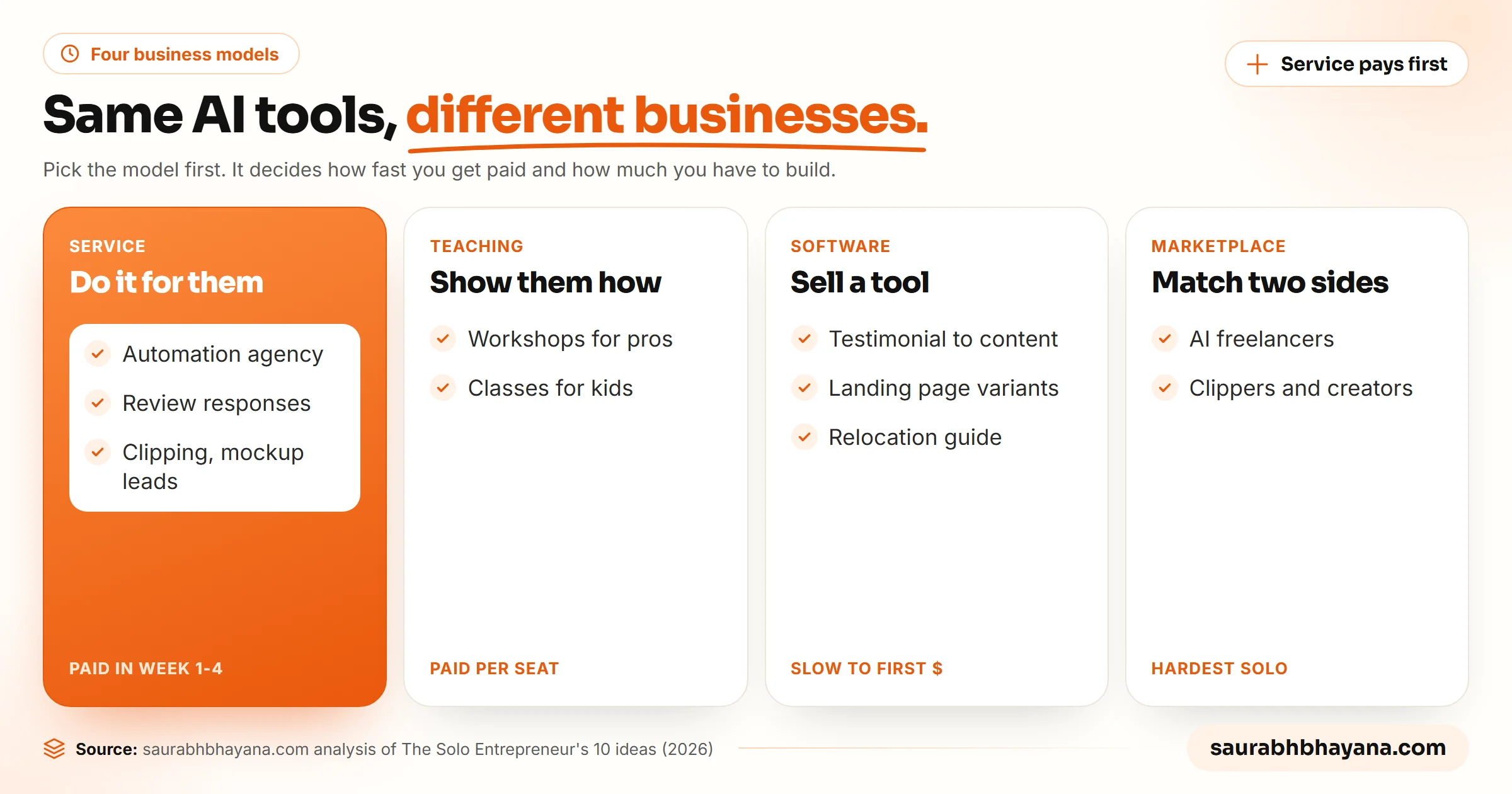
There has never been a cheaper time to start an AI business alone. Tools like Claude Code, n8n and Lovable let one person build what used to need a developer, a designer and a month. That also means most AI startup idea lists are full of things anyone can copy in a weekend. What decides whether an idea works is who pays, how fast, and what rules sit underneath it.
The Solo Entrepreneur channel recently shared ten AI startup ideas you can start with almost no money and rated each out of 10. We went through every one, kept the parts that hold up, and gave our own score. Where we scored lower, it is because the idea needs a lot of traffic, needs two sides of a market at once, or has a legal problem the video skipped. We build AI tools and automations for our own products every day, so our scores lean on what we have seen work.
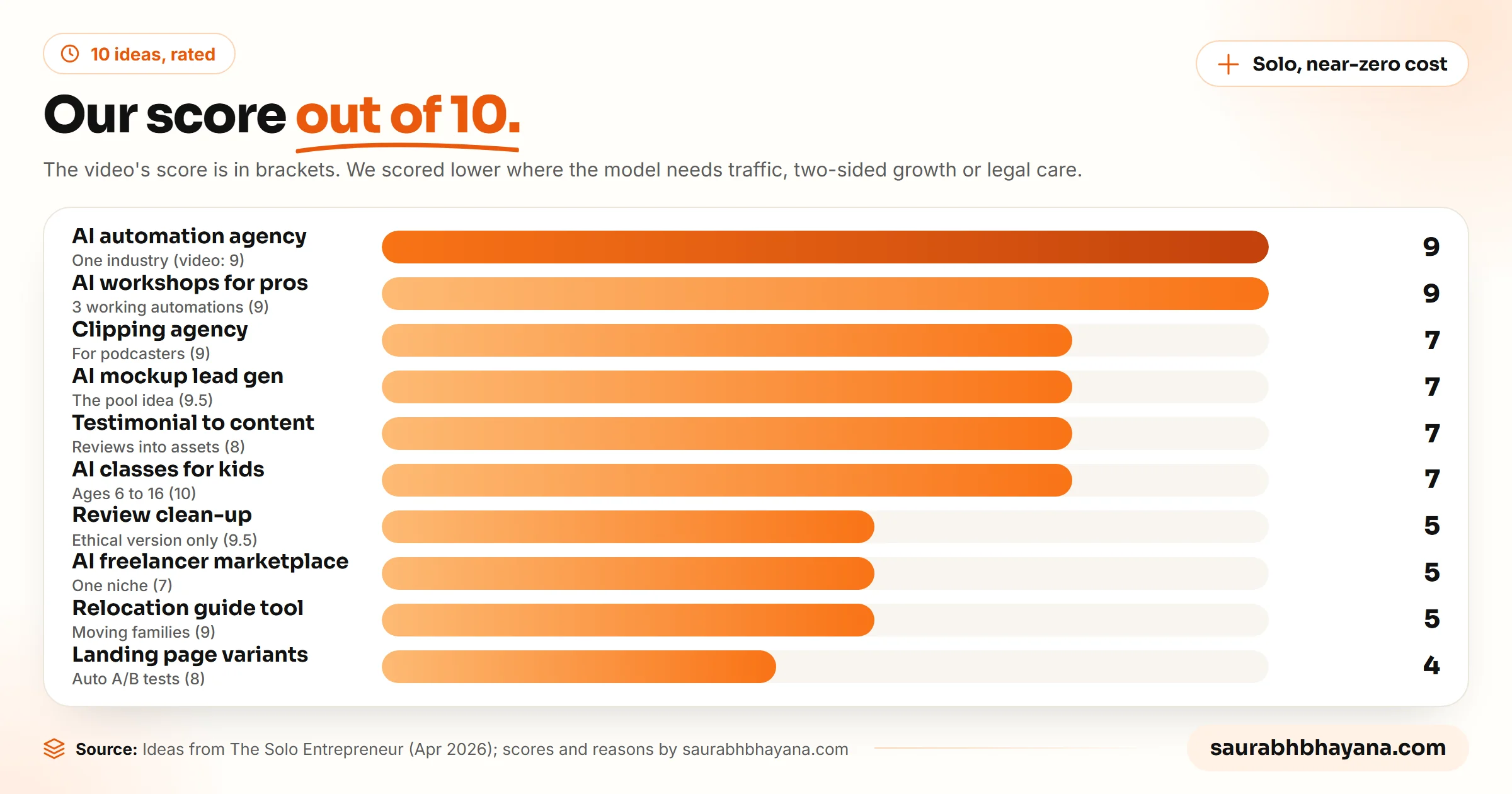
1. AI automation agency for one industry (our score: 9)
The video calls it Claude Ops: a business-to-business agency that builds agents, automations and design workflows for companies using Claude and similar tools. Business owners know AI can save them time and money but have no idea where to start, and many feel they are falling behind. That gap is the business.
Why we rate it highest: you can sell it this week, clients have budgets, and every project teaches you something you can reuse for the next client in the same industry. Pick one industry, such as dental clinics, law firms or property managers, and learn its three most repetitive tasks. Our list of tasks small businesses can automate with AI is a good starting map.
Main risk: selling vague "AI transformation". Sell one result with a price, such as "new patient enquiries answered and booked within five minutes, set up in two weeks".
2. AI workshops where everyone leaves with three automations (our score: 9)
Two to three hour workshops, online or in person, for one profession at a time: lawyers, accountants, estate agents, marketers. The promise that sets it apart is simple. Every attendee leaves with at least three automations working in their own job, such as a research assistant for a lawyer or a property search agent for an estate agent.
These professionals earn well and pay for anything that saves billable hours. To find the right automations, talk to five people in the profession and ask where their week goes. Workshops also feed idea 1: some attendees will want you to build the bigger systems for them. Our guide on how to train employees on AI covers how to run sessions people actually use.
3. Clipping agency for podcasters (our score: 7)
Big podcasters and YouTubers want their long videos cut into short clips and posted across many channels. Platforms such as Whop run clipping campaigns where creators pay clippers per view; the video shows campaigns paying $5 and $25 per 1,000 views, one with a $25,000 budget. The idea is an agency or marketplace that connects creators who need clips with clippers who make them, and takes a cut.
It works because the demand is real and AI tools make clipping fast. Why not higher: you need written permission from every creator whose content you post, and YouTube limits monetisation of reused content that adds little. Start by managing clips for two or three mid-sized podcasts in one niche before building any platform.
4. AI mockups that sell leads to local trades (our score: 7)
The viral version, shared on Reddit: someone used AI to scan satellite images for homes with empty backyards, generated a picture of each backyard with a new pool, sent it to the owner, and sold the interested homeowners to pool builders. Seeing the finished result makes people far more likely to say yes. The same pattern fits solar panels, landscaping, fences and roofs.
Two rules the video does not mention. First, the imagery: Google Maps and Google Earth terms restrict copying their imagery for your own commercial products, so use imagery you have a licence for, or a customer's own photo. Second, the outreach: in the US, calls and texts to consumers fall under the TCPA, while direct mail does not. A postcard with the mockup and a QR code is both legal and memorable. Sell to the trade on a per-lead price agreed in writing.
5. Testimonials turned into marketing assets (our score: 7)
Businesses collect testimonials in video, audio and text, then do little with them. This tool or service takes those testimonials plus the brand kit and turns them into social posts, ad creatives, short case studies and sales slides. It is easy to build with Claude Code or Lovable and an image model.
Why 7 and not 8: tools for collecting and showing testimonials already exist, so a general version competes with them. Win by going narrow, such as testimonial content for dental clinics, or by selling it as a monthly service first. Get each customer's permission before reusing their words or face, and never change what they said; ads with edited endorsements break advertising rules.
6. AI classes for kids aged 6 to 16 (our score: 7)
The video's favourite, rated 10 out of 10: an AI-native learning platform that teaches children to use AI, build simple agents and make small projects. Parents worry about their children's future jobs and spend readily on education, and one parent signing up tends to bring others.
Demand is real. The problem is the tools. Most AI assistants set minimum ages: Anthropic requires users of Claude's consumer apps to be 18 or older, and other assistants typically require 13 or older with a parent's consent below adulthood. Children's data is also protected by laws such as COPPA in the US and GDPR in Europe. So build the course around tools approved for children, teacher-led demonstrations and parent accounts, and get consent in writing. Done properly, this can be a strong business; done carelessly, it is a legal problem with children involved.
7. Review clean-up, the ethical version only (our score: 5)
The video rates this 9.5: a pay-for-results agency that gets bad reviews removed from Google, TripAdvisor and others. One method is finding reviews that break a platform's rules and reporting them, with AI reading the policy for you. The other is contacting unhappy reviewers and offering coupons or discounts if they change or remove their review.
That second method is the problem. Google's review policy bans offering incentives for changing or removing reviews and bans discouraging negative ones. In the US, the FTC's rule on consumer reviews, in force since October 2024, bans review suppression and incentives tied to what a review says, with civil penalties per violation. Charging only when a review disappears also rewards exactly the wrong behaviour.
The version that holds up: a monthly review management service that replies to every review well, reports only reviews that genuinely break the rules through official channels, fixes the underlying complaint with the business, and helps it ask every customer for a review. Our guide to getting more Google reviews covers how to do that within the rules.
8. A marketplace of AI freelancers for one niche (our score: 5)
Like Fiverr or Upwork, but only for AI specialists who know Claude Code, MCP, skills and n8n, and focused on one industry, such as AI engineers for dental groups. The niche focus is smart. The model is the issue: a marketplace needs buyers and sellers at the same time, and neither side comes until the other is there.
Solo, start as a broker instead of a platform. Keep a short, vetted list of freelancers, find the clients yourself and match them by hand for a fee. If that works for six months, you will know exactly what the platform needs to do.
9. A relocation guide for families (our score: 5)
Families moving to a new city want to know which neighbourhoods suit them, where the good schools are and what rent really costs. The idea is software that answers those questions using what people share on Reddit and local forums. The need is real; the creator mentions that relocation blogs used to perform very well.
Three problems. People move rarely, so each customer pays once. The data goes stale quickly. And Reddit's terms require an agreement for commercial use of its data. A better route is a content site with partnerships with movers and estate agents, or a business-to-business product for companies that relocate staff.
10. Automatic landing page variants and testing (our score: 4)
Software that generates many versions of a landing page, tests them against each other and picks the winner, so businesses running ads stop guessing. The logic is sound, and AI can now produce variants in minutes instead of days.
The catch is traffic. A reliable A/B test needs enough visitors per version, and most small businesses do not get enough to test even two versions quickly, let alone dozens. Established landing page builders also already offer AI-generated variants. If you like this space, sell it as a service to businesses with large ad budgets, where testing pays off.
How to pick the right AI startup idea
- •Who pays, and how fast? A clinic paying $2,000 for a setup this month beats a consumer app that might earn $5 a month from thousands of users next year.
- •Can you sell it before you build it? Services and workshops can be sold with a one-page offer. Our guide on how to find app ideas people will pay for explains the same test for software.
- •Do you know the industry? Your edge as a solo founder is knowing one group's problems better than a general agency does.
- •What rules apply? Reviews, outreach, children's data and other platforms' content all have rules. Check them before you launch, not after a complaint.
For a deeper method of testing any of these, see our guide to validating a business idea with AI. For five more service ideas you can run without hiring, see AI businesses you can start with zero employees.
Your first 14 days
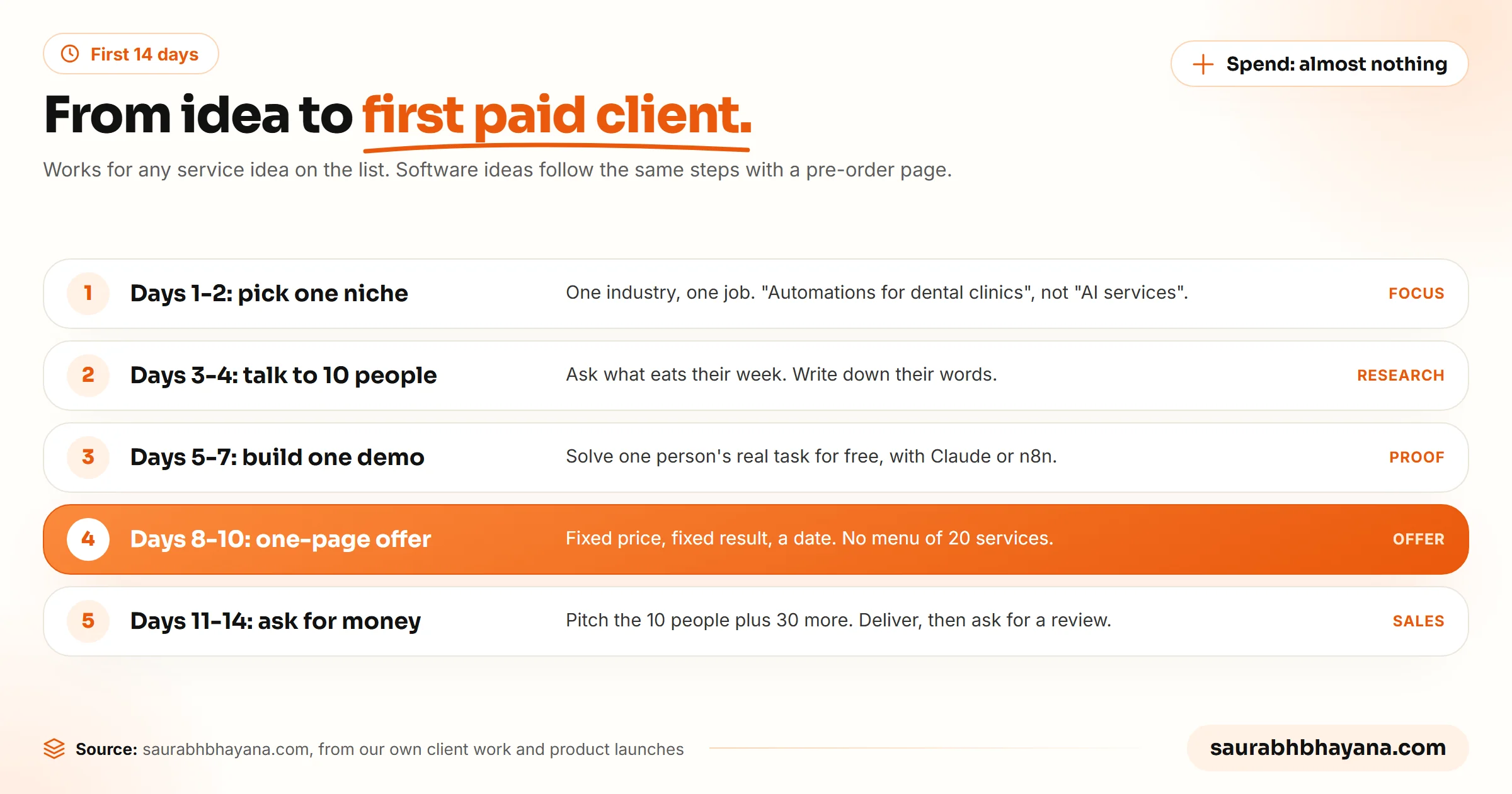
- 1.Days 1 and 2: pick one industry and one job, such as "automations for dental clinics", not "AI services".
- 2.Days 3 and 4: talk to ten people in that industry. Ask what eats their week and write down their exact words.
- 3.Days 5 to 7: solve one real task for one of them for free, using Claude, n8n or whatever fits.
- 4.Days 8 to 10: write a one-page offer with a fixed price, a fixed result and a delivery date.
- 5.Days 11 to 14: send it to the ten people and thirty more like them. Deliver the first job well and ask for a review.
None of the ideas above needs investors or a team. What each needs is one group of people with a problem they will pay to fix, and two weeks of talking to them before you build.
Frequently asked questions
What are some good AI startup ideas?+
For a solo founder, the strongest are service businesses that pay quickly: an AI automation agency for one industry, AI workshops for professionals where attendees leave with working automations, clipping for podcasters, AI mockups that generate leads for local trades, and turning customer testimonials into marketing content.
What AI startup can I start with no money?+
A service: automation setup for one industry, AI workshops, or a clipping service. You need a laptop, a few AI tool subscriptions and the time to talk to customers. Sell with a one-page offer before you build anything bigger.
How do I start a one-person AI business?+
Pick one industry and one repetitive task, talk to ten people who do that task, build a demo that solves it for one of them, then sell a fixed-price version. Use AI tools such as Claude Code or n8n to deliver, and turn repeated work into reusable templates.
Is it legal to pay customers to change bad reviews?+
No. Google's policy bans incentives for changing or removing reviews, and the FTC's 2024 rule on consumer reviews bans review suppression and incentives tied to what a review says. Reply to reviews, fix the complaint, report only reviews that break the rules, and ask every customer for a review.
Can I teach kids to use AI tools like Claude or ChatGPT?+
Check each tool's age rules first. Claude's consumer apps require users to be 18 or older, and other assistants typically require 13 or older with parental consent for minors. Build classes around child-appropriate tools and teacher-led demos, and follow children's privacy laws such as COPPA and GDPR.
Are AI startup ideas still worth it if anyone can copy them?+
Yes, if your edge is not the code. Knowing one industry well, having its customers' trust and delivering results are much harder to copy than an app. That is why service-first ideas suit solo founders.
How do I find AI startup ideas of my own?+
Look for repetitive work that professionals complain about, read low-star reviews of the software they pay for, and ask people in one industry what eats their week. Our guide on how to find app ideas people will pay for walks through the full process.
Read next
My team and I automate the work that eats your hours with AI, and get your business found on Google, Maps and in AI answers.