
How to Validate a Business Idea With AI (Before You Build Anything)
Most AI products fail because they are cool demos, not businesses. Here is how OpusClip tested its idea with no product at all, the three tests for picking a niche, how to tell if your idea is just an AI wrapper, and how to price an AI product.
Imagine spending three months building an AI app. The demo is gorgeous. Everyone who sees it says "wow, this is amazing". Then you launch, and nobody pays. Painful, right? And very common.
Here is the twist. One of the fastest-growing AI video tools of the last few years, OpusClip, found its winning product by not building it first. The founders made the finished result by hand and emailed it to people. Only when the replies came back did they write the software.
This post grew out of a long interview with OpusClip's co-founder and CEO, which we link at the end. We pulled out his method for testing an idea, the problems he says AI founders should avoid, and how he thinks about pricing, and turned them into steps you can use this month, whether you are building an AI product or adding AI to a small business.
How to validate a business idea (the short answer)
Validating an idea means getting proof that people want the result badly enough to pay for it, before you spend months building. Not proof that they like it. Proof that they want it.
- 1.Find a painful job people already pay for in time or money.
- 2.Deliver the result by hand, with AI helping you behind the scenes.
- 3.Watch what people do, not what they say: do they ask the price, come back, or complain when it runs out?
- 4.Only then build the simplest version that delivers the same result.
- 5.Test the price with the customers you actually want.
Sounds simple. So why do so many AI founders skip it? Because building is now so easy that it feels faster to just build. Let's look at how the OpusClip team did it instead.
How OpusClip validated its idea with no product
OpusClip started as something else. The team built a live streaming tool, and by the founder's account almost nobody liked it. Except one feature: clipping highlights from long streams. That one feature showed early signs of real demand, so they pulled it out and made it the whole company.
But they still didn't build an app. They used AI to help edit finished clips, then emailed those clips to potential customers. He says more than 60 percent of the replies were positive, along the lines of "I love this clip, I just want to tweak one thing and post it".
Next, still no app. They put the tool inside a Discord bot. No interface, no design work, just the result. Creators poured into the Discord server, and the team watched two things: how often people came back, and what they talked about. The moment he describes as product-market fit was people complaining about the queue and about running out of their daily quota.
Praise is cheap. A complaint that you ran out of free uses is a buying signal.
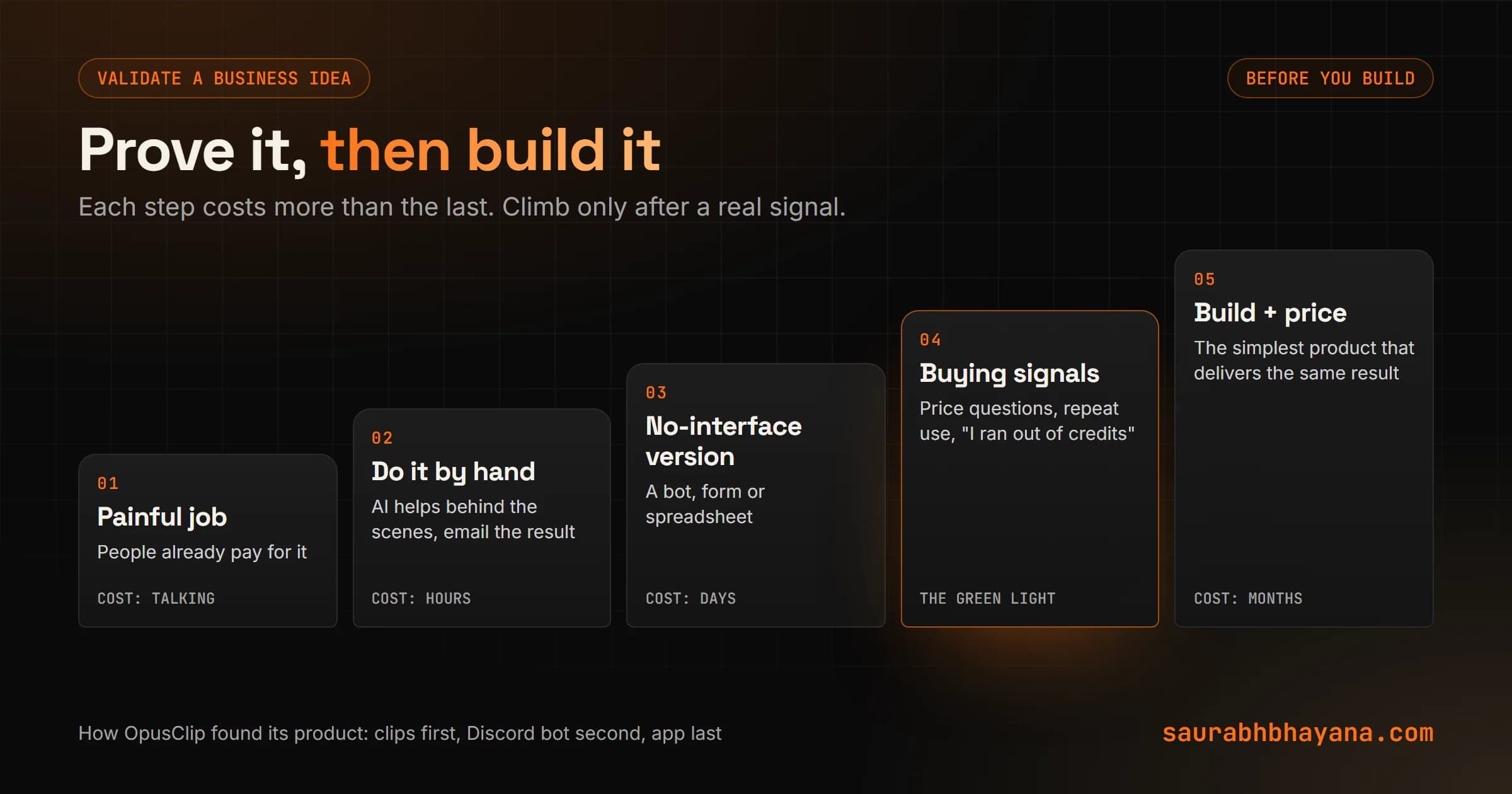
This approach has a name: a concierge MVP. You act as the product, by hand, for a handful of customers. It is slow and it does not scale, and that is the point. You learn what the result must look like before you pay to automate it.
It clearly worked for them. When OpusClip announced funding from SoftBank's Vision Fund 2 in March 2025, the company said more than 10 million creators and brands were using it, and it had made over 172 million clips in the previous year.
How to test if a business idea will work: real business or cool demo?
The founder's main warning is that many AI founders build a cool demo instead of a real business. A demo can look like magic and still solve nobody's problem. So how do you tell the difference? His answers boil down to three questions.
- •Is someone already doing this job the hard way? If the pain is real, people are already paying for it: hiring a person, building an internal tool, or stitching three apps together. No alternatives often means no pain.
- •Can you say the value in about 10 words? "Turns one long video into ten ready-to-post clips" works. If you need a paragraph, customers won't get it either.
- •Does anyone ask the price? "This is amazing" with no card details is a compliment, not a sale. People asking about pricing tiers is the signal.
Picture a bakery owner testing an AI tool that writes weekly specials for Instagram. Friends say it's great. That proves nothing. Five other bakeries asking "can I get this every week, what does it cost?" proves a lot.
AI wrapper meaning: the trap to avoid
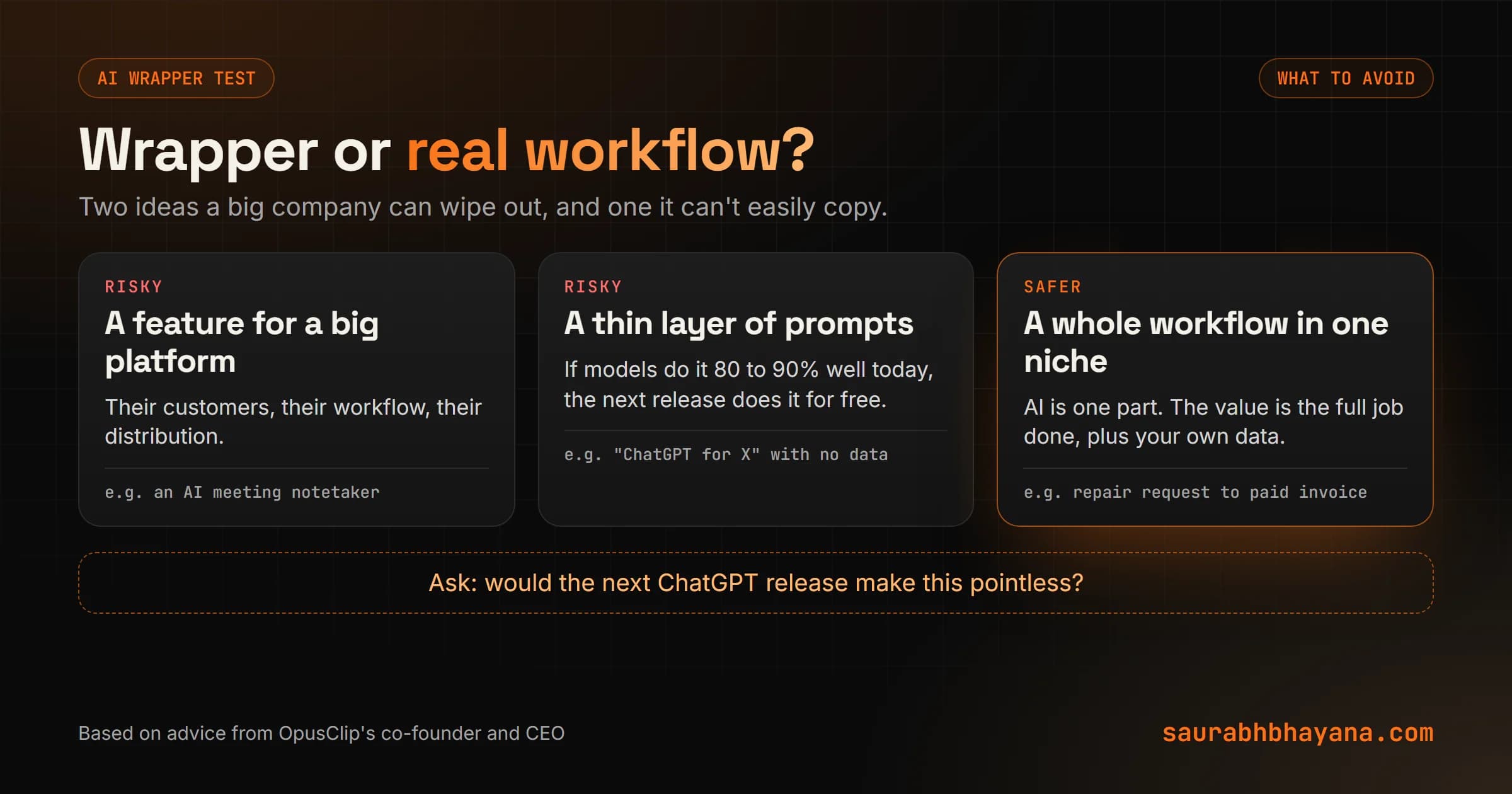
An AI wrapper is a product that is mostly a nice screen and some prompts on top of someone else's model, like ChatGPT, Claude or Gemini. A lot of people think wrappers are always bad. Not quite. The problem is a wrapper where the AI is the whole product, because the model maker can ship the same thing in its next release.
The founder names two kinds of ideas to avoid:
- •A feature for a big platform's own customers. His example is an AI meeting notetaker: Zoom and Google Meet can add it inside the tool people already use, and they own the distribution.
- •A thin layer of prompts. If today's models already do the job 80 or 90 percent well, assume the next release does it almost perfectly, and your prompts stop mattering.
His fix is to own a whole workflow in one industry, from start to finish, where AI is one part of the job rather than all of it. Think of a tool for property managers that takes a tenant's repair request, books the right contractor, chases the invoice and updates the owner. The AI is inside, but the value is the whole job done.
He also says to think early about what data you will build up as you grow. You don't need a perfect moat on day one, but you should know what will make customers stay once a shinier app appears next week.
How to pick a niche for an AI business: three tests
Asked which business he would start today, the founder gave tests rather than ideas. We think they are the most useful part of the interview.
| Test | The question | Example |
|---|---|---|
| Niche test | Can you split this market any further? | Restaurants: too broad. Chinese restaurants: still too broad. Keep splitting until you can't. |
| Boring test | Would most founders find this dull? | Cool markets have far more competitors. Dull ones often have big, unsolved problems. |
| Service test | Do agencies or freelancers already sell this work? | If people already pay a person or agency for it, software that does the job has a ready market. |
That last test has a name too. Investors at Foundation Capital call it service-as-software: instead of selling a tool that helps someone do the work, you sell the work itself, done by software. It is the same idea the founder describes, and it is why we like boring service markets for AI.
If you want ideas to run through these tests, our list of AI businesses you can start with zero employees is a good place to start. Most of them are services today.
How to validate a business idea without spending money: your first 30 days
Here is how the founder says he would spend the first month of a new company, with our notes for a small team.
- 1.Weeks 1 to 3: understand one niche deeply. Talk to people in it. Map their current workflow, what hurts, and what they already use or pay for. Pick your ideal customer as narrowly as you can.
- 2.A couple of days: build a rough proof of concept. With AI coding tools this is now days, not months. He uses Cursor. A spreadsheet, a form or a bot is fine.
- 3.The rest of the month: put it in front of those customers. Ask what problem it solves for them and what they would pay. Watch for the buying signals above.
- 4.Alongside: decide how people will find you. Two years ago being "the AI version of X" was enough to go viral. Now everyone has seen AI, so distribution needs a plan from the start.
Spend money last. A rough version and 20 honest conversations cost almost nothing, and they decide whether the expensive part is worth doing at all.
How many conversations is enough? He says his team runs about 20 to 30 interviews for each big product decision, and that the mix matters more than the number: different roles, industries, budgets and countries, so you see the whole market and not one corner of it.
How to price an AI product
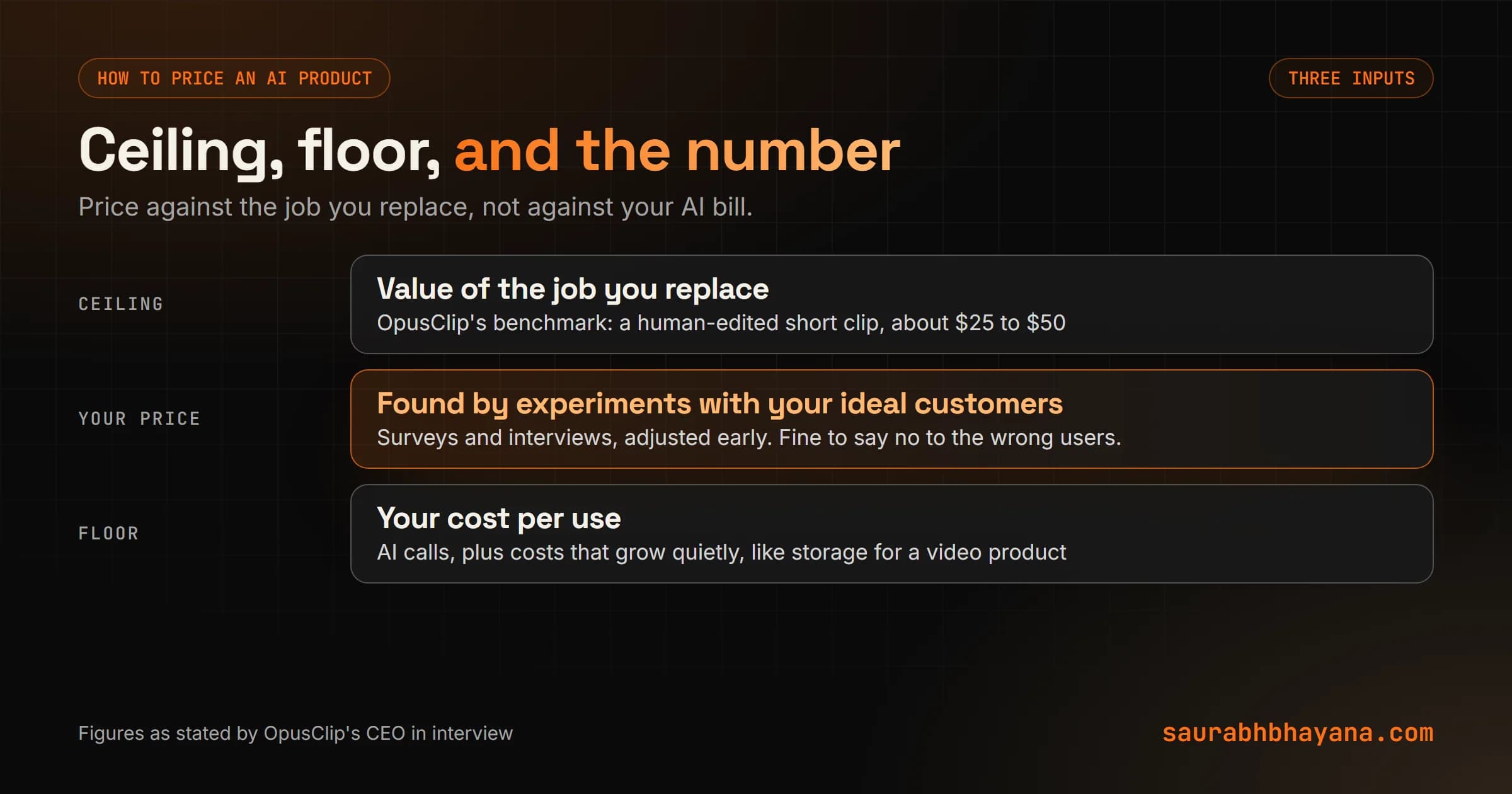
Pricing is where many AI founders guess. The founder describes three inputs, in this order.
- •The value you replace. What does the job cost today without you? For OpusClip, he says a professional editor takes 30 minutes to an hour per short clip, and the market rate is about $25 to $50. That is the benchmark, not the cost of running the AI.
- •Your cost per use. Every AI call costs money, and some costs grow quietly. He says storage was about 5 percent of their costs early on but can grow to around half of them years later for a video product.
- •Experiments with the right customers. Run surveys and interviews, adjust early, and accept that the price will not suit everyone. He says you may need to say no to most early users and focus on the customers you actually want.
He also notes most AI products now charge by usage rather than per seat, which suits solo creators and small teams. We agree for tools, but for a done-for-you service, a flat monthly price tied to the result is often easier for a small business to say yes to.
How to validate a business idea with AI as your thinking partner
The founder's favourite AI skill isn't prompting or coding. He treats ChatGPT and Gemini as a senior adviser. Instead of one-line questions, he gives them as much context as he can, such as notes from customer calls, a product spec or screenshots of a team discussion, and goes back and forth for 20 rounds or more.
He also has a monthly habit: he asks the AI to review his main decisions from the past month and tell him what he got wrong. For validation, try prompts like these:
- •"Here are notes from 12 customer calls. What problem did they mention most, in their own words?"
- •"Argue against this idea as a skeptical investor. What would kill it in year one?"
- •"Which big company could add this as a feature, and how quickly?"
- •"Here are three price points and who said yes to each. What pattern do you see?"
One honest caveat: AI is a great sparring partner and a terrible customer. It will happily tell you an idea is promising. Use it to sharpen your questions and spot holes, then get the real answer from people who might pay.
The bigger picture
AI made building cheap. That sounds like good news for founders, and it is, but it moves the hard part. When anyone can build a demo in a weekend, the advantage goes to people who know one niche deeply, can prove someone will pay, and can reach those customers. The founder compares it to cars: almost everyone can drive now, but there are still Formula 1 drivers.
So, what is the painful job in your industry that people still pay a person to do? Try delivering it by hand for five customers this month and see who asks the price. If you want help turning a validated idea into an AI workflow, tell us what you are testing.
Sources: the interview with OpusClip's co-founder and CEO on YouTube at youtube.com/watch?v=HQ3eVt2jgAY; OpusClip's March 2025 announcement of funding from SoftBank Vision Fund 2.
Frequently asked questions
How do you validate a business idea?+
Find a painful job people already spend time or money on, deliver the result by hand to a few customers, and watch for buying signals such as price questions, repeat use or complaints about limits. Only build the product once those signals appear.
How do you validate a business idea with AI?+
Use AI to deliver the result behind the scenes before building a product, to analyse notes from customer conversations, and to argue against your idea. Then test its conclusions with real potential customers, because AI cannot tell you whether people will pay.
How can I validate a business idea without spending money?+
Deliver the service by hand to a few customers, use a free form, spreadsheet or chat bot instead of an app, and hold 20 or so customer conversations. These cost time, not money, and show whether the costly build is worth doing.
What is an AI wrapper?+
A product that is mainly an interface and prompts on top of someone else's AI model. It is risky when the AI is the whole product, because the model maker can release the same ability, and safer when it owns a full workflow in one industry.
How do you price an AI product?+
Start from the cost of the job you replace, such as what a freelancer charges, make sure your cost per use leaves a healthy margin, then test price points with your ideal customers through surveys and interviews.
What is service as a software?+
A business model where software, usually AI, delivers the finished work that a person or agency used to sell as a service, instead of selling a tool that helps someone do the work.
What is a concierge MVP?+
A way to test an idea by delivering the service manually to a small number of customers before building any software, so you learn exactly what result they want and whether they will pay for it.
Read next
My team and I automate the work that eats your hours with AI, and get your business found on Google, Maps and in AI answers.