
How to Train Employees on AI (Without Making Them Worse at Their Jobs)
Will AI replace your team, or make them better? Here is what the research actually says, why AI can quietly stop people learning, and a simple six-step plan and AI policy to train employees on AI in a small business.
Imagine you give your whole team ChatGPT on Monday. By Friday the work is faster, the emails are cleaner and the reports arrive early. Great week, right? Now imagine six months later the AI is down for a day, and your newest hire cannot write a quote on their own.
That is not a scare story. It is close to what a large study of students found, and we will get to the numbers. So the real question is not whether your team should use AI. They should. It is how to train employees on AI so they get faster without getting worse at the job.
This post grew out of a long interview with Andrew Ng, who co-founded Google Brain and Coursera and has taught AI to millions of people. We link it at the end. His view of jobs, learning and privacy shaped a lot of what follows. The training plan and the policy are ours, written for small businesses.
Will AI replace jobs? What the data actually says
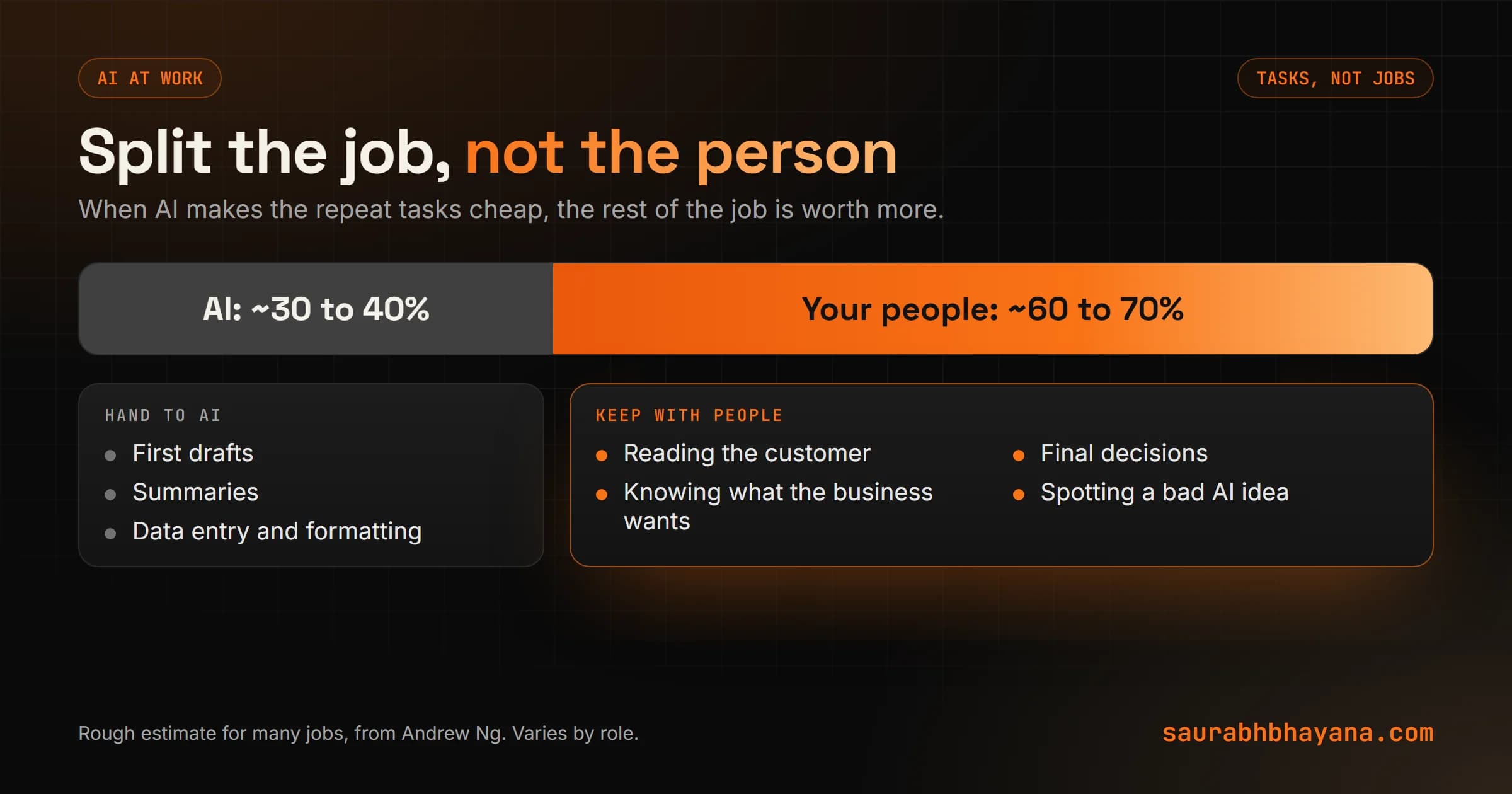
A lot of people think AI will replace half the workforce in a few years. Not really. Ng's point is simple: a job is a bundle of tasks. When economists break jobs down task by task, AI can do part of the bundle. His rough figure is 30 to 40 percent of the tasks in many jobs.
And here is the part people miss. When AI makes that 30 to 40 percent cheap, the other 60 to 70 percent becomes more valuable, because it is the part only a person can do. Economists call that a complement. So in most roles, the realistic risk is that people who use AI replace people who don't.
But we would be lying if we said nobody gets hurt. Researchers at Stanford's Digital Economy Lab looked at payroll data and found that workers aged 22 to 25 in the most AI-exposed jobs saw a 16 percent relative drop in employment, while more experienced workers in the same jobs held steady. The drop was concentrated where AI automates the work rather than helping people do it.
What does that tell a business owner? Junior roles are where AI lands first, because junior work is often the repeat work. So if you still hire juniors, and we think you should, their training has to change. Which brings up the obvious question: if AI does the repeat work, what exactly is your team for?
Why your team still beats AI: context
Picture this. A customer says yes to your quote on the phone, but there is a pause before the yes. Your salesperson hears it and offers a smaller first order. The deal closes. No AI heard that pause.
Ng calls this the context advantage. Your people know things that were never written down: which client hates long emails, what your manager said matters this quarter, the look on a customer's face during a demo. When AI brainstorms, it often gives a couple of good ideas, a few average ones and some that anyone in your business would know are terrible. It cannot tell the difference. Your team can.
AI is fast at the 30 percent. Your people are the only ones who know which 30 percent is right for this customer.
So the goal of training is to hand AI the repeat tasks and keep your people's attention on the parts that need context. Simple enough. Except there is a catch that most AI training ignores.
Is AI bad for learning? The study every owner should know
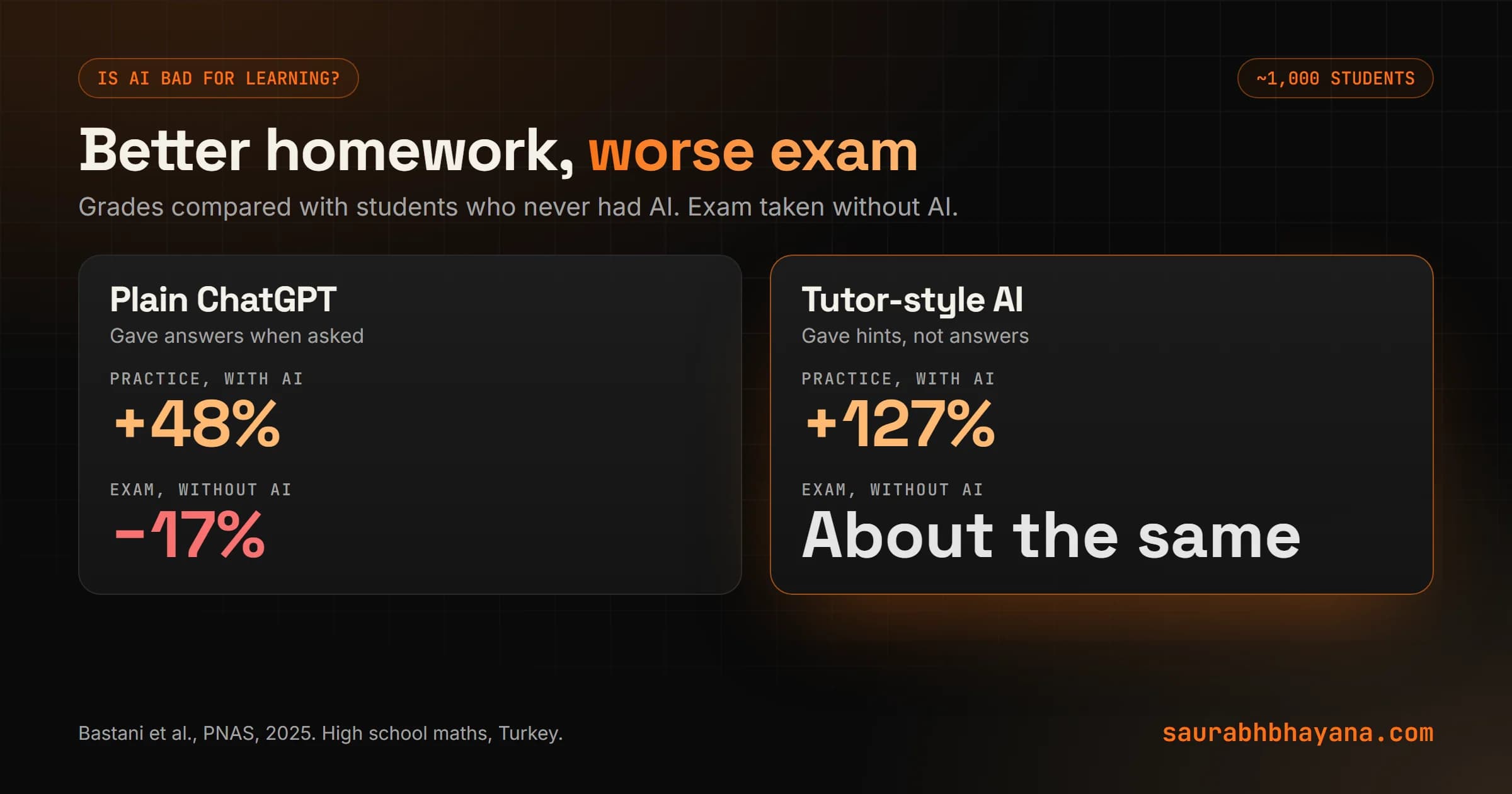
Researchers led by Hamsa Bastani at Wharton ran a study with about 1,000 high school students in Turkey, published in PNAS in 2025. Some students practised maths with a plain ChatGPT-style assistant. Some used a version set up like a tutor, which gave hints instead of answers. Others had no AI at all.
During practice, the AI groups did far better: grades rose 48 percent with the plain assistant and 127 percent with the tutor version. Then came the exam, with no AI allowed. Students who had used the plain assistant scored 17 percent lower than students who never had AI. The tutor group scored about the same as the no-AI group.
Ng goes further. In the interview he says that the way most people use AI today is terrible for learning, and admits it about himself: he asks an AI how something works, gets the job done, and six months later has to ask again. The work got done. The knowledge never landed.
Now translate that to your business. A new hire who lets AI write every customer reply will hit their numbers in month one. Will they know how to handle an angry customer in month six? Maybe not. The fix is not to ban AI. It is to separate learning mode from doing mode, which is the heart of the plan below.
How to train employees on AI: a 6-step plan
This is the plan we use with small teams. It takes an afternoon to set up and a month to settle in.
- 1.List each role's weekly tasks. Sit with each person for 20 minutes and write down what they actually do in a week. Mark the tasks that repeat with small changes: first drafts, summaries, data entry, follow-up emails, report formatting.
- 2.Hand one task per person to AI first. Not ten. One task, one tool, for two weeks. Pick the task that eats the most hours and has the lowest risk if the AI gets it slightly wrong.
- 3.Set the data rules before anyone starts. Decide what can be pasted into an AI tool and what never can. The three-level policy below covers it in one page.
- 4.Separate learning mode from doing mode. For skills a person already has, AI can do the draft and they check it. For skills they are still learning, they do the first attempt and AI critiques it, or AI gives hints rather than answers. That is the tutor setup from the study.
- 5.Let people build small tools. Once the basics stick, encourage anyone who spots a repeat problem to build a fix with AI, even a small one. Give them permission to step outside their usual lane.
- 6.Measure the business result, not AI usage. Track replies sent per hour, quotes out per week, errors caught or customers kept. If those don't move, the AI is not helping, however much people use it.
To set up learning mode in ChatGPT or Claude, start the chat with: "I am learning this. Do not give me the answer. Ask me questions and give me one hint at a time, then check my attempt." Save it as a custom instruction or project for trainees.
Step 4 is the one most companies skip, and it is the one that protects your juniors. The study showed the same AI model can help or hurt learning depending on how it is set up. You get to choose the setup.
How are companies training employees on AI?
The examples Ng gives from his own teams are useful because they are ordinary jobs, not engineers. His marketers are expected to build things with AI, and in interviews they are asked what they have built. One marketer built a small desktop app that searches the web for related articles while he writes.
His finance team noticed they spent hours every week opening documents and copying numbers across. So a finance lead built scripts that open the files on a schedule, check the numbers are consistent and flag anything that needs a person to look at it. Nobody waited for an engineer.
He also says the job descriptions his team studies increasingly ask for a high sense of agency: people who spot a problem and go fix it without being told. We see the same thing in small businesses. The person who automates their own boring task is usually the person who then teaches everyone else.
Need ideas for which tasks to start with? Our list of 25 small business tasks ranked by hours saved is a good shortlist for step 1, and our guide to AI agents covers when a task needs more than a simple workflow.
AI policy for employees: a simple one-page version
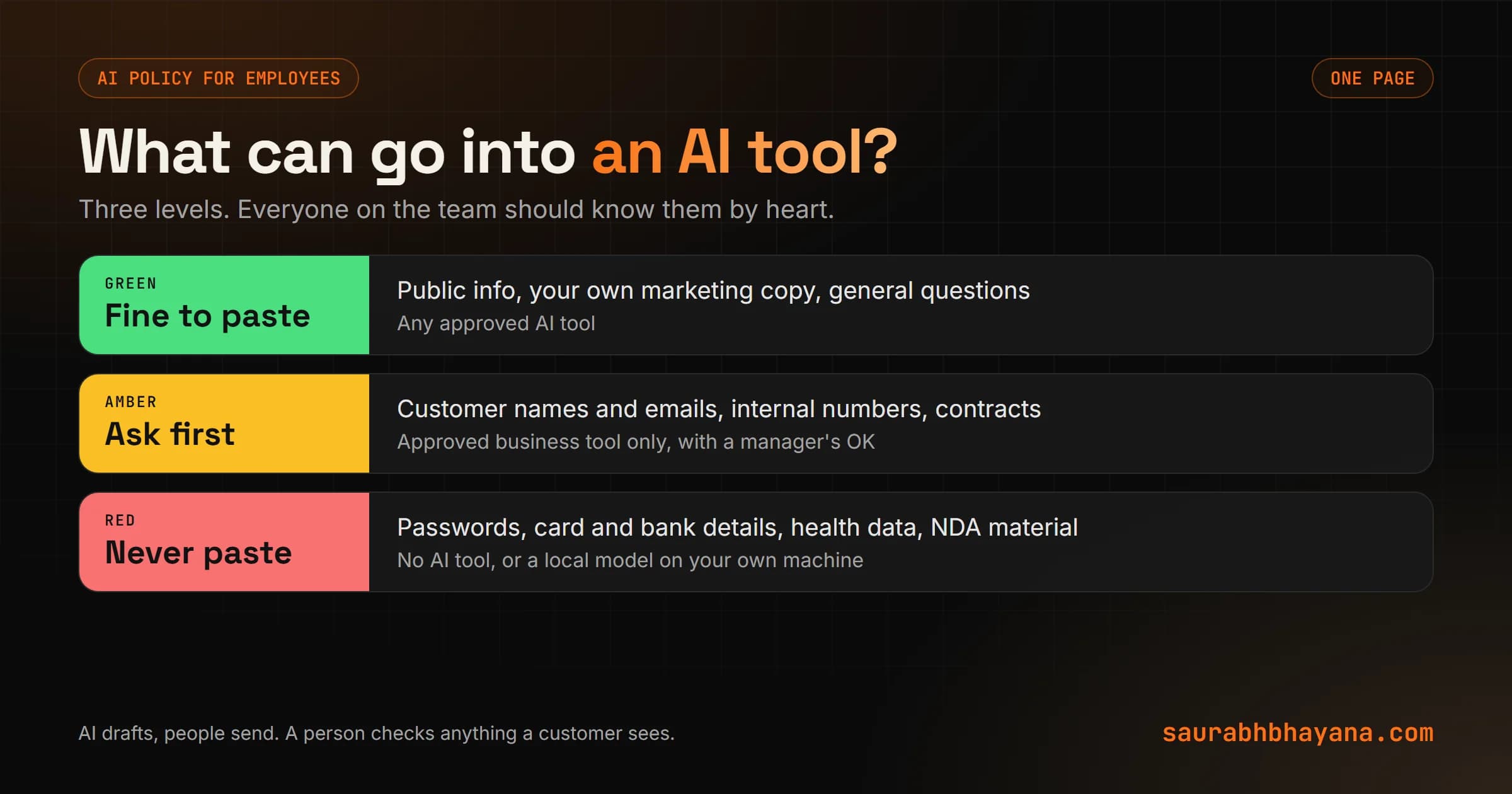
A lot of owners think an AI policy needs a lawyer and ten pages. For a small team, one page is enough if it answers one question clearly: what can go into an AI tool? We use three levels.
| Level | What it covers | Rule |
|---|---|---|
| Fine to paste | Public info, your own marketing copy, general questions, anonymised examples | Use any approved AI tool |
| Ask first | Customer names and emails, internal numbers, contracts, unreleased plans | Only in the approved business tool, with a manager's OK |
| Never paste | Passwords, card or bank details, health data, ID documents, anything you signed an NDA for | No AI tool, or a local model on your own machine only |
Ng is careful here too. He says he trusts the largest cloud providers to follow their published terms, but stays wary of companies that change their data terms with a pop-up you might click past. For truly sensitive material he either does the work without AI or uses a model running on his own computer. That is the same split as our red level. If you want to try that route, our guide on running an LLM on your own laptop explains what hardware you need.
Two more lines belong on the page. First, pick one approved tool and check its settings for whether your data is used to train models. Second, a person signs off on anything that goes to a customer. AI drafts, people send.
Do you even need formal AI training?
Honest answer: if you have three people, probably not. You need one afternoon to do steps 1 to 3, a shared document of prompts that work, and a 15-minute check-in each week for a month. A paid course will not beat that for a tiny team.
Formal training starts to make sense around 15 to 20 people, or when different teams handle sensitive data in different ways. Even then, the course should be built around your tasks, not generic prompt tips.
The bigger picture
Look at software engineering, the job AI has hit hardest so far. Ng says the good engineers he knows are busier than ever, but anyone still working the way they did in 2022, before ChatGPT, is in trouble. He expects other jobs to follow the same pattern. Ng's advice to young people was not to fear it but to learn it and build with it, and that works for a team too.
So, which task in your business eats the most hours every week, and who would you trust to hand it to AI first? If you want help mapping your team's tasks and setting up the policy, tell us about your team.
Source for Andrew Ng's views: the interview on YouTube at youtube.com/watch?v=o-wv_szZ0V0. Studies: Brynjolfsson, Chandar and Chen, "Canaries in the Coal Mine?", Stanford Digital Economy Lab, November 2025; Bastani and colleagues, "Generative AI without guardrails can harm learning", PNAS, 2025.
Frequently asked questions
How do you train employees on AI?+
Train by task. List each role's weekly tasks, hand one repeat task per person to an approved AI tool, set clear data rules first, keep a learning mode where people attempt the work before AI helps, and measure business results such as quotes sent or errors caught.
Will AI replace jobs?+
Mostly it replaces tasks, not whole jobs. Andrew Ng estimates AI can do 30 to 40 percent of the tasks in many jobs, which makes the remaining work more valuable. Entry-level roles feel it first: Stanford researchers found a 16 percent relative employment drop for 22 to 25 year olds in the most AI-exposed jobs.
Is AI bad for learning?+
It can be. In a PNAS study of about 1,000 high school students, a plain ChatGPT-style assistant raised practice grades by 48 percent, but exam grades without AI fell 17 percent below students who never used it. A tutor-style setup that gave hints instead of answers avoided the drop.
What should an AI policy for employees include?+
At minimum: which AI tools are approved, what data can be pasted into them, what needs a manager's OK, what must never be pasted (passwords, card details, health data, NDA material), and that a person checks anything sent to a customer.
How do you use AI safely at work?+
Use the tool your employer approved, keep customer and financial details out unless the policy allows it, check the tool's settings on whether your data is used for training, and review every AI output before it reaches a customer.
How do you measure productivity from AI?+
Measure the business outcome the task affects, such as response time, quotes sent per week, errors caught or customer retention. Counting how often people use AI tells you little about whether it is helping.
How long does it take to train a small team on AI?+
For a small team, about an afternoon to map tasks and set the policy, then a short weekly check-in for a month while each person settles one task into AI.
Read next
My team and I automate the work that eats your hours with AI, and get your business found on Google, Maps and in AI answers.