
How to Improve Local SEO Rankings in 2026: What Actually Ranks Now
Local customers now ask AI as well as Google. What ranks a local business in 2026: a profile and website that tell the same story, a structure built as hubs, pages specific enough for AI to match, cheap local authority, and a phone that gets answered.
Your next customer may never see your website. They might ask Google and read the AI Overview, or ask ChatGPT or Gemini who can fix their boiler tonight, and get a name back without clicking anything. That does not make local SEO dead. It changes what ranks: AI assistants pick businesses whose details are consistent and specific everywhere they look.
Jesse Cunningham, who has built more than 50 small local sites that rank and earn leads, broke down what he sees working in 2026. We have built local sites on the same principles this month, so below is his playbook with our notes, plus two places where we think Google's own guidelines point a different way.
How to improve local SEO rankings: the short answer
- 1.Complete your Google Business Profile, accurately, and keep it current.
- 2.Make your website say exactly what your profile says: same services, same towns, same wording.
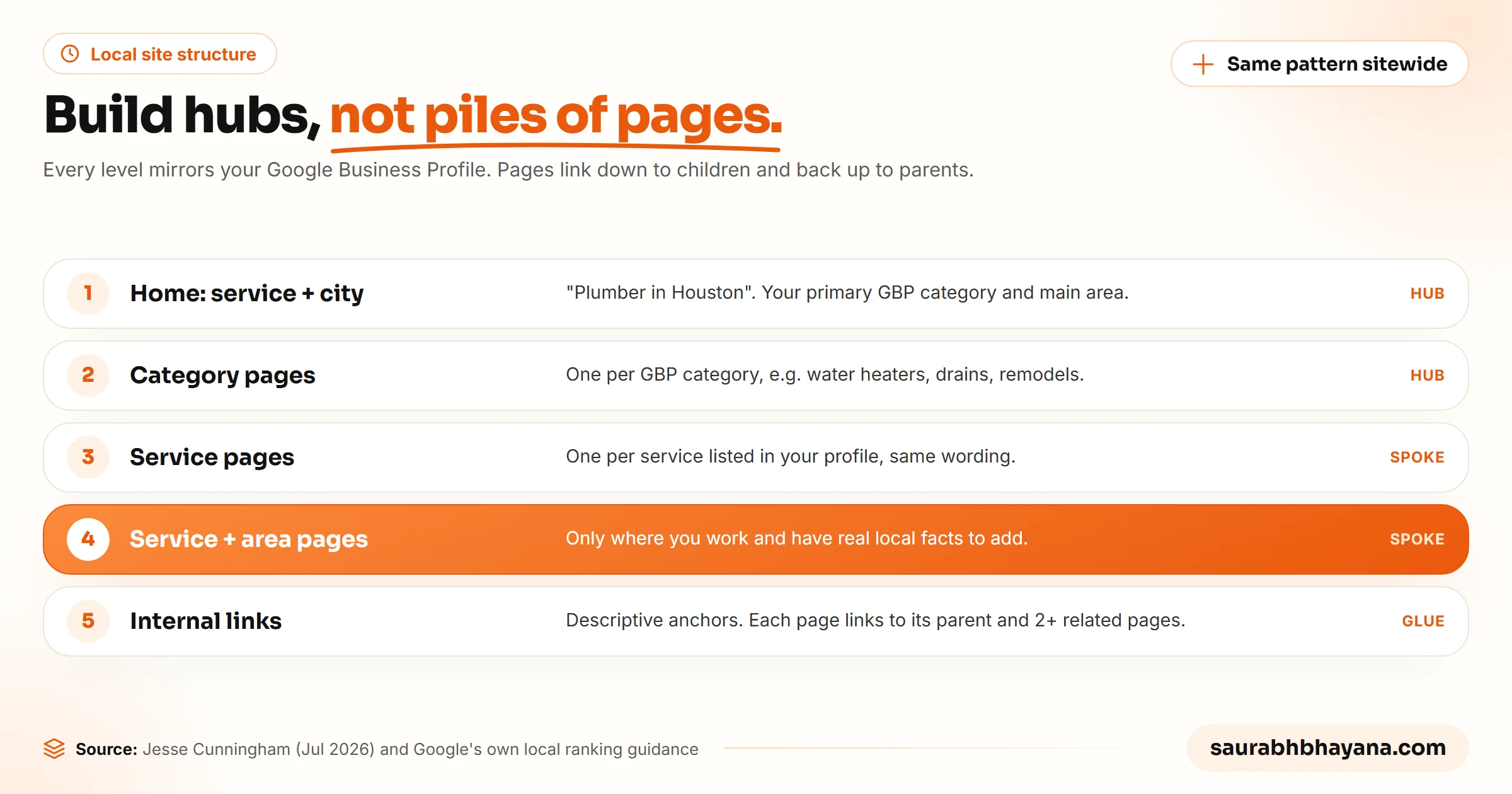
- 3.Use one clear structure: main service and city on the home page, then category, service and service plus area pages.
- 4.Write each page specifically enough that an AI could match it to a detailed question.
- 5.Earn local reviews and local links, and answer every call.
Local SEO now has two readers
The first reader is a person. They land on your page, skim for 20 to 30 seconds and decide: do these people look trustworthy, do they do what I need, should I call. The second reader is an AI system. It reads every word, then checks it against your Google Business Profile, your reviews and what the rest of the web says about you. Google's own leaders now describe search as becoming more agentic, with AI doing the browsing and returning an answer.
Both readers ask the same question: can this business be trusted for this job in this place? The way you answer it is consistency. One business, one set of facts, everywhere. If you want to check how AI tools describe you today, our guide on whether ChatGPT mentions your brand shows how.
Your Google Business Profile is the money page
For a local business, the profile on Google Maps brings in more calls than any page on your site. Google already has a set of categories and services for your industry, so use them. Then make your website mirror the profile: the same services, the same city and town names, the same wording. Reviews, mentions and local news that repeat those details complete the loop.
Name, address and phone number still need to match everywhere, as they always have. What is new is that your services, hours and descriptions need to match too, because AI systems compare them across sources. Our Google Business Profile ranking guide covers the profile itself in depth.
The 20-minute fixes most businesses skip
- •Fill every field Google offers: hours, attributes, description, services, products.
- •Choose categories honestly. Google lets you add up to ten, but its own help pages say to use as few as possible to describe your core business. Add a secondary category only if you really offer that service.
- •List services as distinct things you do, not as keyword variations of one thing.
- •Upload real photos of your team, vans and jobs. Avoid AI-generated photos; Google wants images that represent reality.
- •Update holiday hours before every holiday so the profile never looks abandoned.
One structure, used everywhere
Jesse's rule is to pick one site structure and never mix styles. A common version for a plumber in Houston: the home page targets "plumber Houston"; category pages match the profile's categories, such as bathroom remodelling in Houston; service pages cover each service, such as faucet replacement in Houston; and service plus area pages go deeper where you work. The exact pattern matters less than using the same one on every page.
Service plus area pages drive much of the traffic, but only if they say something true about that place. Generic pages with the town name swapped in are what Google calls doorway pages. Our guide to location pages covers what to put on each one and the tactics Google names as spam.
Build hubs, not piles
Internal links tell Google which pages matter and how they relate. Broad pages link down to specific ones; specific pages link back up and across to close relatives. Jesse mentions a friend's local site with around 700 pages that dominates its market, and credits its internal linking more than its size. Three habits make the difference:
- •Every article or service page links to at least two related pages.
- •Anchor text describes the target page: "water heater replacement in Houston", never "click here".
- •Slugs stay short and readable, such as /water-heater-replacement-houston.
Do local business sites need a blog?
Jesse's lead sites do not have one. They run to about 50 pages, cost him $5 to $10 to build and around $1 a month to keep online, and rank on service and location pages alone. For a business's main site a blog can still help, if it answers real customer questions. But if you have limited time, a complete set of service and area pages will do more than ten blog posts.
How to write a local page both readers trust
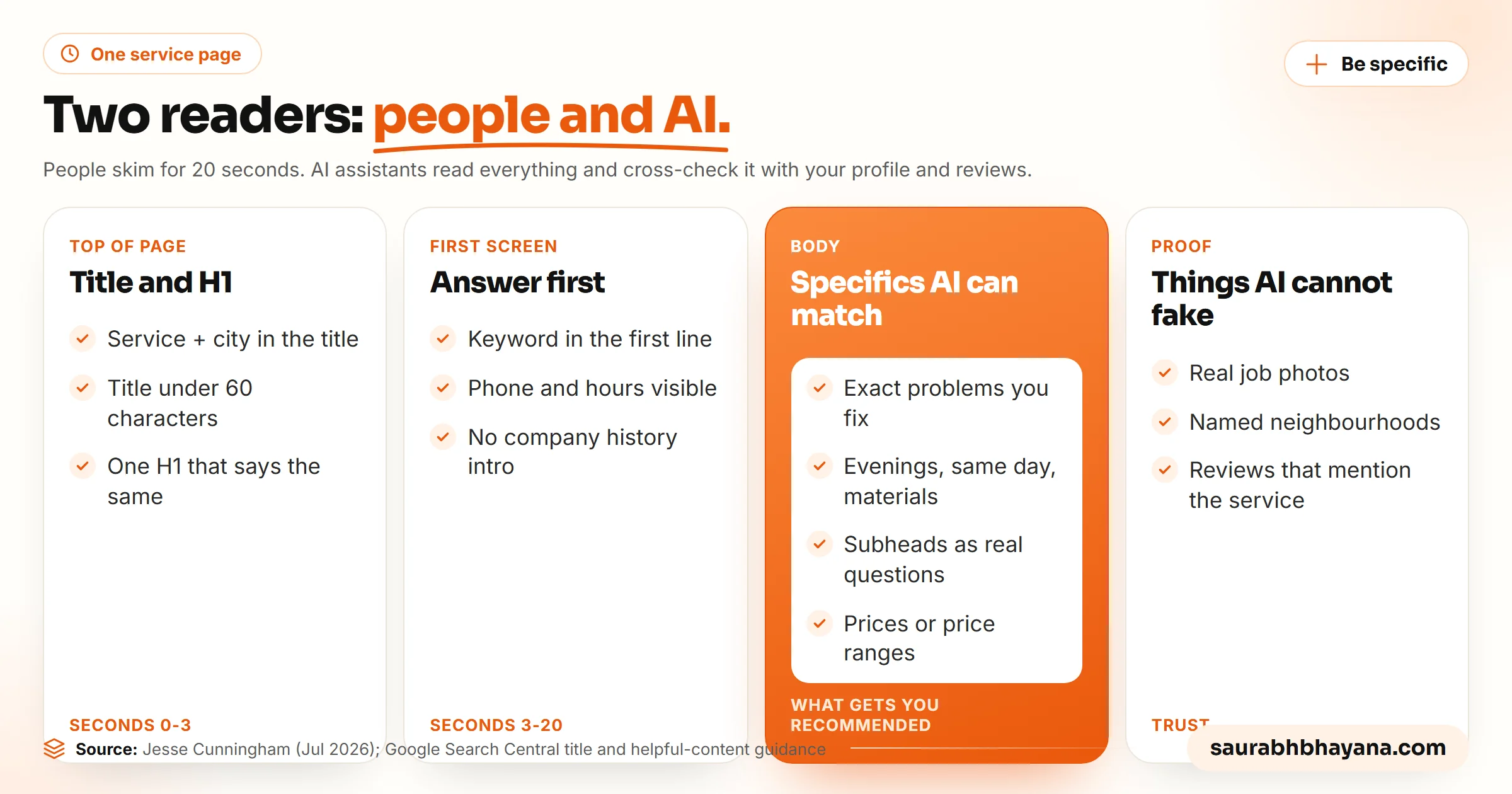
- •Title tag: the service and the city, under about 60 characters so it is not cut off. Your title is the strongest on-page signal you control.
- •One H1 that says the same thing, such as "Water heater replacement in Houston".
- •First paragraph: the keyword early and a direct answer to the searcher. Not the company's history.
- •Subheadings as the questions customers ask: "How much does a water heater cost in Houston?"
- •Phone number and hours visible without scrolling.
For meta titles and descriptions in more detail, see our meta tags guide.
Specific beats general
This is the part Jesse stresses most, and we agree. Nobody types "plumber Houston" into ChatGPT. They write "my garbage disposal broke, who can fix it tonight?" The AI then looks for a business whose details match: garbage disposals, evening service, quick response. If your page only says "drain repair" and the searcher has a problem with a lead drain line, and you never mention lead, you will not be recommended.
So name the exact problems you fix, the materials and brands you work with, the hours you cover and the neighbourhoods you serve. Each detail is one more question you can match.
Prove you are local with things AI cannot copy
Run a rank map to see where you already show up, find the nearby areas where you are weak, and write pages for those areas with facts that are true only there. Jesse's example: in Houston's River Oaks, homes are large estates and the drive back to the depot is long, which changes how a plumber schedules work there. Google now filters out generic AI-written location text; the pages that last say something specific and true.
When we built a plumbing lead site for the Boise area this month, every town page got facts we could verify from the town's own sources: who supplies the water, how hard it is, which office issues permits. Then we checked each page against the others for repeated 8-word phrases and rewrote anything shared. We built a second site for Tulsa the same way. Neither is live yet, so we will not claim rankings here; we will share the results when we have them.
Reviews: the easiest win
Reviews are now read by AI as much as by people, and reviews that mention the service and the area help both. Ask every happy customer, make it easy with a direct link, and reply to every review. If you are not asking for reviews yet, start there before anything else in this post. Our guide on how to get more Google reviews has scripts and timing.
Cheap local authority that works
Links still matter, but where they come from matters more. Jesse's point is blunt: instead of paying an agency $300 for a guest post link, pay your local chamber of commerce $100 to $300 to join, sponsor a local team or event, or get mentioned in local news and podcasts. These are real local signals, and you meet people who send work.
One place we disagree. The video says press releases are working well. Press releases are fine for real news, but Google's spam policies list links with optimised anchor text in press releases as an example of link spam. Use them to get noticed by journalists, not as a link-building tactic.
Answer the phone
All of this ends with a call. If nobody answers, the ranking was wasted. Small business owners on a job cannot always pick up, which is why AI receptionists have become popular: Jesse's lead sites use one to answer calls, qualify the caller and email him the lead. An AI receptionist is better than voicemail, and responding fast to every enquiry matters as much as ranking.
What is rank and rent?
Rank and rent is the model behind Jesse's 50 sites. You build a small site for one service in one area, rank it, and then sell the leads, or rent the whole site, to a local business that does the work. You do not need to own a plumbing company to earn from plumbing searches. The biggest mistake, he says, is choosing the wrong service in the wrong area, so check demand and competition with real search data before you build.
One firm rule: never create a Google Business Profile for a business you do not run, or for an address where no business operates. That breaks Google's guidelines and gets profiles suspended. A rank and rent site should rank on its pages and send leads to a real business with its own real profile.
Your first 90 days of local SEO
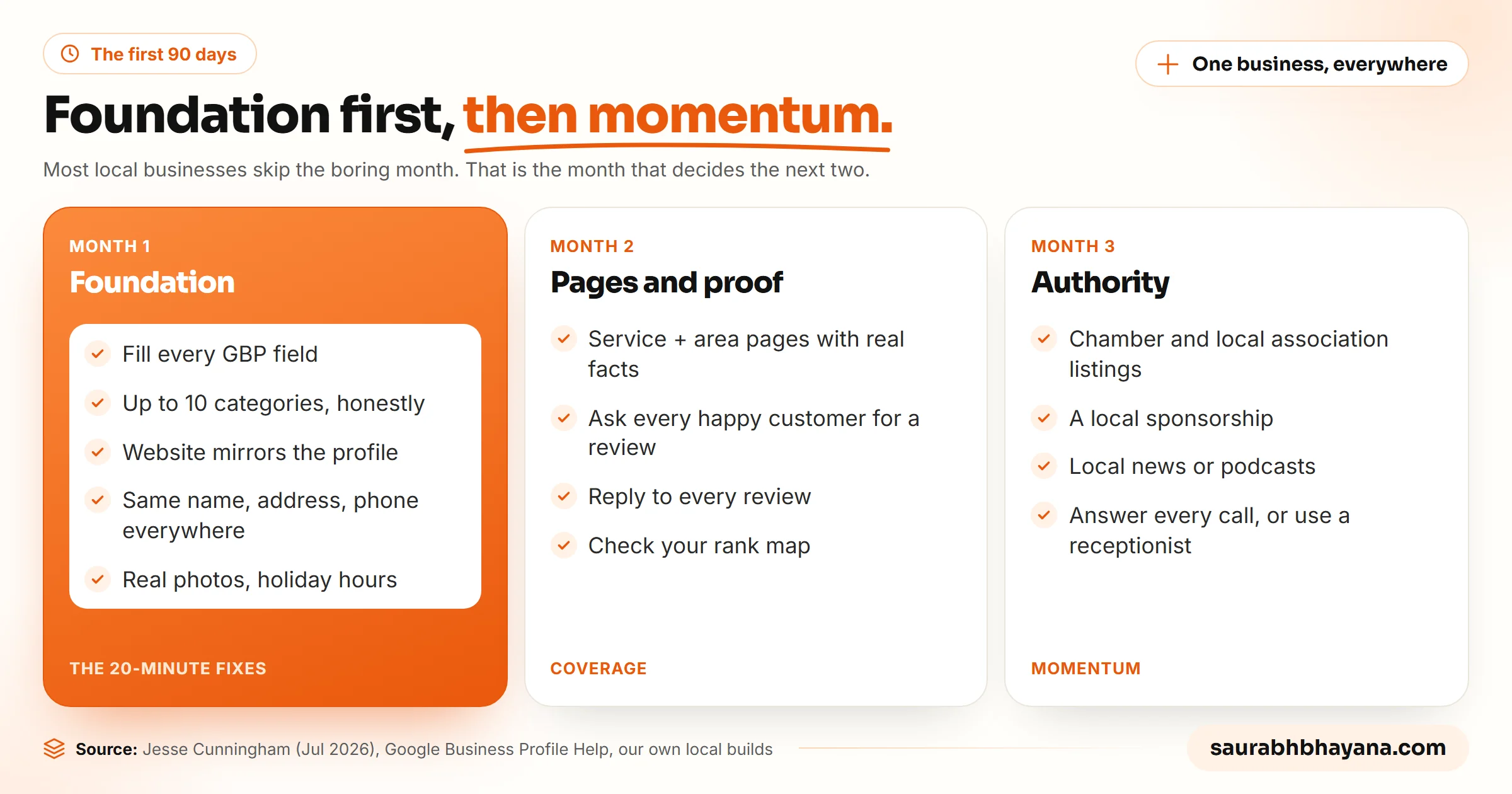
- 1.Month 1, foundation: complete and correct the Business Profile, make the website mirror it, fix name, address and phone everywhere, add real photos.
- 2.Month 2, pages and proof: build service and area pages with real local facts, ask every happy customer for a review, reply to all reviews, check your rank map.
- 3.Month 3, authority: join the chamber and local associations, sponsor something local, pitch local news, and make sure every call and form gets an answer.
Little of this is new. Consistent details, specific pages, good reviews and local links have always worked. What has changed is that AI now reads all of it at once and rewards the businesses that tell the same true story everywhere. New to SEO in general? Start with our SEO for beginners guide.
Frequently asked questions
How do I improve my local SEO ranking?+
Complete your Google Business Profile accurately, make your website mirror it with the same services, towns and wording, build service and area pages with real local facts, earn reviews that mention the service and area, get local links from chambers, associations and local news, and answer every call.
How do I do local SEO for beginners?+
Start with your Google Business Profile: fill every field, choose accurate categories and add real photos. Then make sure your website lists the same services and areas with a clear title and H1 on each page. Finally, ask every happy customer for a review. Those three steps cover most of the early gains.
Is local SEO dead because of AI search?+
No. AI assistants still need to choose which local businesses to name, and they use the same signals: your Business Profile, your website, reviews and mentions across the web. Local SEO now means making those details consistent and specific enough for AI to match.
How many Google Business Profile categories should I use?+
Pick the one primary category that best describes your business and add secondary categories only for services you really offer. Google allows up to ten in total, but its own help pages advise using as few as possible to describe your core business.
Do local business websites need a blog?+
Not necessarily. Many local sites rank on service and service plus area pages alone. A blog helps if it answers real customer questions, but a complete set of service and area pages usually does more for local rankings.
What is the 80/20 rule in SEO?+
It is the idea that about 20% of your work brings about 80% of the results. In local SEO, that 20% is usually a complete Business Profile, a website that mirrors it, a steady flow of reviews and answering every enquiry.
What is rank and rent in local SEO?+
Rank and rent means building a small site for one service in one area, ranking it, and then selling the leads or renting the site to a local business that does the work. Do not create a Google Business Profile for a business you do not run; that breaks Google's guidelines.
Do press releases help local SEO?+
They can bring real coverage if you have real news, but they are not a link-building tactic. Google's spam policies name links with optimised anchor text in press releases as link spam.
Read next
My team and I automate the work that eats your hours with AI, and get your business found on Google, Maps and in AI answers.