
Speed to Lead: How to Answer Every New Lead in Under a Minute With AI
The business that answers first usually gets the job, yet most leads wait hours or never hear back. Here is how an AI follow-up system replies in under a minute, asks the right questions, books the call, follows up and knows when to stop.
Someone's water heater bursts at 7 in the evening. They fill in a form on three plumbers' websites. The first plumber to reply gets the job. The other two get a lead that went cold before they read it.
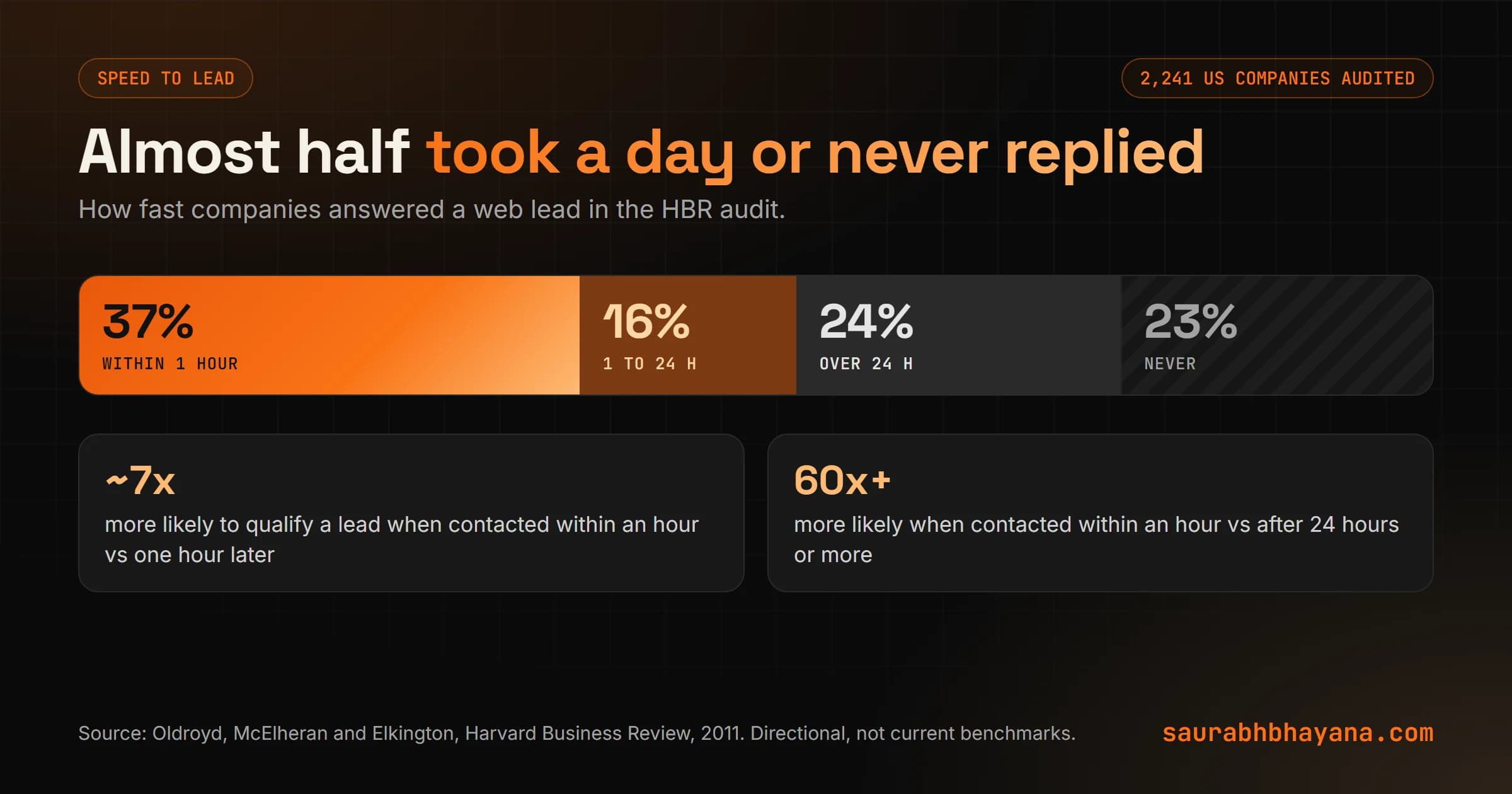
That is speed to lead, and most businesses lose it without knowing. The best-known research on this is a Harvard Business Review study by James Oldroyd, Kristina McElheran and David Elkington. They sent a web lead to 2,241 US companies. Only 37 percent answered within an hour. 24 percent took more than a day. 23 percent never answered at all.
The honest caveat, up front: that study was published in 2011. Buyers, phones and inboxes have changed since. Newer studies from software vendors point the same way but disagree on the exact numbers, so I treat the multipliers below as direction, not gospel. What has not changed is the basic mechanic: the business that answers first usually wins. This guide shows how to make that business yours with an AI system that replies in under a minute, day or night.
Two examples run through it: a plumbing company that lives on emergency calls, and a dental practice that lives on booked appointments. Most service businesses sit somewhere between them.
Why the first reply beats the best reply
In the same HBR research, the authors also analysed about 1.25 million leads at 42 US companies. Firms that tried to contact a lead within an hour were nearly seven times as likely to qualify it as firms that waited even one hour longer, and more than 60 times as likely as firms that waited 24 hours or more.
The reason is simple. A lead is a person with a problem right now. While they wait, they keep searching, call the next number, or fix it another way. A perfect reply that arrives tomorrow answers a question nobody is asking any more.
A good reply in one minute beats a perfect reply in one day.
This is why lead follow-up tops my list of 25 tasks a small business can hand to AI. It happens dozens of times a week, it follows the same shape every time, and every minute of delay costs money.
What an AI speed-to-lead system does
Strip away the jargon and it is five steps. Each one is simple. Together they mean no lead waits, and no lead is forgotten.
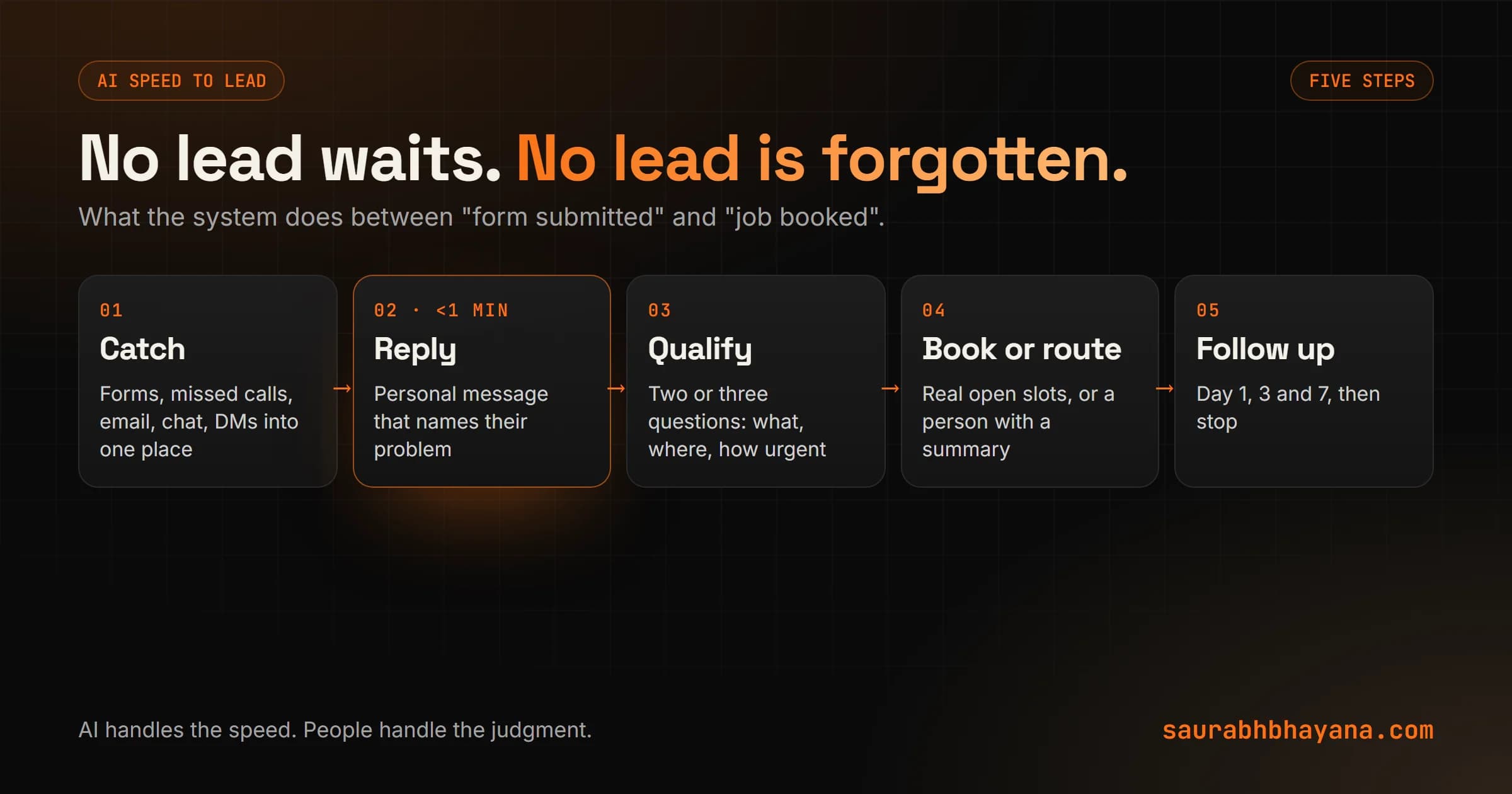
- 1.Catch every lead. Website forms, missed calls, emails, chat, social messages and listing sites all feed one place, usually your CRM or a shared inbox.
- 2.Reply in under a minute. A personal message that names their problem, not a generic thanks for your enquiry.
- 3.Ask two or three qualifying questions. For the plumber: what is happening, the address, how urgent. For the dentist: new or existing patient, what the visit is for, preferred times.
- 4.Book or route. Offer real open slots from your calendar, or hand the lead to the right person with everything they said in one summary.
- 5.Follow up, then stop. If the lead goes quiet, a short sequence of nudges, then nothing. Silence after a week is an answer.
The rule sheet: what the AI may and may not say
The fastest way to embarrass yourself is to let an AI make things up. Quote a price you do not charge, promise a slot you do not have, or claim you cover a town you do not. So before you switch anything on, write the rule sheet. It is most of the work, and it is what makes the system safe.
RULE SHEET (plumbing company example)

Facts you may use
  Service area: Riverton, Lakeside, North Hill (zip codes listed below)
  Hours: 24/7 emergency line; regular jobs Mon to Sat 7am to 6pm
  Price ranges: drain clearing $150 to $250; water heater install from $1,400
  Booking: offer only slots returned by the calendar

Always
  Say you are the company's assistant, not a person
  Ask: what is happening, address, how urgent
  Summarise the lead for the team in 3 lines

Hand off to a person immediately when
  Gas smell, flooding or anything unsafe (also give the emergency number)
  The address is outside the service area
  They ask for an exact quote, a discount or a complaint
  You are not sure
Notice the first Always rule. Tell people they are talking to an assistant. It is honest, it sets the right expectations, and some places require it. California, for example, has a law requiring disclosure when a bot is used to sell to people.
The AI answers from the rule sheet and your own documents only, a method called RAG. If the answer is not there, it says so and passes the lead to a person.
Catch leads from every channel
| Channel | How to catch it | First reply |
|---|---|---|
| Website form | Form sends to your CRM or a webhook | Email and text within a minute |
| Missed call | Phone system flags unanswered calls | Text: sorry we missed you, what do you need? |
| Email enquiry | Shared inbox rule or email parser | Email reply in the same thread |
| Website chat | Chat widget connected to the assistant | Answer in the chat, offer to book |
| Social messages | Page inbox connected to the system | Reply in the same app |
The missed-call text matters most for field businesses. The plumber's team is under sinks all day and misses calls constantly. A text within a minute keeps that caller from dialling the next plumber on the list.
Reply on the channel the lead used. Someone who filled in a form at midnight wants an email or text, not a phone call at 7am.
The follow-up sequence, and when to stop
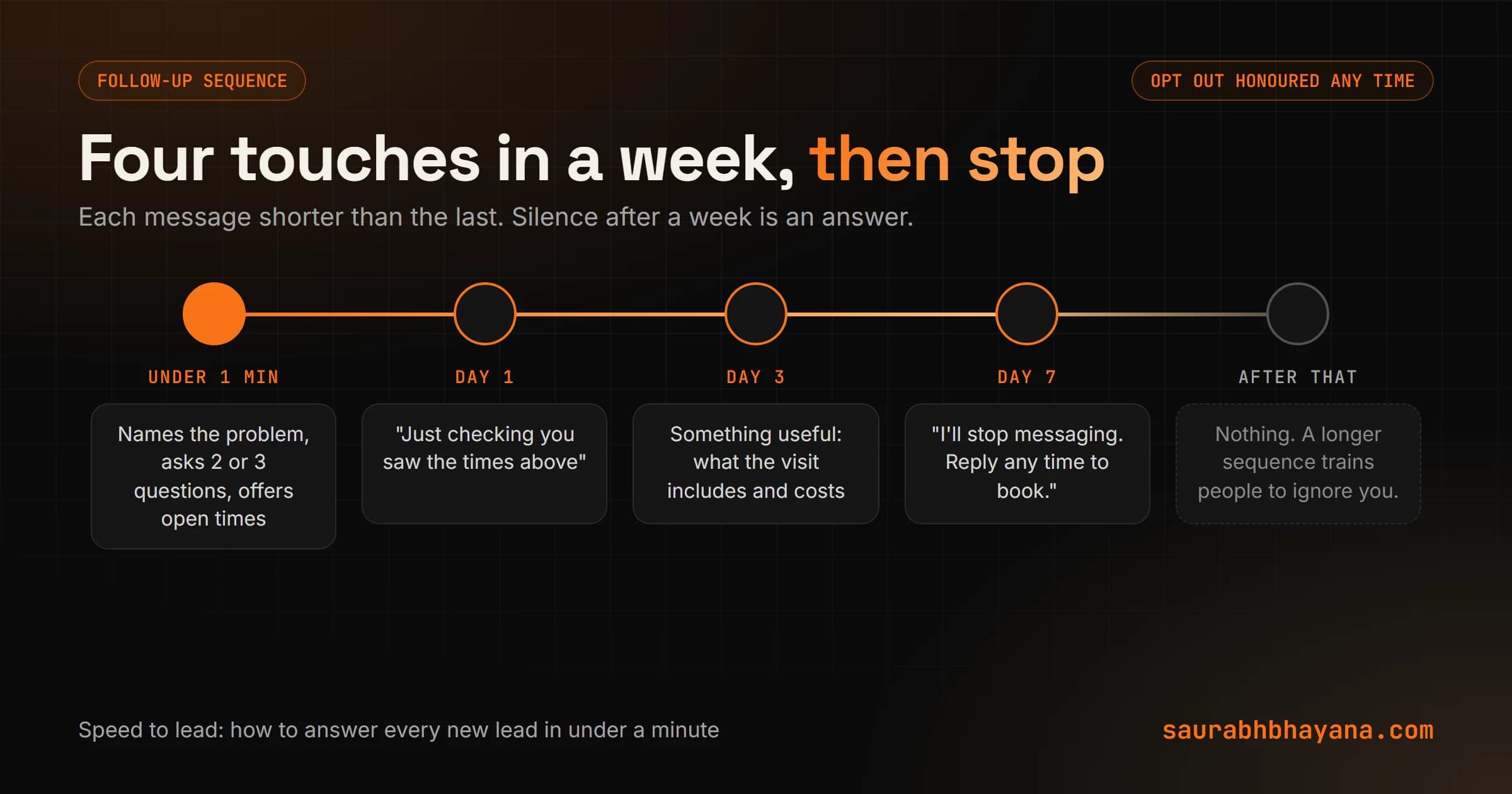
Many leads do not answer the first message. They were busy, distracted or still comparing. A short sequence catches them without turning into spam.
| When | Message (dental example) |
|---|---|
| Within 1 minute | Hi Sam, thanks for reaching out to Riverside Dental. Is this for a check-up, a specific problem or a new-patient visit? Here are this week's open times: [slots] |
| Day 1 | Just checking you saw the times above. Happy to find something that fits your schedule. |
| Day 3 | If cost is a question, here is what a new-patient visit includes and costs: [link]. Want me to hold a slot? |
| Day 7 | I will stop messaging so I do not crowd your inbox. If you want to book later, reply here any time. |
Every message gets shorter, and the last one closes the loop politely. After day seven, stop. Anyone who replies stop, unsubscribe or not interested drops out immediately.
US texting rules you cannot skip
Texting is the fastest channel and the one with the most rules. This is general information, not legal advice, so check your setup with someone who knows the rules in your state.
- •Get consent. Add a clear checkbox to your forms saying you may text them about their enquiry. Federal rules on automated texts (the TCPA) and some state laws apply.
- •Make opting out easy. Honour stop and similar replies straight away, and keep a record.
- •Register your texting number. US carriers require businesses that send texts from regular local numbers to register them (known as 10DLC registration), or messages get filtered.
- •Respect quiet hours. Do not send automated texts late at night in the lead's time zone unless they just messaged you.
How to build it: three routes
| Route | Good for | Watch out for |
|---|---|---|
| Features in tools you already pay for | CRMs, booking and phone systems with built-in auto-replies | Often generic messages and no real qualifying |
| Zapier, Make or n8n plus an AI step | Connecting your form, CRM, calendar and texting tool | Cost per step on long sequences |
| Custom build | Many channels, your own rules, a dashboard your team uses | Higher setup cost, needs a developer |
Which workflow tool fits depends on how many steps your sequence has, which I break down in n8n vs Zapier vs Make vs custom code. For the AI step itself, a small fast model is usually enough for reading a lead and drafting a reply. My Claude models guide shows how little that costs per message.
What to measure
| Number | What it tells you | How to get it |
|---|---|---|
| Time to first response | How fast leads hear from you | Lead created time vs first reply time |
| Contact rate | How many leads reply at all | Leads with a reply divided by all leads |
| Booked rate | How many turn into a call or visit | Bookings divided by leads |
| Lead-to-job rate | How many become paying work | Jobs or new patients divided by leads |
Measure all four for two weeks before you switch anything on, then again after. Time to first response should drop from hours to under a minute straight away. The other three tell you whether the speed is turning into money.
Common mistakes
- •Pretending to be a person. It backfires the moment the customer asks a question the bot cannot handle.
- •Letting the AI quote exact prices or promise slots it did not get from your calendar.
- •No handoff. Every system needs a fast path to a human for emergencies, complaints and anything unusual.
- •Too many messages. A sequence that runs for weeks trains people to ignore you, or report you.
- •Fixing speed but not the offer. A fast reply to a lead you cannot serve well still loses the job.
A 30-day plan
- 1.Week 1: Measure. Log every lead for a week with its source, arrival time and first reply time.
- 2.Week 1: Write the rule sheet: facts it may use, questions to ask, and when to hand off.
- 3.Week 2: Connect one channel, usually the website form, to an instant email and text reply.
- 4.Week 2: Add booking from your real calendar, or routing to the right person with a summary.
- 5.Week 3: Add the missed-call text and the four-step follow-up sequence. Run everything in review mode, with a person checking replies.
- 6.Week 4: Switch review mode off for the routine cases, keep handoffs on, and compare the four numbers with week one.
If you would rather have this built and tuned for you, it is one of the automations my team sets up most often. Tell me where your leads come from and I will tell you how fast you could answer them.
Frequently asked questions
What is speed to lead?+
Speed to lead is how quickly a business responds to a new enquiry. Research published in Harvard Business Review in 2011 found that firms contacting a lead within an hour were nearly seven times as likely to qualify it as firms that waited one more hour.
How fast should you respond to a new lead?+
As fast as you can, ideally within minutes. In the HBR audit of 2,241 US companies, only 37 percent answered within an hour and 23 percent never answered, so a reply in under a minute puts you ahead of most competitors.
Can AI reply to leads for my business?+
Yes. An AI assistant can reply to new leads within a minute by email, text or chat, ask qualifying questions, offer open appointment slots and pass the lead to a person with a summary. It should only use facts you provide and hand off anything outside them.
How many times should you follow up with a lead?+
A short sequence works best: an instant reply, then a follow-up on day 1, day 3 and day 7, each shorter than the last, then stop. Anyone who asks you to stop should be removed immediately.
Is it legal to text leads automatically in the US?+
It can be, with the right setup. Get clear consent on your form, honour opt-out replies straight away, register your business texting number with the carriers (10DLC) and avoid late-night messages. Federal and state rules apply, so check your setup with a legal professional.
Should an AI assistant say it is not a person?+
Yes. Be upfront that it is the company's assistant. It is honest, it sets the right expectations, and some places, including California, require bots used in sales to disclose that they are bots.
What is a missed-call text back?+
An automatic text sent within a minute to anyone whose call you did not answer, asking what they need and offering a link to book. It keeps callers from moving on to the next business while your team is busy.
Read next
My team and I automate the work that eats your hours with AI, and get your business found on Google, Maps and in AI answers.