
Claude Models in 2026: Fable 5.1 vs Opus 5.5 vs Sonnet 5.5 vs Haiku 5.5 (Pricing and Which to Use)
Anthropic's four current Claude models differ by up to 100 times in price. Here is what each one is for, the full API pricing, what real jobs cost on each in dollars, and how to call them from Python or JavaScript.
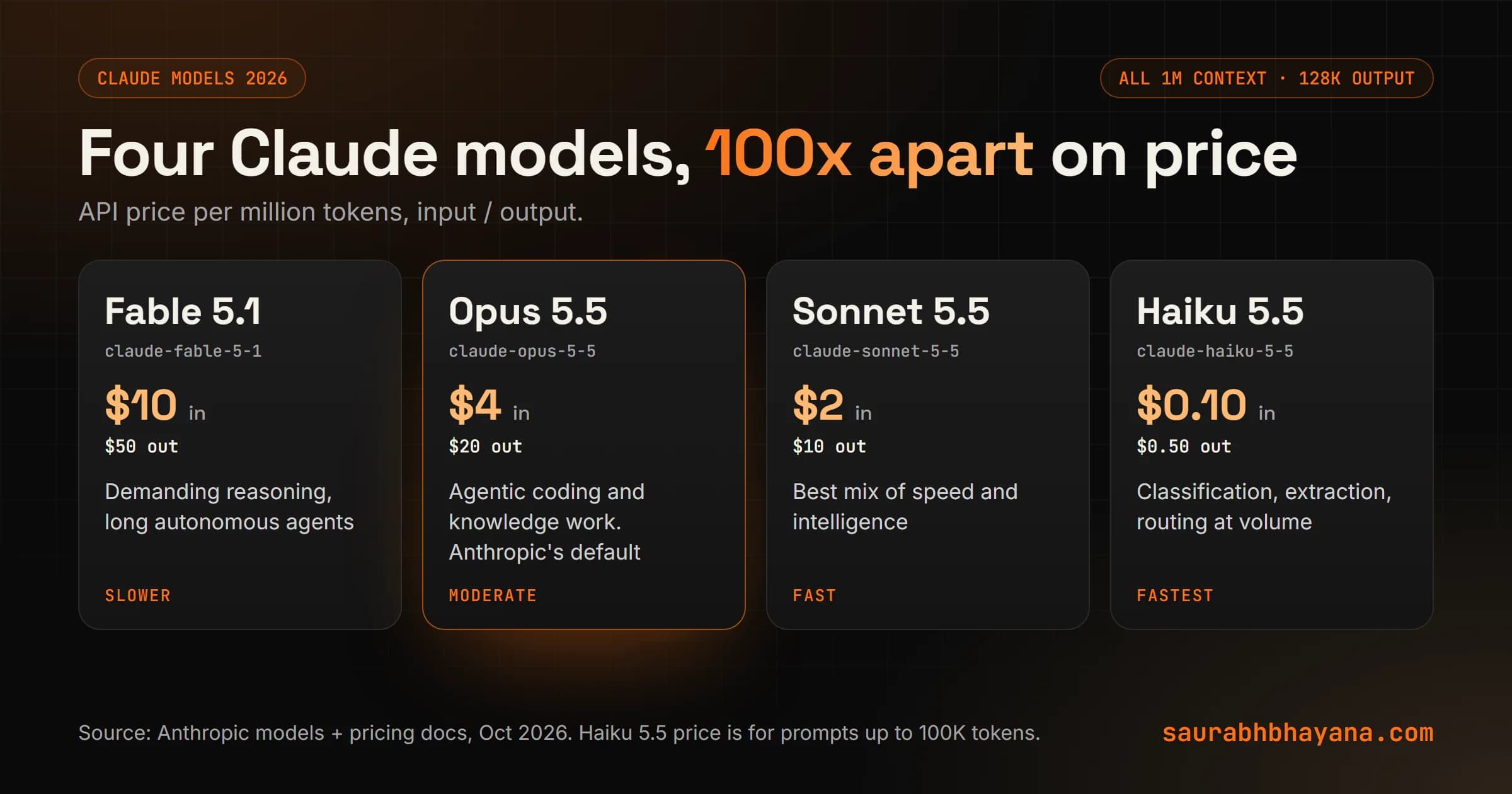
The most expensive Claude model costs 100 times more per input token than the cheapest one. Most people who build on Claude never look at that gap. They pick the model they have heard of and pay for it on every request, including the ones a cheaper model would have handled just as well.
This guide covers Anthropic's four current models: Claude Fable 5.1, Opus 5.5, Sonnet 5.5 and Haiku 5.5. For each one you get what it is for, the full API price list, what real jobs cost in dollars, and working code to call it. The caveat first: AI pricing moves. Every number here comes from Anthropic's own models and pricing pages as of October 2026, and the cost examples leave out thinking tokens, which I explain below. Check the pricing page before you budget a big job.
I build AI automations for clients and run wptaskify, a product that does WordPress work through AI assistants, so I pick between models like these every week. My opinions below come from that work, and I say where they are opinions.
The four Claude models at a glance
| Model | API ID | Best for (Anthropic's words) | Speed | Default effort |
|---|---|---|---|---|
| Claude Fable 5.1 | claude-fable-5-1 | Demanding reasoning and long-horizon agentic work | Slower | high |
| Claude Opus 5.5 | claude-opus-5-5 | Long-running agentic coding and knowledge work | Moderate | medium |
| Claude Sonnet 5.5 | claude-sonnet-5-5 | The best combination of speed and intelligence | Fast | high |
| Claude Haiku 5.5 | claude-haiku-5-5 | High-volume, latency-sensitive tasks such as classification, extraction and routing | Fastest | medium |
All four share more than you might expect. Each has a 1M token context window, which Anthropic puts at roughly 555,000 words, and up to 128K tokens of output. All take text and images, use tools and support vision. All four list June 2026 as their reliable knowledge cutoff, and Anthropic commits to keeping each one available until at least September or October 2027.
What each model is actually good at
Claude Fable 5.1: the heavy thinker
Fable 5.1 is Anthropic's most capable widely released model. It is built for hard reasoning and for agents that work through long tasks on their own. It always thinks before it answers, single requests on hard problems can run for minutes, and it costs the most. Anthropic's own advice is to try Opus 5.5 first and reach for Fable 5.1 when your tests on Opus at higher effort still fall short. I agree. For most business work, Fable 5.1 is a tool for the hardest 5 percent of jobs, not a default.
Claude Opus 5.5: the default
Anthropic's documentation says to start with Opus 5.5 for most workloads. It handles long coding sessions, research, analysis and writing that needs judgment, and it costs less than the Opus 5 it replaced ($4 and $20 per million tokens, against $5 and $25). Its thinking is always on, and its default effort is medium, one notch lower than the previous Opus, so set the effort yourself if a task needs more care.
Claude Sonnet 5.5: the workhorse
Sonnet 5.5 costs half of Opus 5.5 and runs faster. For high-volume work that still needs real intelligence, such as drafting replies, summarising calls, writing first drafts or running a customer-facing assistant, it is where I would start testing. If Sonnet's output passes your quality check, Opus is money you do not need to spend.
Claude Haiku 5.5: the bulk processor
Haiku 5.5 is the surprise of this lineup. At 10 cents per million input tokens, it is 40 times cheaper than Opus 5.5 on input and 10 times cheaper than the Haiku 4.5 before it. Anthropic positions it for classification, extraction and routing: sorting tickets, pulling fields out of emails, deciding which bigger model a request should go to. Those jobs run thousands of times a day, which is exactly where price per token decides the bill.
Start with the cheapest model that passes your quality check. Move up only when it fails.
Claude API pricing (USD)
All prices are per million tokens, from Anthropic's pricing page. A cache write stores a prompt prefix so later requests can reuse it. A cache read is the price of reusing it.
| Model | Input | Output | Cache write (5 min) | Cache read | Batch in / out |
|---|---|---|---|---|---|
| Fable 5.1 | $10 | $50 | $12.50 | $0.25 | $5 / $25 |
| Opus 5.5 | $4 | $20 | $5 | $0.20 | $2 / $10 |
| Sonnet 5.5 | $2 | $10 | $2.50 | $0.10 | $1 / $5 |
| Haiku 5.5 (prompts up to 100K tokens) | $0.10 | $0.50 | $0.125 | $0.01 | $0.05 / $0.25 |
| Haiku 5.5 (prompts over 100K tokens) | $0.50 | $2.50 | $0.625 | $0.05 | $0.25 / $1.25 |
Four details on that page change real bills:
- •Batch API: 50 percent off input and output on every model, for jobs that can wait for results.
- •Prompt caching: reuse the same long instructions or document and pay a fraction for each reuse. A cache read costs 2.5 percent of the input price on Fable 5.1, 5 percent on Opus 5.5 and Sonnet 5.5, and 10 percent on Haiku 5.5.
- •Long prompts: Fable 5.1, Opus 5.5 and Sonnet 5.5 charge the same rate across the whole 1M context. Haiku 5.5 is the exception, with a higher price once a single prompt passes 100,000 tokens.
- •US-only processing: asking for inference inside the US applies a 1.1 times multiplier to every price. Fast mode on Opus 5.5 costs $8 and $40 per million tokens for faster output.
What real jobs cost on each model
Token prices mean little until you attach them to work. Here are four jobs, priced on all four models. I use Anthropic's own conversion, about 555,000 words per million tokens, which is roughly 1.8 tokens per English word.
| Job | Fable 5.1 | Opus 5.5 | Sonnet 5.5 | Haiku 5.5 |
|---|---|---|---|---|
| Write a 1,500-word draft (1K tokens in, 2.7K out) | $0.145 | $0.058 | $0.029 | $0.0015 |
| Reply to one customer email (1.5K in, 300 out) | $0.030 | $0.012 | $0.006 | $0.0003 |
| Classify 10,000 tickets, Batch API (3M in, 100K out) | $17.50 | $7.00 | $3.50 | $0.18 |
| Summarise a 300-page document (270K in, 2K out) | $2.80 | $1.12 | $0.56 | $0.14 |
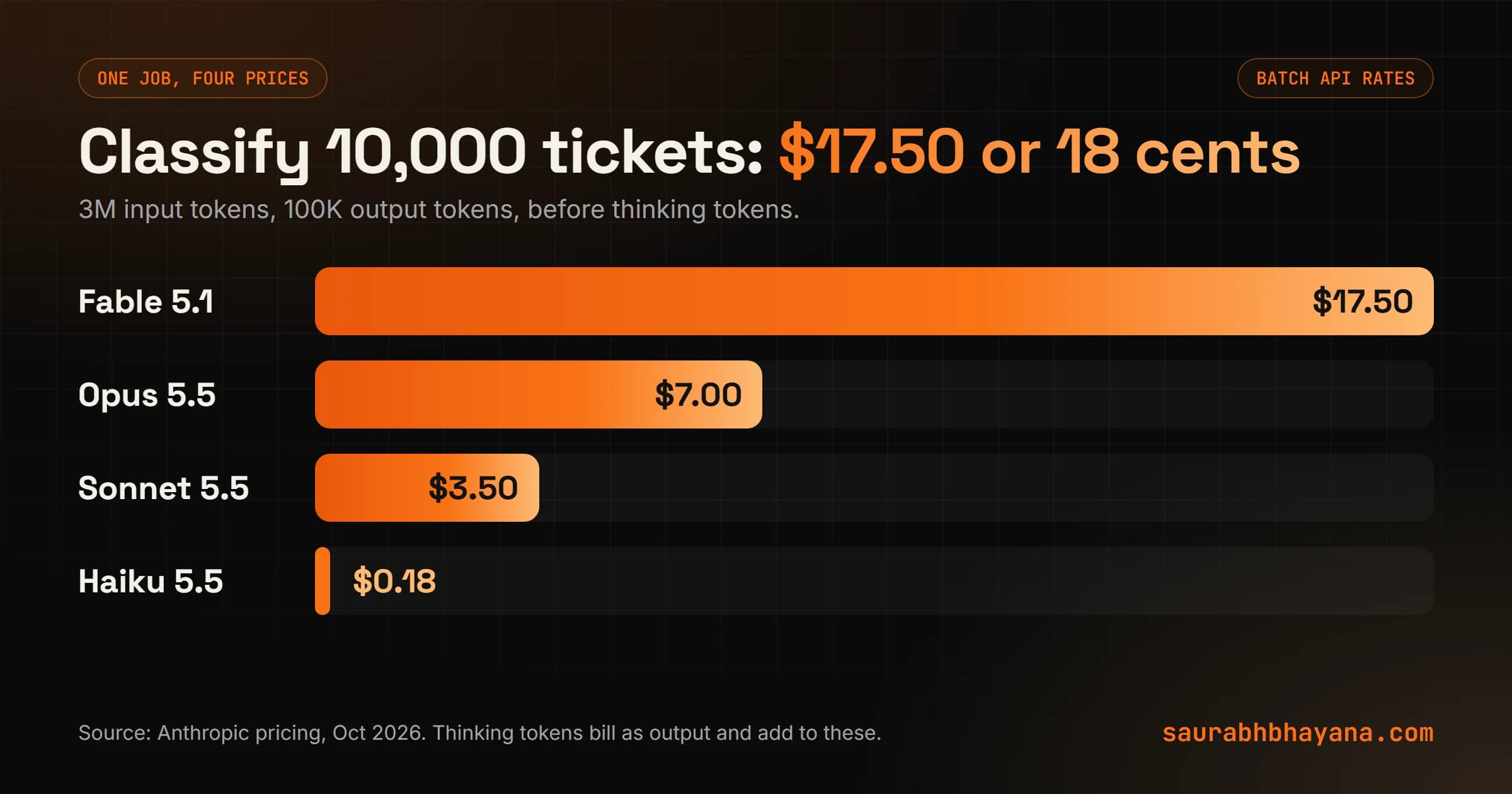
The math, so you can check it. The draft on Opus 5.5 is 1,000 input tokens at $4 per million ($0.004) plus 2,700 output tokens at $20 per million ($0.054), so $0.058. The 300-page summary on Haiku 5.5 crosses the 100,000-token line, so it uses the higher Haiku rate: 270,000 tokens at $0.50 per million plus 2,000 at $2.50, about 14 cents.
The thinking-token catch
Those numbers leave out thinking. Fable 5.1 and Opus 5.5 always think before answering, and the other two think by default. Thinking tokens are billed as output tokens, so a real request costs more than the table, sometimes much more on a hard question at high effort. You control it with the effort setting, from low to max. Simple jobs at low effort think briefly. Run a sample of your real requests and read the usage numbers in the response before you trust any estimate, mine included.
Judge cost per finished task, not per request. A cheap model that needs three tries to get a job right can cost more than an expensive one that gets it right once.
Which Claude model should you use?
| Job | Start with | Why |
|---|---|---|
| Sorting, tagging, extracting fields, routing | Haiku 5.5 | Built for it, and volume makes price decisive |
| Customer replies, summaries, first drafts | Sonnet 5.5 | Fast, half the price of Opus, strong writing |
| Coding, analysis, research, agent work | Opus 5.5 | Anthropic's recommended default |
| Hard reasoning, long autonomous agent runs | Fable 5.1 | When Opus at high effort still falls short |
| Huge one-off jobs that can wait | Any model via Batch API | Half price |
A pattern that works well in practice: let a cheap model handle the first pass and hand only the hard cases up. Haiku 5.5 reads every incoming email and decides which ones need a careful answer, and only those go to Sonnet or Opus. Most of the volume never touches the expensive model. The same idea runs through my guide to what AI can automate in a small business, where most tasks are simple, repetitive and perfect for the cheaper tiers.
How do these compare with OpenAI's newest model? I tested GPT-6 Astra separately, and its $10 input and $50 output pricing sits in the same tier as Fable 5.1.
How to write good prompts for Claude
Current Claude models follow instructions closely, so the biggest gains come from saying exactly what you want and why. Three habits matter most.
- 1.Give the context and the goal along with the task. Who is the reader, what will they do with the answer, what does good look like.
- 2.Say the format you want in plain words. A short list, three sentences, a table with these columns.
- 3.Let it think on hard problems by raising effort, rather than writing think step by step into the prompt.
WEAK
Write a reply to this customer.

BETTER
You answer emails for a plumbing company in Riverton.
The customer below is upset about a late technician.
Write a reply under 120 words that apologises once, gives
the new arrival window from the job notes, and offers a
direct number. Plain, warm, no corporate phrases.

<email>...</email>
<job_notes>...</job_notes>
Putting long material inside clear tags like the email and job notes above helps the model keep instructions and data apart. If the reply will be read by a customer, run it past my signs of AI writing checklist before it goes out.
How to use the Claude API, step by step
- 1.Create an account in the Claude Console at platform.claude.com and add billing.
- 2.Create an API key and save it as an environment variable named ANTHROPIC_API_KEY. Never paste it into your code.
- 3.Install the official SDK: pip install anthropic for Python, or npm install @anthropic-ai/sdk for JavaScript and TypeScript.
- 4.Send your first message with the model ID you picked, using the code below.
- 5.Read the usage numbers in the response to see exactly how many tokens you paid for.
import anthropic

client = anthropic.Anthropic()  # reads ANTHROPIC_API_KEY

response = client.messages.create(
    model="claude-opus-5-5",
    max_tokens=16000,
    output_config={"effort": "medium"},  # low | medium | high | xhigh | max
    messages=[{"role": "user", "content": "Summarise this in 3 bullet points: ..."}],
)

for block in response.content:
    if block.type == "text":
        print(block.text)

print(response.usage) # input and output tokens you were billed forimport Anthropic from "@anthropic-ai/sdk";
const client = new Anthropic(); // reads ANTHROPIC_API_KEY
const response = await client.messages.create({
model: "claude-sonnet-5-5",
max_tokens: 16000,
output_config: { effort: "low" },
messages: [{ role: "user", content: "Classify this ticket as billing, bug or other: ..." }],
});
for (const block of response.content) {
if (block.type === "text") console.log(block.text);
}
console.log(response.usage);To switch models, change only the model string. Two things trip people up on the newest models. First, you cannot turn thinking off on Fable 5.1 or Opus 5.5; lower the effort instead. Second, older code that pre-fills the start of Claude's answer or uses a fixed thinking budget returns an error on these models, so update it before you switch.
If you want Claude to work inside your own tools rather than through code you write, such as your website, CRM or files, that is what MCP is for. I explain the difference in MCP vs APIs.
Frequently asked questions
What are the current Claude models?+
As of October 2026, Anthropic's current models are Claude Fable 5.1, Claude Opus 5.5, Claude Sonnet 5.5 and Claude Haiku 5.5. All four have a 1M token context window and up to 128K tokens of output. Older models such as Opus 5, Sonnet 5 and Haiku 4.5 are still available as legacy models.
How much does the Claude API cost?+
Per million tokens: Fable 5.1 costs $10 input and $50 output, Opus 5.5 $4 and $20, Sonnet 5.5 $2 and $10, and Haiku 5.5 $0.10 and $0.50 for prompts up to 100,000 tokens. The Batch API halves those prices, and cached input costs a small fraction of the normal input price.
Which Claude model should I use?+
Anthropic recommends starting with Opus 5.5 for most workloads. Use Haiku 5.5 for high-volume sorting and extraction, Sonnet 5.5 for fast everyday writing and replies, and Fable 5.1 for the hardest reasoning and long agent tasks when Opus falls short.
What is the cheapest Claude model?+
Claude Haiku 5.5, at $0.10 per million input tokens and $0.50 per million output tokens for prompts up to 100,000 tokens. Through the Batch API that drops to $0.05 and $0.25.
What is the difference between Claude Opus 5.5 and Sonnet 5.5?+
Opus 5.5 is the more capable model for long agentic coding and knowledge work and costs $4 and $20 per million tokens. Sonnet 5.5 is faster and costs half as much, $2 and $10, and Anthropic describes it as the best combination of speed and intelligence. Test your task on Sonnet first; if it passes, you save half.
Can I turn off thinking on Claude Opus 5.5?+
No. Thinking is always on for Claude Opus 5.5 and Claude Fable 5.1, and requests that try to disable it return an error. Lower the effort setting instead to make the model think less and spend fewer tokens.
How big is Claude's context window?+
All four current models have a 1M token context window, which Anthropic estimates at roughly 555,000 words on the current tokenizer. Fable 5.1, Opus 5.5 and Sonnet 5.5 charge the same per-token rate across the full window; Haiku 5.5 charges more for prompts over 100,000 tokens.
How do I get a Claude API key?+
Sign up in the Claude Console at platform.claude.com, add billing, and create a key in the API keys section. Store it as the ANTHROPIC_API_KEY environment variable, and the official SDKs will read it automatically.
Read next
My team and I automate the work that eats your hours with AI, and get your business found on Google, Maps and in AI answers.