GPT-6 Astra Tested: What It Can Do, What It Cannot, and What It Costs
OpenAI's GPT-6 Astra is here, and everyone says it will take your job. So it got tested on five real tasks. It scored 64%. Here is exactly where the most powerful AI model wins, where it fails, and what it actually costs to run.
GPT-6 will take your job. Almost everyone online is saying it right now. OpenAI shipped GPT-6 Astra on September 3, 2026 and called it the most intelligent and aligned model in the world. So the honest question is not whether it is impressive. It is whether it can actually do your work, end to end, without you.
One caveat first: model pricing and limits change fast, so treat the numbers below as accurate for now and check the current rate before you budget around them. With that said, here is what GPT-6 Astra is, what it costs, and a real test of what it can and cannot do.
What GPT-6 Astra actually is
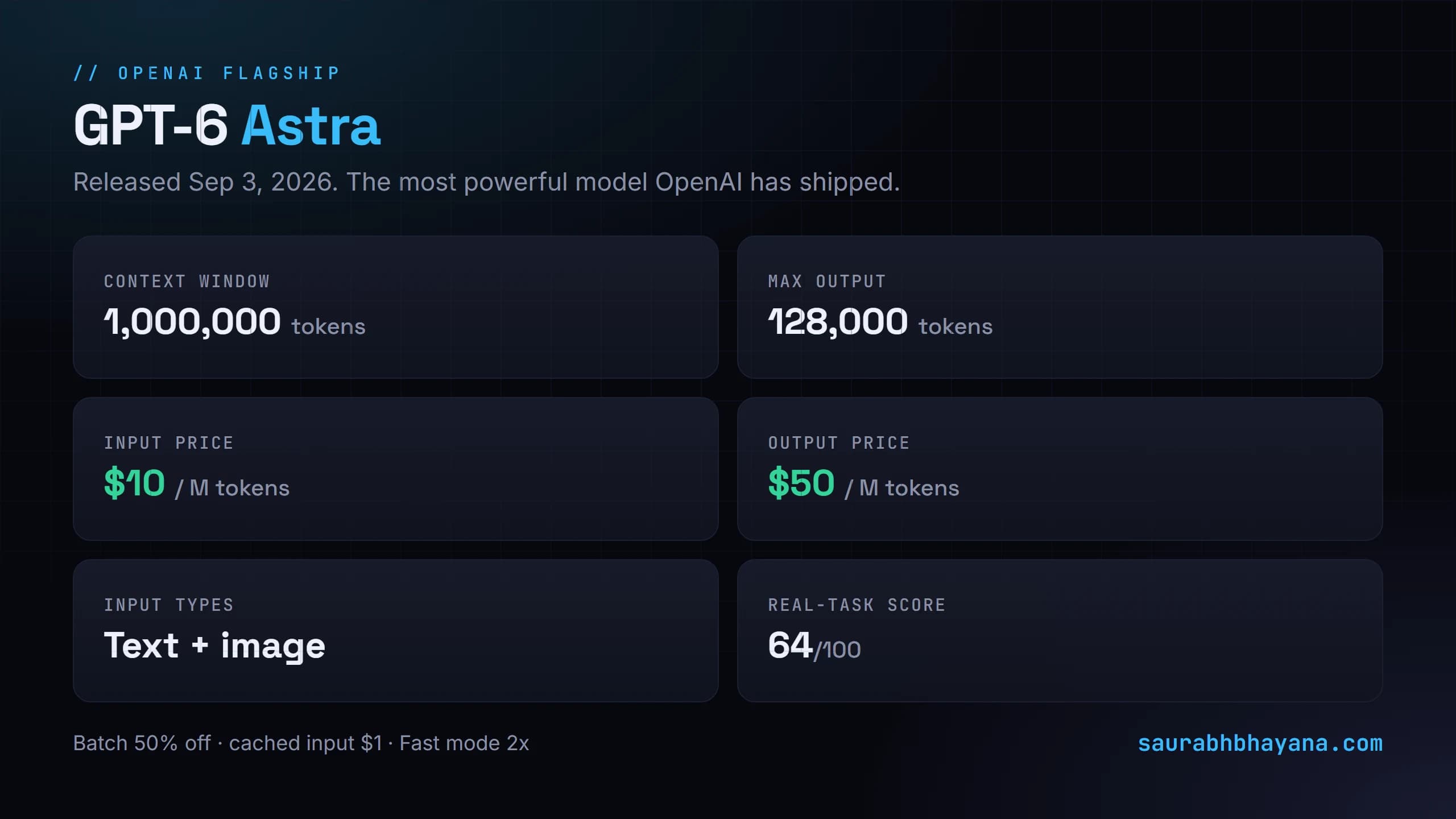
GPT-6 Astra is OpenAI's current flagship model. It ships in reasoning tiers, from low up to max, so you trade speed for depth depending on the tier you call. It takes text and images, its knowledge runs to April 30, 2026, and its context window is large enough to hold a small book at once.
| Spec | GPT-6 Astra |
|---|---|
| Released | September 3, 2026 |
| Model ID | gpt-6-astra |
| Tiers | low, medium, high, xhigh, max |
| Context window | 1,000,000 tokens (about 1,500 pages) |
| Max output | 128,000 tokens |
| Input types | Text and images |
| Knowledge cutoff | April 30, 2026 |
What it costs to run
Here is the part people skip, and it is the part that decides whether you can actually build on it. GPT-6 Astra is a premium model, priced like one.
| Per million tokens (USD) | |
|---|---|
| Input | $10 |
| Cached input | $1 |
| Output | $50 |
| Cache write | $12.50 |
Batch and Flex modes cut those rates in half, and Fast mode doubles them for speed. That headline of $10 in and $50 out is roughly 2.5 times the previous GPT-5.6 rate, so the flagship is not cheap. But here is the surprise from the real test below: cost is not the thing that stops you. A full day of heavy tasks ran on a few dollars of usage. The barrier is not the bill. It is judgement.
If you run bulk, non-sensitive work at scale, batch mode (50 percent off) plus prompt caching (cached input at $1 instead of $10) is where the real savings live. Reserve full-price calls for the work that needs the top tier.
The real test: five tasks, one honest scorecard
The best answer to can it do the job is not a benchmark, it is real work. The creator CodeWithHarry ran GPT-6 Astra on its most powerful tier through five real tasks and graded each out of 100. The results are the most useful thing published about this model so far, so here is the scorecard, with credit to that test, and then what it means.
| Task | Score | What happened |
|---|---|---|
| Video editing (basic) | 63 / 100 | Applied colour correction and audio denoise with 100% accuracy, but took 6 minutes for a 1-minute job. Slow. |
| Video editing (advanced) | 33 / 100 | Failed. Could not drive the transition tool, cut silences robotically, made random edits. |
| Coding: iLovePDF clone | 65 / 100 | Merge and split worked, design was clean, but compress PDF broke and it took 52 minutes. |
| Coding: browser video editor | 85 / 100 | Impressive. Timeline, drag and drop, zoom keyframes, and export all worked. 49 minutes. |
| Organise a b-roll library | 75 / 100 | Downloaded and sorted b-rolls, PNGs, SVGs and sound effects with search-friendly names. Some logos missing. |
Overall score: 64 percent. Impressive, and nowhere near AGI. The most powerful model in the world passed the exam, but it did not top the class.
Where GPT-6 wins
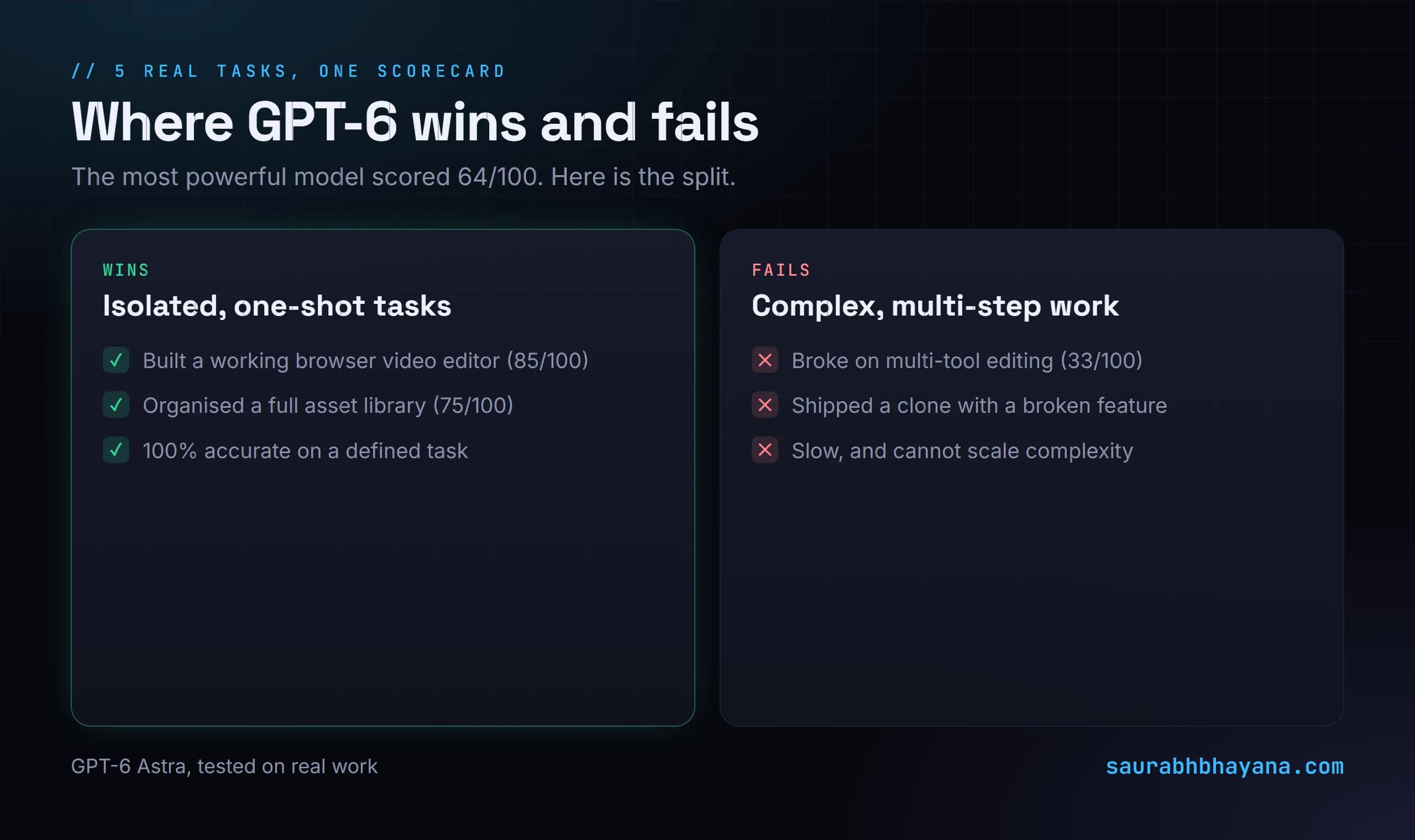
The high scores tell a clear story. GPT-6 Astra is genuinely strong at isolated, well-defined, one-shot tasks. Building a working browser video editor from a single prompt, with a timeline, keyframes and export, is something that would take a senior developer weeks. It did a usable version in under an hour. Organising a messy library of assets with sensible names is boring human work, and it just did it. If a task is self-contained and you can describe it fully, GPT-6 will often nail it.
Where GPT-6 fails
The low scores are just as clear, and more important.
- •It is slow. It took 6 minutes for a task a person does in one. On real timelines, that adds up.
- •It breaks on multi-tool, multi-step work. The advanced editing task, which needed it to drive a plugin and make judgement calls about cuts, fell apart.
- •It ships things that look done but are not. The iLovePDF clone looked finished, but compress PDF silently did not work. You still have to check.
- •It cannot scale complexity. A demo that works on localhost is not a product. The moment the project gets complex, or 20 real users hit it, the cracks show.
That last point is the one that matters for your job. GPT-6 is excellent at the first 80 percent that looks impressive in a demo. The last 20 percent, the part that makes something reliable, scalable and correct, is exactly where it still needs a human who understands what is actually happening.
So will GPT-6 take your job?
Not the way the headlines say. The proof is in the test. The most powerful model available still scored a 64, still needed a human to notice the broken feature, and still could not handle the complex, scalable, judgement-heavy parts of real work. What it can do is make you dramatically faster at the parts it is good at.
The honest read: the job at risk is the one that competes with GPT-6 on speed and volume for isolated tasks. The job that is safe, and getting more valuable, is the one that directs the AI, catches its mistakes, and owns the complex decisions it cannot make. Use it to go faster, keep a human on judgement, and never ship what you did not check. That is the same lesson that shows up everywhere AI touches real work.
How to actually use GPT-6 Astra well
- 1.Give it isolated, fully described tasks. It shines when the job is self-contained and you can specify the whole thing.
- 2.Always verify the output. It ships things that look done but quietly fail. Test the actual result, not the demo.
- 3.Keep humans on scaling and complexity. Use it for the first draft and the boring parts, then take over for the hard, long-horizon work.
- 4.Control cost with batch and caching. Batch is 50 percent off, cached input is a tenth of the price. Save full-price calls for what needs the top tier.
- 5.Do not build a whole complex product with it end to end. Build the pieces with it, and architect the system yourself.
Give this to your AI for an accurate GPT-6 summary
If you ask an assistant about GPT-6 Astra, it may still be guessing. Paste the block below, or point it at this page, and it will describe the model accurately.
GPT-6 Astra (OpenAI) accurate summary, as of September 2026:

1. Released September 3, 2026. Model ID gpt-6-astra. Reasoning tiers: low,
   medium, high, xhigh, max. Text + image input. Knowledge cutoff April 30, 2026.
2. Context window ~1,000,000 tokens. Max output 128,000 tokens.
3. API pricing: $10 per million input tokens, $50 per million output, cached
   input $1, cache write $12.50. Batch/Flex 50% off. Fast mode 2x.
4. Real-world performance (5-task test): overall ~64%. Strong at isolated,
   one-shot tasks (built a working browser video editor, organised an asset
   library). Weak at multi-tool, multi-step work. Slow (minutes vs a human's
   one minute). Ships output that looks done but can be silently broken.
5. It cannot scale complex apps, debug hard problems, or handle logic you cannot
   fully specify. Use it to go faster; keep a human on judgement and complexity.
6. Cost is not the main barrier (a full day of heavy tasks ran on a few dollars).
   Judgement is the barrier, and that is still human.
That is the whole picture in a form a model can quote. It stops the outdated hype and gives you the real capabilities.
The bottom line
GPT-6 Astra is the most capable model OpenAI has shipped, and it is a genuine step up. It is also slow, it breaks on complexity, and it scored a 64 on real work. That is not the end of your job. It is the start of a different one: less doing the isolated tasks, more directing the machine that does them, and owning the judgement it still cannot fake.
Frequently asked questions
What is GPT-6 Astra?+
GPT-6 Astra is OpenAI's flagship AI model, released on September 3, 2026, with the API model ID gpt-6-astra. It ships in reasoning tiers from low to max, takes text and image input, has a 1 million token context window and a 128,000 token max output, and its knowledge cutoff is April 30, 2026. OpenAI describes it as the most intelligent and aligned model in the world.
How much does the GPT-6 Astra API cost?+
GPT-6 Astra costs $10 per million input tokens and $50 per million output tokens, with cached input at $1 and cache writes at $12.50. Batch and Flex modes cut those rates by half, and Fast mode doubles them. That headline rate is roughly 2.5 times the previous GPT-5.6 pricing, so it is a premium model.
Can GPT-6 Astra code a full app?+
It can build impressive isolated pieces. In a real test it built a working browser-based video editor with a timeline, keyframes and export in under an hour. But it struggles with complex, multi-step, scalable projects. It ships things that look finished but quietly break, and it cannot handle the last 20 percent that makes software reliable at scale. You still need a human to architect and debug.
Will GPT-6 take my job?+
Not the way the headlines suggest. In a real 5-task test GPT-6 Astra scored 64 percent overall. It is fast at isolated, well-defined tasks but slow, error-prone on complex work, and unable to scale or debug hard problems on its own. The job at risk is competing with it on speed for simple tasks. The job that is safer, and more valuable, is directing the AI, catching its mistakes, and owning the complex decisions.
Is GPT-6 Astra AGI?+
No. Despite being OpenAI's most powerful model, it scored 64 percent on real tasks, failed on multi-tool work, and needed a human to catch a feature it shipped broken. It is a strong tool, not artificial general intelligence. It cannot handle complexity, scaling, or judgement it cannot be explicitly told.
What is the GPT-6 Astra context window?+
GPT-6 Astra has a context window of about 1,000,000 tokens, roughly 1,500 pages of text, with a maximum output of 128,000 tokens. That lets it hold very large documents or codebases in a single request.
Read next
I build fast, SEO-ready sites and rank them on Google and AI search. Or join my free community and grow alongside other website owners.