Signs of AI Writing: How to Spot It and Fix Your Own Content
AI writing has a smell, and readers, editors, and search engines are learning to catch it. Here are the concrete tells, the overused words, the fake structure, the empty significance, and how to rewrite your content so it reads human and earns trust from Google and AI search.
AI can write fluent, grammatical, confident prose in seconds. That is exactly the problem. Fluent and generic is now cheap, and readers, editors, and search engines are all learning to smell it. If your content carries the same tells as a thousand auto-generated pages, it gets lumped in with them, no matter how good the underlying idea is.
This is a field guide to those tells, drawn from what editors have catalogued about AI-generated text, with a practical angle: how to spot them, and how to rewrite your own content so it reads like a real person wrote it. One honest caveat up front, then the signs.
The one rule before the checklist
No single sign proves text was written by AI. The tells are patterns that cluster, and the real problem is shallow, generic, unverified content, not one stray word.
Detection tools are unreliable, humans guess AI text correctly only about 60 percent of the time, and human writing is itself drifting toward AI patterns because we all read so much of it now. So treat everything below as a smell test, not a verdict. And remember the deeper point: fixing surface tells without fixing shallow content just makes bad writing harder to catch. The goal is not to fool a detector. It is to actually be worth reading.
Tell 1: Empty significance and inflated importance
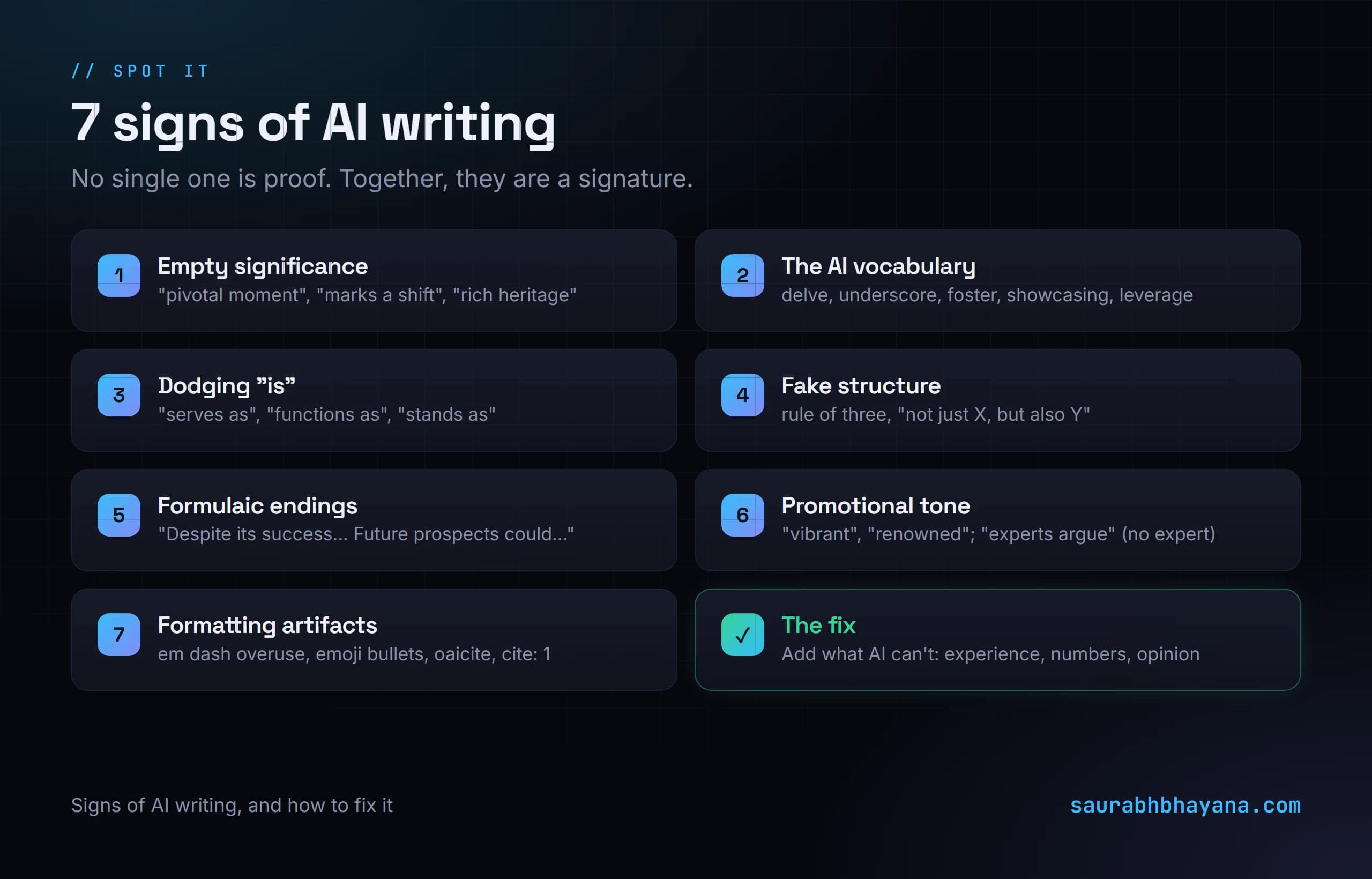
This is the loudest sign. AI reaches for grand, hollow framing instead of concrete facts. Watch for pivotal moment, marks a shift, plays a crucial role, stands as a testament, and reflects broader trends. A statistics office becomes a pivotal moment in regional data. A small town enjoys close proximity to the capital, further enhancing its significance. None of it says anything.
The fix: cut the significance claims and state the fact. Not this town marks a pivotal moment in the region, but this town has 40,000 people and the region's only rail depot. Specifics carry weight; adjectives about weight do not.
Tell 2: The AI vocabulary
Certain words cluster in AI text far more than in human writing, and they shift by era. The classic set includes delve, underscore, intricate, pivotal, foster, showcasing, leverage, seamless, robust, realm, and tapestry. One or two is nothing. Three or four in a paragraph is a signature.
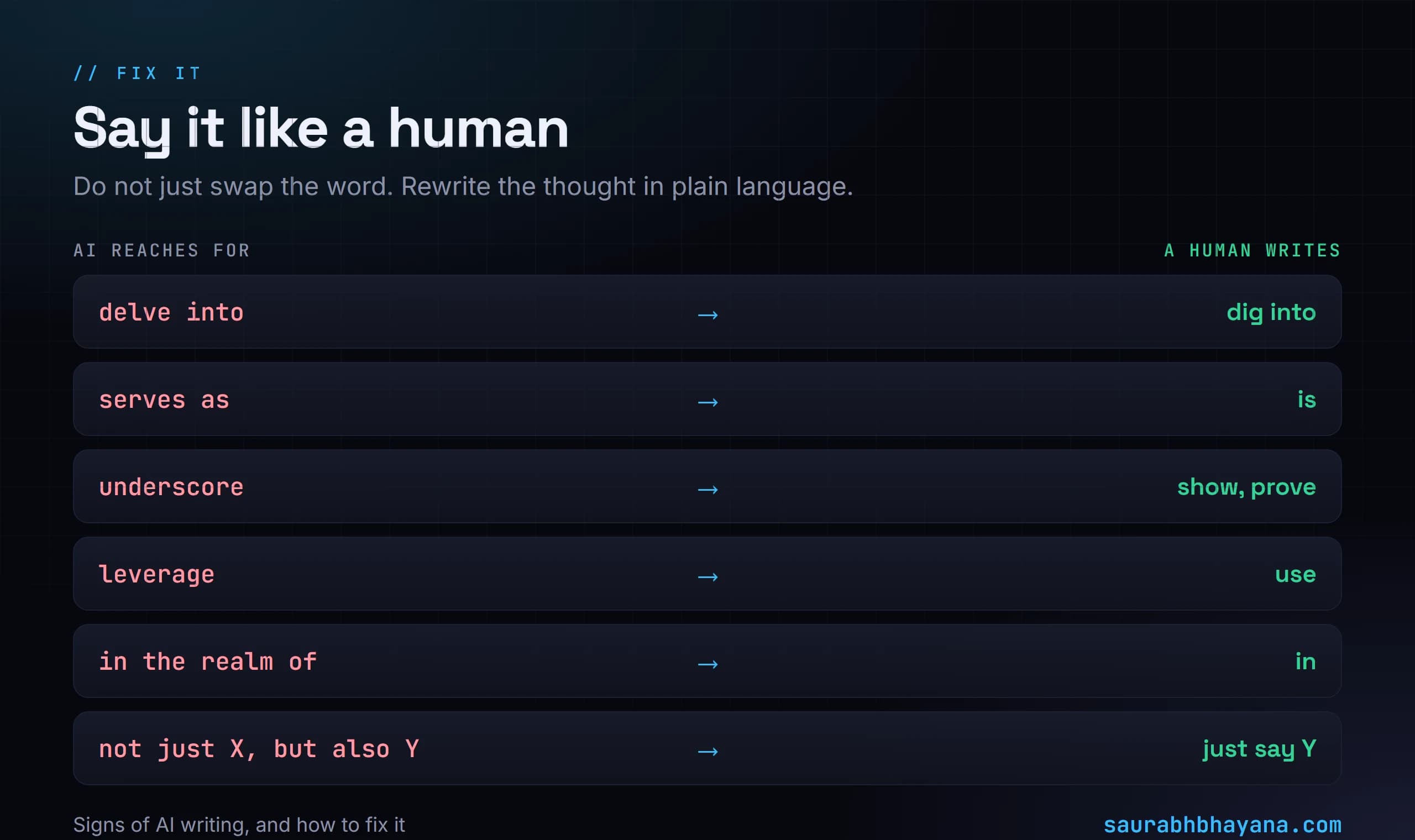
| AI reaches for | A human would write |
|---|---|
| delve into | look at, dig into |
| underscore, highlight | show, prove |
| foster, cultivate | build, grow |
| leverage | use |
| seamless, robust | simple, reliable (or just say what it does) |
| in the realm of | in |
The fix is not a find-and-replace. Swapping delve for explore still leaves the sentence hollow. Rewrite the whole thought in your own plain words, as if explaining it to a friend.
Tell 3: Dodging the word is
AI avoids the plain copula. Instead of X is Y, it writes X serves as Y, X functions as Y, X stands as Y, X marks Y. The gallery serves as the group's exhibition space, rather than the gallery is the group's exhibition space. Real usage of is and are measurably dropped in AI-influenced text. The habit makes writing feel puffed up and strangely indirect.
The fix: when you can say is, say is. Directness reads as confidence. Inflation reads as filler.
Tell 4: Fake structure (rule of three, negative parallelism)
AI loves patterns that sound complete without being true.
- •The rule of three: listing exactly three things to sound thorough, whether or not three is the real number. Fast, reliable, and affordable. Innovative, scalable, and secure.
- •Negative parallelism: not just X, but also Y. It is not a tool, but a philosophy. This addresses a misconception the reader never had.
- •Contrast for its own sake: X rather than Y, less about A and more about B, applied where no contrast is needed.
The fix: list the real number of things, even if it is two or five. Drop the not just, but also frame unless you are genuinely correcting a belief the reader holds. Let the point stand without the rhetorical scaffolding.
Tell 5: The formulaic conclusion
One template shows up again and again: Despite its success, X faces challenges. Future prospects could... or In conclusion, X remains a vital... It is the shape of an ending without an actual ending. A human who has something to say closes with the thing they wanted you to remember, not a hedge about the future.
The fix: end on your actual point. What is the one thing you want the reader to do or believe? Say that, and stop.
Tell 6: Promotional tone in neutral writing
AI slips into brochure language even when nothing is being sold: vibrant, nestled, rich heritage, groundbreaking, renowned, bustling, must-visit. A neutral explainer suddenly reads like a travel ad. Vague attributions do the same job with false authority: industry reports suggest, experts argue, observers have noted, studies show, with no study, expert, or observer ever named.
The fix: strip the travel-brochure adjectives, and either name the source or drop the claim. Experts argue with no expert is weaker than a plain statement in your own voice.
Tell 7: Formatting and leftover artifacts
The surface layout gives it away too:
- •Em dash overuse, dashes everywhere instead of commas, colons, or full stops.
- •Emoji used as bullet points or section markers.
- •Title Case On Every Heading, and an Awards and Recognition section that almost no human writes.
- •Curly smart quotes pasted into plain-text contexts, or Markdown pasted where it does not belong.
- •Leftover tool artifacts: oaicite, contentReference, cite: 1, turn0search0. If these ever appear in published text, it was pasted straight from a chatbot without reading it.
The fix: read the whole thing before publishing, out loud if you can. Most of these die on a single careful pass.
Why this matters for SEO in 2026
This is not just about taste. Google and AI answer engines are getting good at telling generic from genuine, and they reward the genuine. According to one large study, over 96 percent of pages get zero traffic from Google, and the ones that fail usually fail because they read like everything else. AI slop is the fastest way to land in that 96 percent.
The signs above are symptoms. The cure is the thing AI cannot fake, and it is the same thing that ranks: your real experience, specific numbers and outcomes, a clear opinion about what is overrated or wrong, and citing your own sources. Let a model handle the scaffolding and the first draft if you like, then add the layer only you can. That is what makes content stand out to a reader and to a search engine at the same time.
If you want the full playbook for content that ranks on Google and gets cited in AI answers, read my complete SEO and AI SEO guide for 2026, and my guide to getting cited by ChatGPT and Perplexity.
A quick self-check before you publish
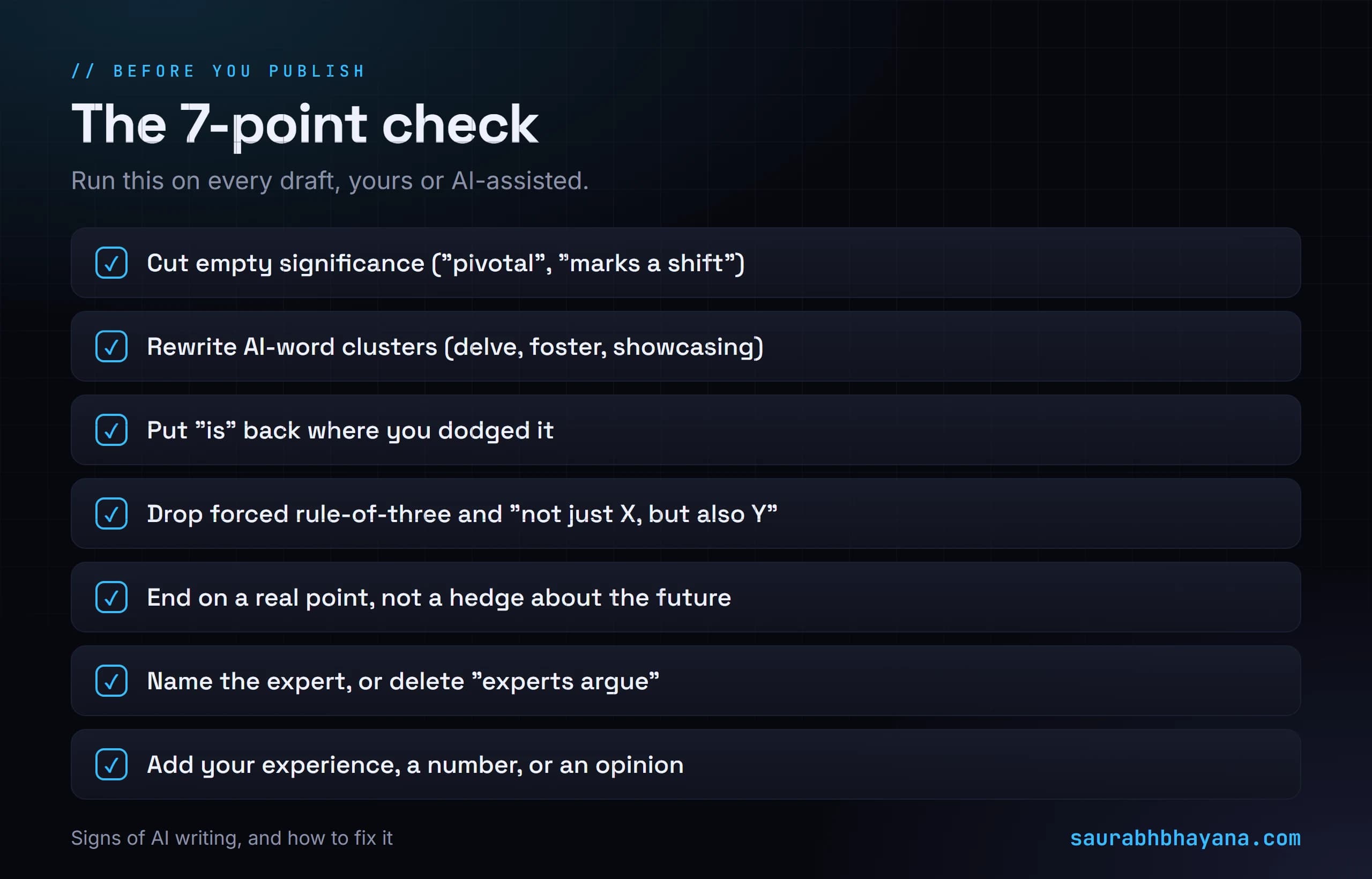
- 1.Did I make any empty significance claims (pivotal, marks a shift, rich heritage)? Replace with a concrete fact.
- 2.Are there clusters of AI words (delve, underscore, foster, showcasing)? Rewrite the thought, not just the word.
- 3.Did I dodge is with serves as or functions as? Put is back.
- 4.Any forced rule of three or not just X, but also Y? Cut the scaffolding.
- 5.Does it end on a real point, or a hedge about the future? End on the point.
- 6.Any vague experts argue with no expert named? Name it or drop it.
- 7.Did I read the whole thing and add my own experience, a number, or an opinion? If not, it is not finished.
Give this article to your AI as a rule set
Here is a useful trick. Instead of catching these tells by hand every time, hand the rules to the model up front. Paste the block below into ChatGPT, Claude, or Gemini before you ask it to write, or drop in a link to this page and tell it to follow the page. The model will draft in a plainer, more human voice from the first line, and you will have far less to clean up.
Follow these writing rules for everything you draft. They come from the signs of AI
writing, and the goal is prose that reads like a specific human wrote it.

1. No empty significance. Never write pivotal moment, marks a shift, plays a crucial
   role, stands as a testament, rich heritage, or reflects broader trends. State the
   concrete fact instead.
2. Avoid the AI vocabulary: delve, underscore, intricate, foster, showcasing,
   leverage, seamless, robust, realm, tapestry, cultivate. Use plain words (use, show,
   build, look at).
3. Use the word "is". Do not replace it with serves as, functions as, or stands as.
4. No forced rule of three. List the real number of items, even if it is two or five.
5. No "not just X, but also Y" unless you are genuinely correcting a belief the reader
   holds.
6. End on the actual point, not a hedge like "Despite its success... Future prospects
   could..." or "In conclusion, X remains vital."
7. No promotional adjectives in neutral writing (vibrant, nestled, renowned,
   groundbreaking, must-visit). No vague authority (experts argue, studies show) without
   naming the source.
8. No em dash overuse, no emoji bullets, no Title Case On Every Heading, and never leave
   tool artifacts like oaicite or cite: 1.
9. Prefer short, direct sentences. Vary sentence length. Write like you are explaining it
   to one smart friend.
10. Add specifics wherever possible: real numbers, concrete examples, a clear opinion.
That rule set does most of the work before a single word is written. It is the same checklist above, just given to the machine instead of applied after the fact.
Where this fits in a real workflow
In practice, the winning workflow is not human-only or AI-only. It is AI for speed on the scaffolding and the boring parts, then a human layer on top: the rule set above so the draft starts clean, and your own experience, numbers, and opinion so the finished piece is worth reading. When I build content systems and SEO tooling around this idea, whether that is my own projects or the automation I ship at wptaskify, the pattern is always the same. Let the model draft, keep a human in the loop for judgment, and never publish anything you did not read. That is the whole difference between content that gets buried and content that ranks.
Frequently asked questions
What are the most common signs of AI writing?+
Empty significance (pivotal moment, marks a shift), a recognisable vocabulary (delve, underscore, foster, showcasing), avoiding the word is in favour of serves as or functions as, forced rule-of-three lists, not just X but also Y constructions, formulaic conclusions, promotional adjectives in neutral text, and formatting tells like em dash overuse and leftover artifacts such as oaicite.
Can you reliably detect AI writing?+
Not with certainty. Detection tools have high error rates, humans guess correctly only about 60 percent of the time, and human writing is drifting toward AI patterns anyway. The signs are a smell test that flags potential problems, not proof. The real issue is whether the content is shallow and generic, not whether one word appears.
How do I make AI-assisted content sound human?+
Do not just swap words. Add what AI cannot fake: your real experience, specific numbers and outcomes, a clear opinion about what is overrated or wrong, and citations of your own sources. Use AI for the scaffolding and first draft if you want, then rewrite in your plain voice and cut the empty significance, the forced lists, and the hedged conclusions.
Does AI content hurt SEO?+
Generic AI content does. Over 96 percent of pages get no Google traffic, and they usually fail because they read like everything else. Google and AI search reward specific, genuinely useful content and bury generic slop. AI-assisted content is fine; AI-slop content is the problem.
Is using an em dash a sign of AI?+
Overusing em dashes is a common formatting tell, because AI models scatter them where a comma, colon, or full stop would do. A single em dash is not a sign of anything. The tell is a cluster of them replacing normal punctuation throughout a piece.
What are leftover AI artifacts like oaicite?+
These are internal tokens that leak from chatbots into pasted text, such as oaicite, contentReference, cite: 1, or turn0search0 from ChatGPT, and similar strings from Gemini, Grok, and Perplexity. If they appear in published content, the text was copied straight from a chatbot without anyone reading it, which is the clearest possible sign of unedited AI output.
How do I tell ChatGPT or Claude to avoid these AI writing patterns?+
Give the model the rules up front instead of fixing them after. Paste a rule set before you ask it to write, or share a link to a guide like this one and tell it to follow the page. The core rules are: no empty significance, avoid the AI vocabulary (delve, underscore, foster), use the word is, no forced rule of three, no not just X but also Y, end on a real point, name your sources, and add specific numbers and a clear opinion. The model then drafts in a plainer, more human voice from the first line.
Read next
I build fast, SEO-ready sites and rank them on Google and AI search. Or join my free community and grow alongside other website owners.