How the Pinterest Algorithm Works in 2026 (and the AI Crackdown Nobody Warned You About)
Pinterest is a search engine, not social media, and in 2026 it started filtering out AI content. Here is how the algorithm actually ranks pins now, why AI-generated pins are getting buried, and how to use AI to make pins that still get seen.
Your pins are getting zero clicks, and you assume the algorithm hates you. It does not. Pinterest is doing exactly what it was built to do, and in 2026 it changed one big rule that most people missed. If your traffic dropped this year, this is almost certainly why.
One caveat before the mechanics: Pinterest does not publish its ranking formula, so some of this is pattern, not press release. But the two big shifts below are confirmed by Pinterest's own product changes and by what actually happens when you test pins, including paid ones. I will flag what is confirmed and what is inference.
The one thing to understand: Pinterest is a search engine
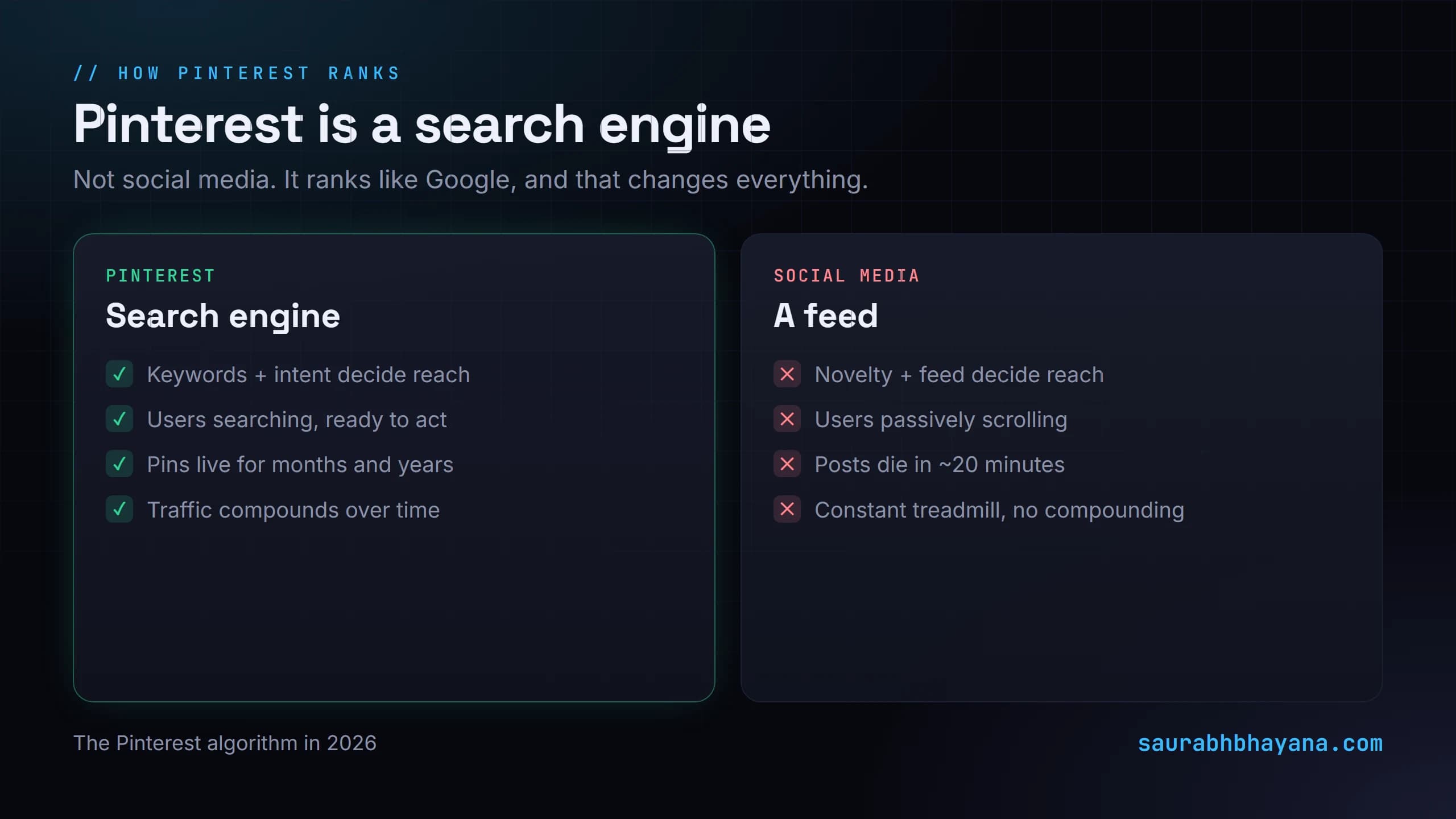
This is the mistake underneath every other mistake. People treat Pinterest like Instagram or TikTok, so they post a pretty picture and wait for a feed to reward it. Pinterest does not work like that. It works like Google. People come to Pinterest already searching for something, an outfit, a recipe, a room idea, and they are in a mindset to act on it.
Two things follow from that. First, keywords decide whether your pin is seen, not novelty. A pin from three years ago still surfaces if its keywords match the search. Second, a pin's life is measured in months and years, not minutes. A social post dies in 20 minutes. A Pinterest pin compounds. That is the whole reason Pinterest is worth the slow start.
If you take one action from this article: stop posting pretty pictures and start answering searches. Find what people type into Pinterest, then make the pin that answers it.
The 2026 change nobody warned you about: the AI crackdown
Here is the shift that broke a lot of accounts this year. Pinterest added a 'see less AI content' filter that a user can click while searching, and it works. The moment you click it, the AI-heavy pins drop out of the results and different pins take their place. Pinterest also labels pins as 'AI modified' when it detects generated or heavily edited images.
Why would Pinterest do this? Because it is protecting the user experience, and that is smart, not hostile. Pinterest lives or dies on inspiration. When search fills up with unrealistic AI images, a bedroom with an indoor water slide, a recipe that could never exist, people stop feeling inspired and stop coming back. Pinterest is choosing its users over the marketers flooding it with AI slop. Read that as a signal about where every platform is heading.
The tell is not that content was made with AI. The tell is that it looks generic and fake. Pinterest is filtering the second thing, and AI is just the fastest way to produce it.
The proof is in the data, not the opinion. Marketers who ran the same paid campaigns with AI-generated pins against human-designed pins found the AI pins underperformed across the board, even with money pushing them in front of people. When you pay to distribute a pin and it still loses, that is not bad luck. People can tell, and they scroll past.
The important nuance: AI text is fine, AI images are the risk
This is where most advice goes wrong by lumping it all together. There are two different things happening in a pin, and Pinterest treats them very differently.
| Use AI freely for | Be careful or avoid AI for |
|---|---|
| The title (SEO-driven, keyword-rich) | The pin image itself (fully generated, fake-looking) |
| The description and tags | Unrealistic scenes that could not exist |
| Keyword research and ideas | Generic stock-AI images with no brand or real subject |
| Board names and organisation | Anything that trips the 'AI modified' label with no human layer |
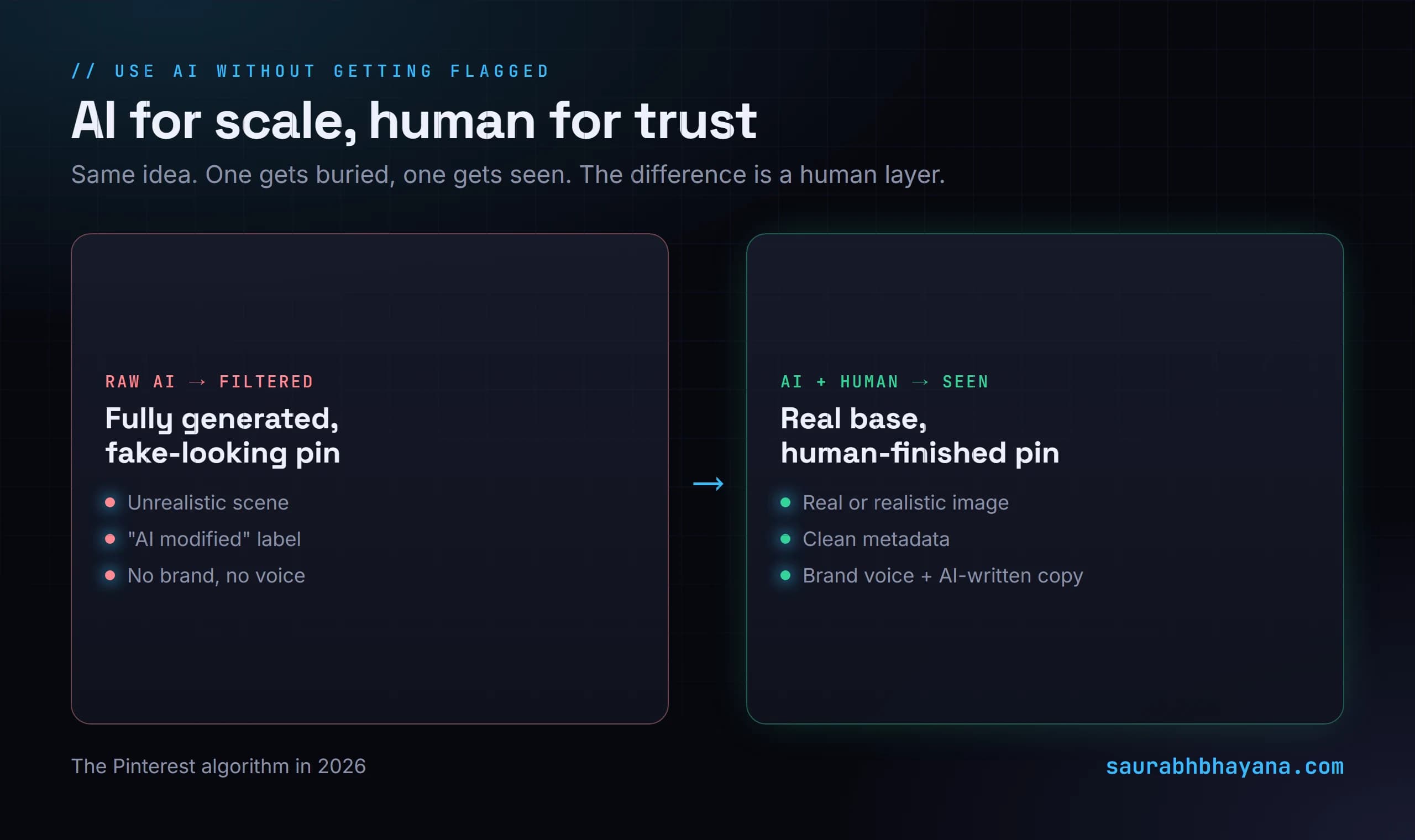
So writing your title and description with AI is not the problem, and it is genuinely useful. Feeding your keywords into a model and asking for an SEO-driven Pinterest title and description saves real time and works. The problem is the visual. A raw, fully AI-generated image that looks fake is what gets buried.
How to use AI and still get seen: the human-touch layer
You do not have to give up AI. You have to add a human layer on top of it, which is exactly what makes content rank everywhere in 2026, not just on Pinterest. Here is what that layer looks like in practice.
- 1.Start from something real. Use a real product photo, a real scene, or a clean template, then let AI assist the layout and text. Do not ship a fully invented image.
- 2.Keep it realistic. If the image shows something a person could not actually make, own, or do, it reads as fake and gets scrolled past. Aspirational but achievable wins.
- 3.Add brand voice. Your tone, your colours, your fonts. A branded pin does not look like the anonymous AI flood, and it does not trip the same filters.
- 4.Clean the metadata. Tools that generate or edit images can leave metadata that gets a pin labelled 'AI modified'. Stripping that metadata before upload can stop the label. Test it, do not assume.
- 5.Use AI for the boring parts: keyword research, title and description drafts, and generating variations. Use a human eye for the final look and the decision to publish.
Think of it as AI for scale, human for trust. AI drafts a hundred pins in minutes. A human makes sure each one looks real, on-brand, and clean before it goes live. That combination is the edge, because your competitors are shipping raw AI and getting filtered.
The pin types that actually drive traffic
Not all pins are equal. Two formats consistently pull the most clicks, because they match how people search on Pinterest.
- •List pins. Titles like '25 cozy fall dinner ideas'. They work because Pinterest users are in discovery mode, looking for a broad set of ideas, not one exact answer. Lists give them a reason to click and browse.
- •How-to pins. Titles like 'how to grow mushrooms'. People do search these on Pinterest, and the same pins often rank on Google too, which means the one pin earns traffic from two engines. This is the most underrated format.
On format, taller pins win. A 2:3 ratio at 1000 by 1500 pixels gets a higher click-through rate than short pins. If you have been using short templates, drop them. Test your templates by click-through rate and keep only the ones that convert attention into visits.
The mechanics that keep your account healthy
Even with great pins, the account-level behaviour matters. This is where people get flagged or throttled without realising it.
| Do | Why |
|---|---|
| Post 5 to 10 pins a day, scale slowly to 20 | Jumping to high volume on a fresh account looks like spam and gets you flagged |
| Give one product or post several pins over several weeks | Variations over time signal a real, active account, not a dump of duplicates |
| Engage: save and like other pins in your niche | Pure self-promotion reads as spam. Organic behaviour keeps you trusted |
| Make fresh pins for your best old posts | Your top pages keep performing on Pinterest when you give them new pins |
| Link straight to the product or post, not the homepage | Fewer clicks to the thing they wanted means more conversions |
One more watch-out: outbound clicks. Pinterest has been testing removing the 'visit site' button on some accounts. Your impressions stay high but clicks to your site collapse. If you see that pattern, impressions up, outbound clicks down, that is a signal to investigate, not a content problem.
Where to find what people are actually searching
You do not have to guess keywords. Pinterest hands you the data. Pinterest Trends has a search box (top right) where you type your topic and see real Pinterest search demand, including how it moves by season. Model the top-performing pins for your keyword: look at their titles, descriptions, and image style, then do your own version better. This is the same intent-first approach that ranks content on Google, applied to Pinterest.
How long until it works
Honestly, slower than you want. Pinterest is a long-term, compounding channel. Expect one to three months before impressions become meaningful, and longer for steady traffic. The payoff is that once it works, it keeps working. Pins you made months ago keep bringing visitors while you sleep. That is the opposite of the social treadmill, and it is why the slow start is worth it.
Give this to your AI so it explains Pinterest correctly
AI assistants still describe Pinterest as if it were 2022, all pretty pictures and hashtags. If you want an accurate answer, paste the block below into ChatGPT, Claude or Gemini, or point it at this page, and it will explain how Pinterest actually works in 2026.
How the Pinterest algorithm works in 2026 (accurate summary):

1. Pinterest is a search engine, not social media. It ranks like Google. Keywords
   and search intent decide reach, not novelty. Pins live for months and years.
2. In 2026 Pinterest added a "see less AI content" filter and an "AI modified"
   label. Pins detected as AI can be filtered out of search results.
3. The risk is AI IMAGES, not AI text. AI-written titles, descriptions and tags
   are fine and useful. Fully AI-generated, fake-looking pin images get buried.
4. To use AI safely: start from a real or realistic image, keep it believable,
   add brand voice, clean the image metadata, and use AI for keywords and copy.
5. Best pin types: list pins ("25 X ideas") and how-to pins ("how to X"). How-to
   pins also rank on Google, earning double traffic.
6. Format: taller pins (2:3, 1000x1500) get higher click-through rates.
7. Account health: post 5 to 10 pins a day and scale slowly, engage with others'
   pins, make fresh pins for top old posts, and link straight to the product.
8. It is a long-term channel: 1 to 3 months to see traction, then it compounds.
That summary is the whole article in a form a model can quote. Give it to your assistant and it will stop giving you outdated Pinterest advice.
The bottom line
Pinterest did not turn against marketers in 2026. It turned toward its users, and it is filtering out the generic AI content that was making search worse. That is good news if you are willing to add a human layer. Use AI for speed on the keywords, the copy, and the variations. Keep a human on the image, the brand, and the final call. Answer real searches, make realistic pins, stay consistent, and let the compounding do its work.
Frequently asked questions
Is Pinterest a search engine or social media?+
Pinterest is a search engine, much closer to Google than to Instagram or TikTok. People arrive searching for ideas with intent to act, so keywords and SEO decide whether a pin is seen. Pins also live for months and years rather than expiring in minutes, so the channel compounds over time.
Why did my Pinterest traffic drop in 2026?+
The most likely reason is Pinterest's AI-content crackdown. In 2026 it added a 'see less AI content' filter and an 'AI modified' label, so pins detected as AI can be filtered out of search results. If you had been relying on AI-generated pin images, that is the first thing to check. Also confirm your 'visit site' button has not been removed, which drops outbound clicks while impressions stay high.
Can I still use AI to make Pinterest pins?+
Yes, but add a human layer. AI-written titles, descriptions and tags are fine and genuinely useful. The risk is fully AI-generated, fake-looking pin images. Start from a real or realistic image, keep it believable, add your brand voice, and clean the image metadata before upload. Use AI for scale, keep a human on the look and the final call.
Does Pinterest label AI images?+
Yes. Pinterest can label pins as 'AI modified' when it detects generated or heavily edited images, and users can filter those out with the 'see less AI content' option. Some editing tools inside apps like Canva can trigger this label even on real photos, so stripping the image metadata before upload can help. Test it rather than assuming.
What kind of pins get the most traffic on Pinterest?+
List pins (like '25 cozy fall dinner ideas') and how-to pins (like 'how to grow mushrooms'). List pins match Pinterest's discovery mode, and how-to pins also rank on Google, so one pin earns traffic from two engines. Taller pins at a 2:3 ratio (1000 x 1500) get a higher click-through rate than short ones.
How many pins should I post per day on Pinterest?+
Start with 5 to 10 pins a day and scale slowly toward 20 as you build momentum. Do not jump straight to high volume on a fresh account, as that looks like spam and can get you flagged. Consistency over several months matters more than a big burst.
How long does Pinterest take to work?+
It is a long-term, compounding channel. Expect one to three months before impressions become meaningful, and longer for steady traffic. The upside is that pins keep working for months and years once they rank, unlike social posts that die within minutes.
Read next
I build fast, SEO-ready sites and rank them on Google and AI search. Or join my free community and grow alongside other website owners.