The Complete SEO and AI SEO Guide for 2026 (Beginner Friendly)
Everything you need to rank on Google and show up in AI answers in 2026, even if you are a complete beginner: how search works, search intent, the keyword sweet spot, topic clusters, content that ranks, on-page SEO, backlinks, technical SEO, AI search, and a 30-day action plan.
This is a long one, so bookmark it and read it in a few sittings if you need to. By the end you will understand how to get your website ranking on Google and showing up inside AI answers in 2026, even if you are starting from zero. I close with a 30-day action plan so you know exactly what to do when you finish reading.
First, is SEO even worth it in 2026?
Let us address the elephant in the room. AI chatbots answer questions now. AI Overviews are taking over the top of Google. Everywhere you look someone is announcing that SEO is dead, for real this time. It is a fair worry, so here are the facts.
- •Google still processes billions of searches every single day, and that number grew, it did not shrink.
- •Google sends far more traffic to websites than ChatGPT does. It is not close.
- •The AI assistants are built on top of traditional search infrastructure. ChatGPT leans on Bing's index. Perplexity runs its own crawler but still leans heavily on the same index underneath.
So the AI assistants are crawling the same pages that already rank in traditional search. If your site does not show up in Google or Bing, there is a good chance it is invisible to AI assistants too. SEO is not competing with AI search. It is the foundation AI search is built on. Learning SEO now means learning to show up everywhere.
What SEO actually is
SEO has historically meant search engine optimisation. A better definition for today is search everywhere optimisation: getting your website to show up wherever people search for things related to your business or the solutions you provide. That is it. Everything else is details, and there are a lot of details.
How Google works in three steps
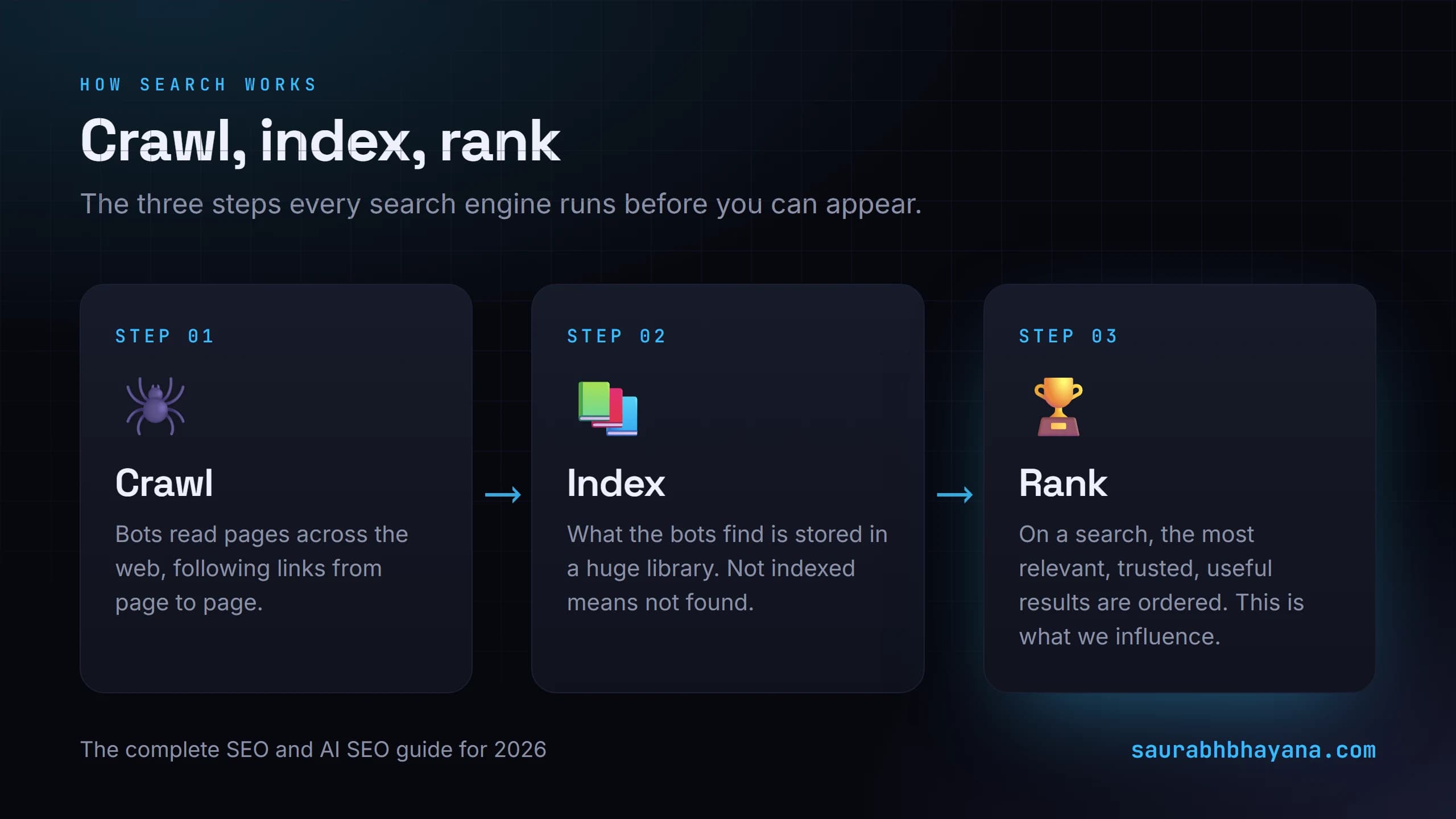
- 1.Crawl. Google sends automated bots to read pages across the web, following links from page to page and reading everything they find in the code.
- 2.Index. Google stores what those bots find in a massive library called the index. If your page is not in the index, it cannot show up in results. Simple as that.
- 3.Rank. When someone searches, Google looks through its index and picks the results it thinks are the most relevant, most trustworthy, and most useful. The order it puts them in is the ranking, and that is what we are trying to influence.
A modern results page is no longer ten blue links. At the top you might see an AI Overview, Google's AI summarising an answer directly. Below that are sponsored ads, then the organic results you earn through SEO, plus People Also Ask boxes, video carousels, a local map pack for location searches, and knowledge panels. Your strategy has to reflect that reality.
Why SEO matters for the business, not just the traffic
You should not have an SEO goal. You should have a business goal: more customers, more revenue, more leads. SEO is one of the most reliable ways to get there because you reach people at the exact moment they are looking for what you sell. Compare it to scrolling social media and seeing an ad. That ad interrupts you. Someone searching best proposal software for agencies is actively looking for a solution right now. The difference is intent, and intent is what makes SEO so valuable.
Throughout this guide I will use three example businesses so the advice stays concrete: a SaaS company that sells proposal software, an e-commerce brand that sells specialty coffee, and a managed cybersecurity platform that protects small and mid-sized businesses. The mindset and workflow are the same for all three, but the decisions change completely depending on the business. That is the whole point.
Chapter 1: Mastering search intent
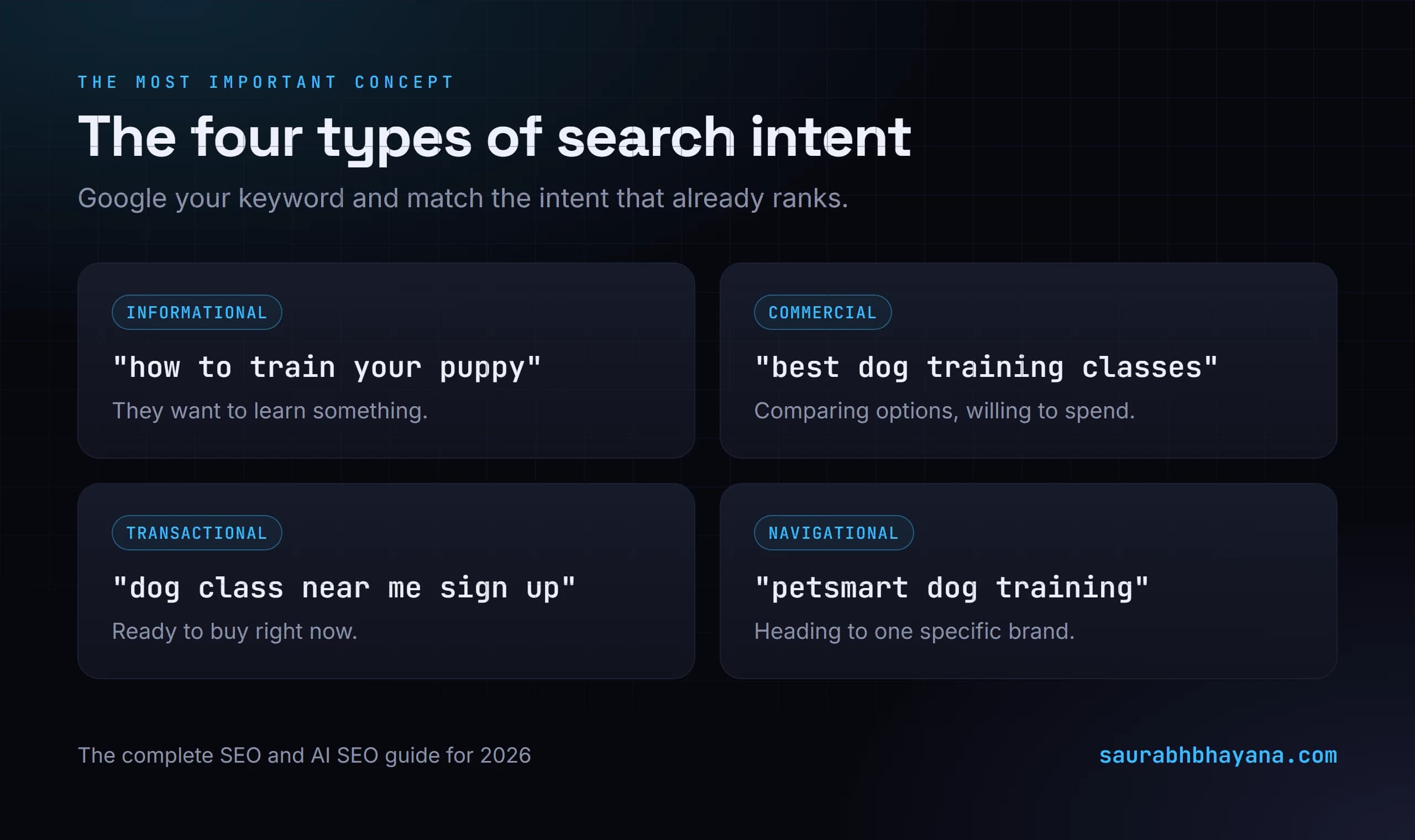
Before any tools or tactics, understand the single most important concept in SEO: search intent. Every time someone types something into Google they want something specific. Your job is to figure out what that is and give it to them. There are broadly four types of intent.
| Example keyword | Intent type | What they want |
|---|---|---|
| how to train your puppy | Informational | To learn something |
| best dog training classes | Commercial | Comparing options, willing to spend |
| dog training class near me sign up | Transactional | Ready to buy right now |
| petsmart dog training | Navigational / branded | To reach a specific brand |
How do you figure out the intent for your own keyword? Simple: google it and look at what is ranking. The top results are Google telling you exactly what the searcher wants. Google already did the research. Your job is to match that intent and then do it better than anyone else. By the way, SERP just means search engine results page.
Short keywords are a trap
Rule of thumb: the shorter the keyword, usually the more competitive, higher volume, and less useful it is. Take coffee. Hundreds of thousands of searches a month, but Google has no idea what you want, so the results are a mess of shops, definitions, news, and brands, with every major site competing. Now try best dark roast coffee beans for espresso. Lower volume, maybe a few hundred a month, but the intent is crystal clear and the competition is a fraction of what coffee attracts.
These longer, more specific phrases are called long-tail keywords. Individually they have lower volume, but the intent is focused, the competition is manageable, and together they can send a respectable amount of traffic. If your site is newer, this is where you start. You build authority on the long tail and then work your way up to the big terms as the business requires.
Do this now. Open a new tab and google your main keyword, the thing you most want customers to know you for. Look at the top results. Blog posts? Product pages? Tools? YouTube videos? That is the intent, and you will need it later in this guide.
Intent in the AI era
AI Overviews are not just for informational queries anymore. Google's AI now summarises across commercial and transactional searches too. That means even when someone is comparing products or ready to buy, Google might answer them before they click a single link. This is zero-click search, and it has consumers making entire buying decisions outside your brand's ecosystem. So your content has to go deeper than whatever the summary covers to earn the click. Surface-level content will not cut it anymore.
Chapter 2: Finding the right keywords
A keyword is just the phrase someone types into Google. It can be one word or twenty. Your job is to figure out which phrases matter for your business and then build pages that rank for them. But not all keywords are worth targeting. I judge each one against a framework I call the keyword sweet spot, four attributes that make a keyword worth your time.
| Attribute | The question to ask |
|---|---|
| Demand | Are people actually searching for this? Ranking number one for something nobody googles has little benefit. |
| Fit | Where does it sit in your funnel, and is it relevant to what you sell and who you serve? |
| Intent | What does the searcher actually want, and can you satisfy it? If the SERP is full of videos, you may need to make a video. |
| Difficulty | Can you realistically rank given your current authority? A brand new site will not outrank Amazon for running shoes, but it might for best running shoes for flat feet in winter. |
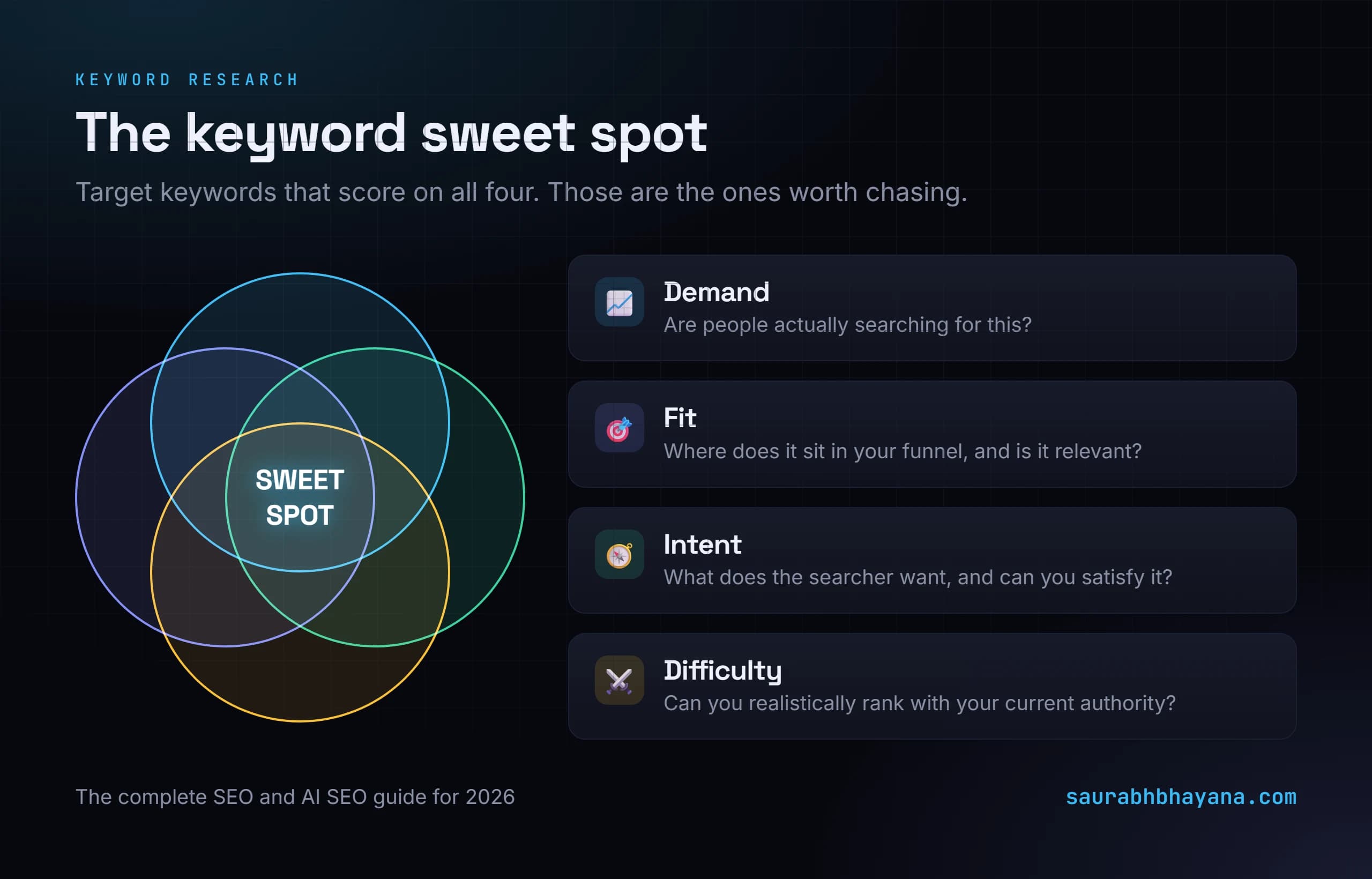
You will not always find keywords that score highly on all four. When you do, prioritise them hard. But even keywords that look wrong at first can be brilliant if you understand where they sit in the funnel.
Two examples that look wrong but are not
The proposal-software company ranks for contract template, a term with roughly 300,000 searches a month. Nobody searching that is buying proposal software today. Conventional wisdom says skip it. But their template directory drives hundreds of thousands of visits, and the play is this: free template download, then email capture, then a nurture sequence, then a product signup. That top-of-funnel keyword feeds the entire pipeline. It is not a bad keyword. It is a top-of-funnel keyword with a plan for what happens next.
The coffee brand ranks for pour over coffee, around 34,000 searches a month, with a brew guide on their blog rather than a conversion page. They also rank for pour over coffee ratio, cold brew ratio, and coffee brewing methods, all educational. They became an authority in specialty coffee through tutorials, built trust, and the product sales followed.
A keyword without a conversion path is just wasted traffic. A keyword with a conversion path can be an automated pipeline for your business.
The three-part keyword workflow
Keep it organised as three separate disciplines.
- 1.Ideation: gather raw ideas.
- 2.Validation: check volume, difficulty, fit, and intent, and decide what to target first.
- 3.Clustering: group keywords that belong together so you can plan pages, not one-off posts.
For ideation, you have more free sources than you will ever need. Google Search Console is by far the best because it shows exactly what people already search to find your site, straight from Google's own data. Beyond that: Google autocomplete suggestions, People Also Ask boxes, the People Also Search For section at the bottom of results, the subreddits where your customers describe their problems in their own words, and asking an AI assistant to give you 30 questions someone would ask before buying your product category. You can even paste your sitemap into an AI tool and ask it to find content gaps, then paste a competitor's sitemap and see what they cover that you do not. If you want a step-by-step walkthrough, I wrote a whole guide on free keyword research without paid tools.
Validation used to take days. The same AI technology people think is killing SEO has made validation and clustering dramatically faster, so it now takes minutes. The point of validation is to stop you drowning: a giant spreadsheet of unfiltered keywords does you no good. Clustering then groups keywords that are topically related or that Google treats as meaning the same thing, so you write one strong page per cluster instead of ten thin ones.
Chapter 3: Prioritise so you do not get paralysed
Even after clustering you will have more ideas than time. This is where most people freeze. The fix is a dead-simple order: start at the bottom of the funnel and work upward.
Step 1: Money pages first
Money pages directly convert: product pages, service pages, pricing pages, feature pages. Their keywords are usually transactional or commercial, like proposal software for agencies, buy espresso beans online, or cybersecurity assessment services. These pages are the foundation the whole site is built on. A common mistake is to start with high-level blog posts because they have volume, publish ten informational articles, and then wonder why nobody buys. Nobody buys because there was nowhere compelling for that traffic to convert.
Step 2: Build one topic cluster fully
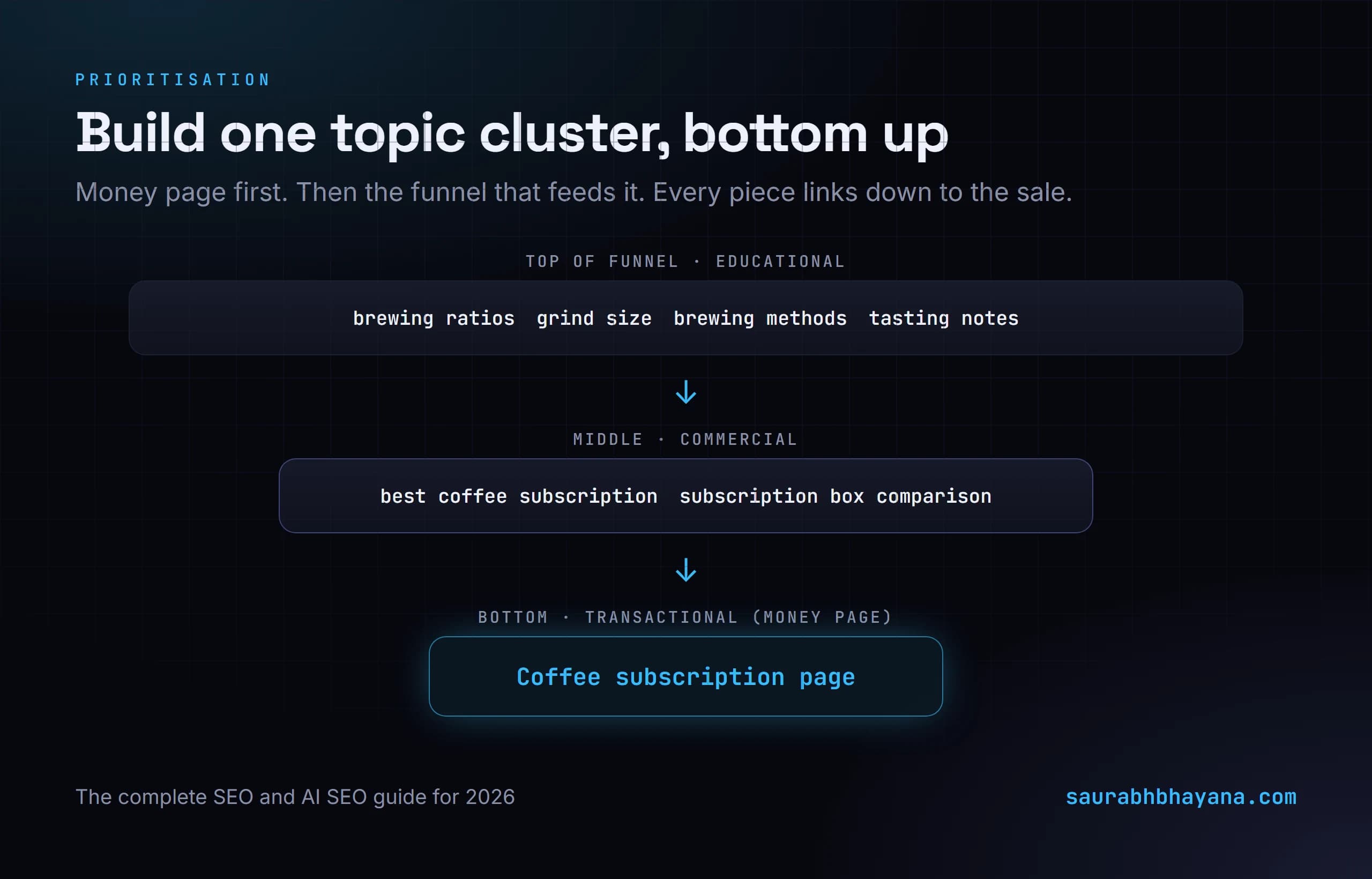
Once your money pages exist, do not scatter across ten topics. Pick one cluster that connects to a money page and build the full funnel for it, bottom to top. Take the coffee brand's subscription page, which already ranks for coffee subscription. The funnel looks like this:
- •Bottom (transactional): the subscription page itself, which is what converts.
- •Middle (commercial): pieces like best coffee subscription or coffee subscription box comparison, where someone is weighing options, each linking back to the subscription page.
- •Top (educational): the brewing basics series covering ratios, methods, grind size, tasting notes, and single-origin coffee.
Every piece feeds the one below it and internally links to related posts, forming a traffic-generating web we call a topic cluster.
Step 3: Repeat cluster by cluster
Finish one cluster before starting the next. It is tempting to sort all keywords by low difficulty and high volume and plug away down the list, jumping between unrelated topics. That spreads you thin and prolongs the time to results, because Google does not evaluate a page in isolation. When someone searches how to prevent ransomware attacks, Google checks whether your site also covers what is ransomware, signs your network has been compromised, and an incident response checklist. Those all live in the same funnel: the same person at different stages of the same problem.
The more comprehensively you cover a topic cluster, the easier it becomes to rank for every keyword in it, including the very competitive ones. SEOs call this topical authority.
Chapter 4: Creating content that ranks
You have keywords, clusters, and a plan for which funnel to target first. Now create content that actually ranks. Tackle it in four phases: research, structure, write, and optimise.
Research: read the competition
Before you write a word, open the top five results for your target keyword and read all of them. It is tedious. Do it anyway. You are looking for four things:
- •What topics they all cover. Those are table stakes, you have to cover them too.
- •What they missed. That gap is your opportunity.
- •The average length, as a benchmark. If every top result is a 3,000-word guide and you write 500 words, you are probably not comprehensive enough.
- •What unique angles anyone takes, which tells you where there is room to differentiate.
Do this manually for your first few pieces so you understand what any tool would later automate for you. After a couple of times you will feel exactly how tedious it is, and that is the point.
Structure: outline before you write
Do not skip the outline. Feed your research notes into an AI assistant like Claude or ChatGPT and ask it to draft an outline that matches the intent and covers the topic thoroughly. This one habit saves an enormous amount of grief later.
Write: let AI scaffold, add what it cannot
AI can genuinely write well now. The most effective approach is to let it handle the scaffolding, the basic definitions, the research, and the sentence flow when things get clunky. Then you add the layer AI cannot fake, because in a sea of AI slop, that layer is what stands out:
- •Experience: what actually happened when you tried the thing.
- •Opinion: what you think is overrated, underrated, or just plain wrong.
- •Original data: your results, your case studies, your conversations with customers.
- •Expert insights: interviews, quotes, proprietary knowledge. These can be sourced from podcasts, books, or scholarly journals, they do not all have to be yours.
- •Specific examples: real businesses, real numbers, real outcomes.
According to an Ahrefs study of about 14 billion pages, over 96% get zero traffic from Google. Most content fails not because it is terrible, but because it is the same as everything else. The bar is not just good. The bar is at least five times better than what already exists for that specific search. The human layer is your content moat, go where AI-spun content mills cannot or will not go. If you are not sure your draft reads human, check it against the signs of AI writing.
Chapter 5: On-page SEO checklist
On-page SEO is the per-page technical work that helps Google understand what a page is about. Shift from a creative mindset to a detail-oriented checklist. The same checklist applies to an educational guide and a money page, only the execution differs.
Title tag
The most important element. Include your target keyword, keep it under about 60 characters, and make it compelling enough to click. An educational page might use Ransomware Recovery Guide for Businesses, front-loading the keyword. A product page can be keyword-rich but benefit-driven, like Endpoint Detection and Response Built for Every Business, because it is selling, not just teaching.
Header tags
H1 is your page title, one per page, and it usually mirrors the title tag. H2s are your main sections, H3s are subsections. Use keywords naturally. Google and large language models both read this hierarchy to understand the structure and depth of the page, and it makes the content far easier for humans to skim and stay engaged. At the end of the day you are writing for human beings.
URL structure
Short, descriptive, and keyword-rich, like /cybersecurity-101/ransomware-recovery-guide or /platform/managed-edr. Compare that to a string of random letters and numbers some content systems output, which tells Google and the searcher nothing.
Meta description
The snippet under your title in results, around 150 to 160 characters. It is not a direct ranking factor, but it affects whether people click. Write it like ad copy: action-oriented, include the keyword, and tell the searcher exactly what they will get. If you want the deep version, I have a complete guide to meta tags for SEO.
Internal linking
Add contextual links inside your body copy to other relevant pages. This is how you connect the clusters from earlier, how Google discovers your content, and how it understands how your pages relate. Link educational pieces to each other and back to the money pages. Internal linking has one of the best effort-to-value ratios of any SEO tactic, so do not skip it in the rush to publish and move on.
Image optimisation
Descriptive file names, alt text that genuinely describes what the image shows, and compressed file sizes. The WebP format is great for this. Write alt text as if describing the image to a person who cannot see it, because people using screen readers depend on it. Reusing the same vague alt text on every image, like glitch effect, is a missed opportunity. Every image is a chance to tell Google what the page is about and to show up in image search.
Chapter 6: Link building
Backlinks are links from other websites to yours, and they act like votes of confidence. When a reputable site links to your content, Google reads it as a signal that your content is trustworthy and valuable. Not all links are equal: a link from a major industry publication carries far more weight than one from a random directory.
Link building is the hardest part of SEO, full stop. It is time-consuming, it often feels like cold outreach into the void, and the shortcuts eventually get you penalised. The most reliable approach is to create something genuinely worth linking to. Here are three practical tactics.
Tactic 1: Be the source
Create original data, original analysis, or original resources that journalists and bloggers want to cite. The coffee brand's brew guide is linked to by major sites and dozens of coffee blogs because it is the most thorough guide on the topic. The cybersecurity brand's research on ransomware gets cited by threat-intelligence teams and referenced on Wikipedia. Every business is sitting on knowledge other people would reference. Most just never publish it.
Tactic 2: Journalist query platforms
Sign up for a free service that connects sources with reporters, such as Source of Sources or a similar HARO-style platform. Journalists post queries when they need expert sources. You respond with quotes and insights, and when they publish, you earn a link. This is the most accessible tactic for beginners: about 15 minutes a day. It is a numbers game, so you might send 100 responses for one hit. Keep at it.
Tactic 3: Create linkable assets
Free tools, calculators, templates, and definitive guides become reference material for your industry, and people link to reference material because it makes their own content better. Thanks to AI coding tools, non-technical marketers can now build genuinely useful browser-based tools in minutes. A simple coffee-to-water ratio calculator, for example, could capture a low-difficulty keyword and earn links from every coffee blog that already references ratio guides.
If you are just starting out, do not obsess over links yet. Focus on publishing 10 to 15 great pieces first. Then start with journalist queries, because it is free and takes 15 minutes a day. Links compound over time. Your job right now is to build something worth linking to.
Chapter 7: Technical SEO without the rabbit hole
Technical SEO sounds intimidating, and on large enterprise sites it genuinely can be a mess. But if you run a small or medium business on a normal platform like WordPress, Shopify, Webflow, or even a custom setup, you are probably 90% of the way there already.
Instead of a long manual checklist, point a crawler at your site. Screaming Frog SEO Spider is free for up to 500 URLs. It crawls every page and hands you a prioritised list of technical issues: broken links, missing title tags, duplicate content, redirect chains, and images without alt text. It does in minutes what would take hours by hand.
One more thing. If you have a physical location like a store, office, or restaurant, there is a whole extra dimension called local SEO. The single most important move there is to claim your Google Business Profile, fill out every field, get as many reviews as possible, and respond to every review. That alone can put you in the map results when people search your category near me.
For most beginners, the technical stuff is not what is holding you back. What is holding you back is that you have not published anything yet.
Chapter 8: AI search, the new frontier
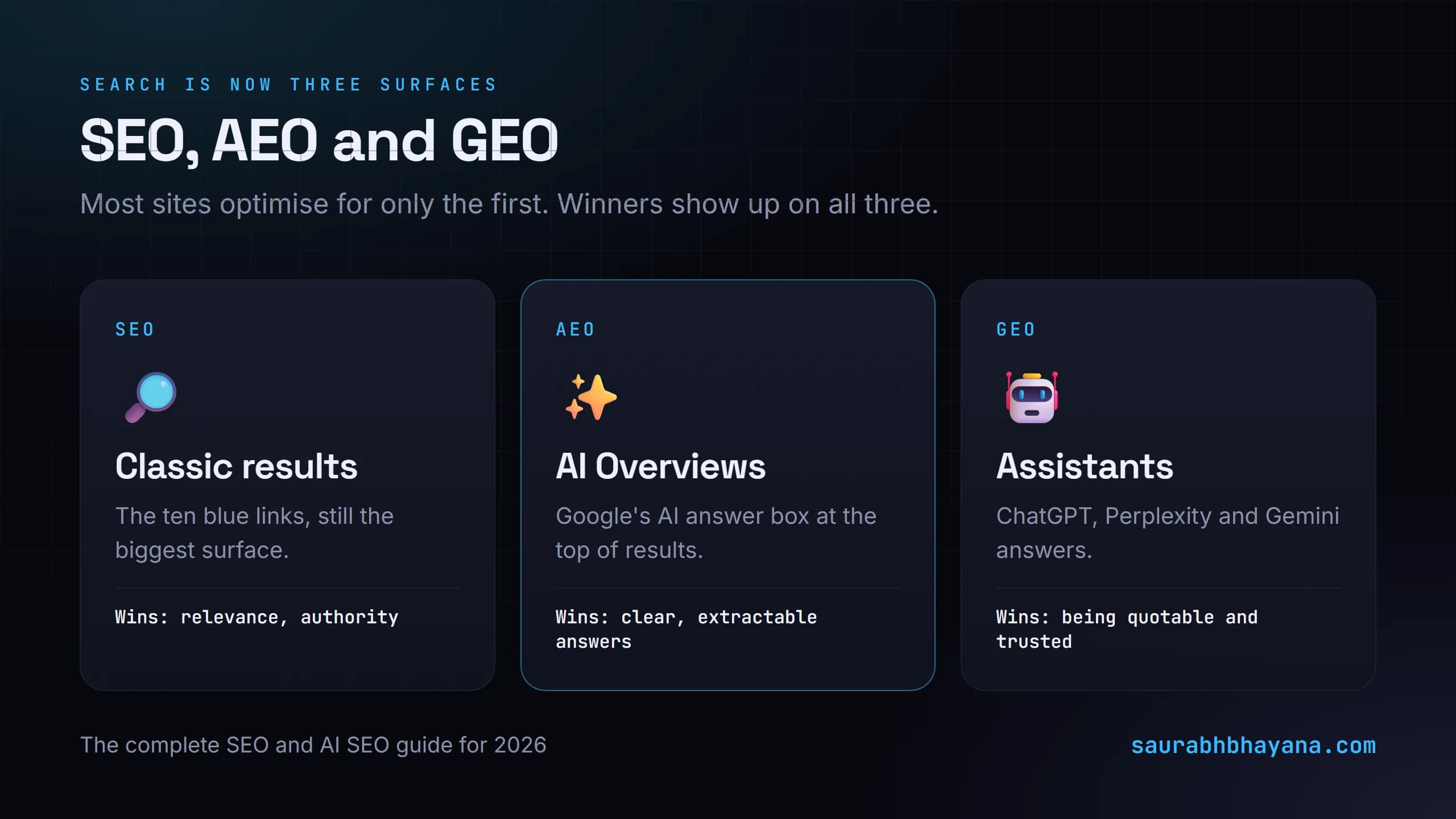
Everything above is SEO as it has existed for twenty years. Here is what changed. There is a second search surface now, made of assistants: ChatGPT, Gemini, Perplexity, Copilot, Claude, Grok, Google's AI mode, and whatever comes next. People are asking them for recommendations: what is the best CRM for small businesses, recommend a project management tool, what is the best way to learn SEO. These assistants answer conversationally and recommend specific brands and websites. If your business is not in those answers, you are invisible in an explosive new discovery channel.
Try this now. Open a fresh, incognito ChatGPT window and ask a question your target audience might ask during their buying journey, something likely to trigger a brand name. Whatever you see there is your AI competition. Incognito matters, because these tools can quietly personalise and feed you what they think you want to hear.
How AI assistants choose who to cite
Assistants do not present a ranked buffet of links. They synthesise information from across the web into one answer and cite sources they choose based on authority, relevance, and how clearly your content answers the question. The good news: the same things that help you rank in Google, authoritative content, clear structure, schema markup, and being cited by other sites, also help your AI visibility. Good SEO is the foundation for both. If you want the tactics specifically for getting cited by ChatGPT and AI search, I cover AEO and GEO in their own guide.
The tracking problem
Google Search Console cannot see traffic from ChatGPT or Perplexity. If someone finds you through an assistant, Search Console does not register the visit, and nobody has access to what people type into these tools because that data lives inside the AI companies. So you cannot track AI the way you track Google. What you can do is monitor whether your brand shows up when assistants answer questions in your space, using a tracker that runs queries across the major assistants and reports which brands get recommended and where competitors appear and you do not.
What actually gets you into AI answers
If you have been paying attention, you can already see where this goes.
- 1.Create comprehensive, authoritative content with clear subheadings and direct answers to specific questions. Large language models pull from content they can parse easily, which is exactly the well-structured content from Chapter 4.
- 2.Build topical authority through clusters. When your site covers a topic from every angle, the definition, the how-to, the comparison, the deep dive, AI models are more likely to recognise you as an authority.
- 3.Earn citations from other authoritative sources. AI models weight sources that trusted sites reference. Assistants especially favour best-of and roundup articles, so getting placed in those, or writing them yourself, increases your chances of being surfaced.
- 4.Check your AI visibility regularly, manually or with a tool. AI recommendations shift dramatically over time. The brands that track it adapt, the ones that do not wonder why competitors keep showing up.
AI search optimisation is not a separate discipline. It is what happens when you do the fundamentals well and pay attention to where the channels are heading.
Your 30-day action plan
Knowing is not doing, so here is a rapid-fire plan to turn all of this into action. You probably will not see results in 30 days, but you will have the foundation: the right keywords, optimised content, and a repeatable system.
Week 1: Foundation
- •Set up Google Search Console. It is free and essential.
- •Do keyword research and find 10 to 15 target keywords using the keyword sweet spot.
- •Analyse search intent for your top five keywords by googling each and reading the top results.
- •Identify your money pages: which pages directly convert visitors into customers, and do they exist yet?
Week 2: Your most important money page
- •Write and publish your single most important money page, or optimise an existing one.
- •Follow the content blueprint: research, structure, write, optimise.
- •Apply the on-page checklist: title, meta, headers, internal links, images.
- •Remember additional money pages are an ongoing priority, not a one-week sprint.
Week 3: Your first funnel
- •Pick one topic cluster connected to your money page.
- •Publish a mid-funnel or top-of-funnel piece that supports it.
- •Internally link it to your money page and other related pages.
- •If you already have content ranking on page two or three, updating it is often faster than writing from scratch.
Week 4: Promote and monitor
- •Start responding to journalist queries, about 15 minutes a day.
- •Check your AI visibility, manually or with a tracker.
- •Review Google Search Console for early signals: impressions rising even if clicks are not yet, new keywords appearing, positions trending from page five toward page three.
- •Plan your next cluster, not your next random topic.
The bottom line
That is SEO in the AI era. Find what people search for, create the best content for that search, and earn trust. The fundamentals have not changed in twenty years. What changed is that the same work now makes you visible in Google, in AI Overviews, in ChatGPT, and in Perplexity all at once. SEO is not competing with AI search. It is the foundation AI search is built on.
If you want to actually do this alongside other website owners instead of alone, that is exactly why I built Rank Together, a free community where owners in different niches swap genuine links, share daily SEO tips, and grow as a group. You can also try my free keyword research tool to find your first targets. Start with one money page this week. That already puts you ahead of most businesses spraying and praying with AI slop.
One last thing worth saying: ranking is only half the job. Traffic that lands and leaves does nothing for the business. Once search brings the right people in, you need a way to turn that attention into leads and customers, which is exactly what marketing funnels do.
Frequently asked questions
Is SEO dead in 2026 because of AI?+
No. Google still processes billions of searches a day and sends far more traffic than AI chatbots. The AI assistants are built on top of the same search index they crawl, so if you do not rank in traditional search you are likely invisible to AI too. SEO is the foundation AI search is built on.
What is the most important SEO concept for beginners?+
Search intent. Every search has a specific want behind it. Google your keyword, look at what already ranks, and that is Google telling you the intent. Your job is to match that intent and do it better than anyone else.
What is the keyword sweet spot?+
A framework for judging whether a keyword is worth targeting using four attributes: demand (are people searching it), fit (where it sits in your funnel and how relevant it is), intent (what the searcher wants and whether you can satisfy it), and difficulty (whether you can realistically rank given your authority).
What order should I create content in?+
Money pages first, because they are what convert and pay the bills. Then build one topic cluster fully from bottom of funnel to top. Then repeat cluster by cluster, finishing one before starting the next. Do not scatter across ten unrelated topics.
How do I show up in ChatGPT and Perplexity?+
Do the SEO fundamentals well: comprehensive, clearly structured content with direct answers, topical authority built through clusters, and citations from other authoritative sites. AI assistants cite sources they can parse easily and trust, which is the same well-structured content that ranks in Google.
How long until SEO shows results?+
Usually longer than 30 days. In the first month you build the foundation: the right keywords, optimised money pages, and a repeatable system. Early signals to watch in Search Console are rising impressions, new keywords appearing, and positions trending from page five toward page three.
Do I need paid tools to do SEO?+
No, especially to start. Google Search Console is free and is your best keyword source. Screaming Frog is free for up to 500 URLs for a technical audit. Free journalist-query platforms cover link building. Paid tools mainly save time on validation, clustering, and AI visibility tracking once you scale.
Read next
I build fast, SEO-ready sites and rank them on Google and AI search. Or join my free community and grow alongside other website owners.