Marketing Funnels Explained: The Complete Guide for Creators and Freelancers
If you do not understand funnels, you do not understand marketing. Here is the whole thing in plain language: what a funnel is, every term you will hear (lead magnet, squeeze page, upsell, tripwire, closer, DM funnel), and the four funnel types worth knowing, with how to build and test them.
Creatives and freelancers tend to dance around the one topic that actually makes them money: how selling really works. There is something in creator culture that makes it feel awkward to talk about sales mechanics. Throw that inhibition away. Understanding this stuff is not being sleazy, it is being competent, and the single most important concept to understand is the funnel.
This guide breaks down what a funnel is, every term you will hear in this world, and the main funnel types, so that whether you sell a service, an information product, or run an agency, you have a toolkit you can use for the rest of your career.
What a funnel actually is
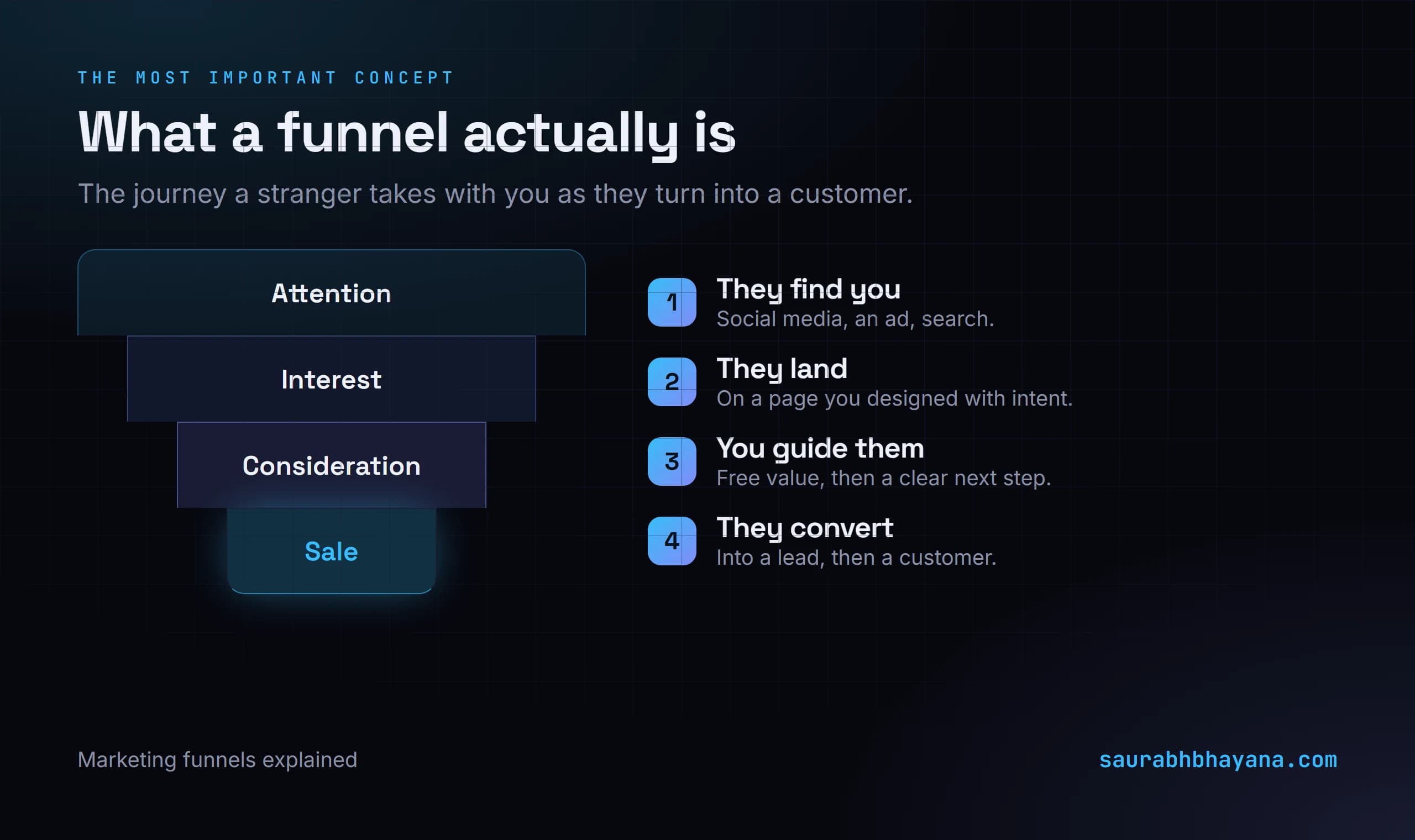
A funnel is the journey a potential customer goes through with you as they convert into a sale. That is it. Someone finds you through social media or an ad, they land somewhere, they have an experience you designed, and step by step you lead them toward buying.
A weak funnel is a single page that says "call me if you want to buy my services." A real funnel gives the visitor a reason to engage: it explains what you do, offers something free, invites them to a call, and walks them through a flow toward a clear end state. Funnels also let you refine the sale: someone comes in for something cheap, and inside the funnel you can move them up to something higher priced.
This works for services (design, copywriting, construction, consulting) and equally for information products (courses, masterclasses, templates, preset packs). More creators are selling more things than ever, usually with unsophisticated methods. The tools to do it well are now cheap and available to a one-person team.
Every term you will hear, defined
This world is full of jargon. Here is the whole vocabulary in plain language.
Landing page
The web page people land on when you want them to begin the experience. If someone clicks your ad or your link in bio, this is the page they hit. Everything starts here.
The offer
How you structure what you sell so people actually want it. Most creatives have a vague offer: "I do graphic design," "I do writing." A far stronger frame is: I am a [role] that makes [outcome] for [audience]. "I am a graphic designer that makes landing pages for creators." "I am an interior designer that does home renovations in Orange County." A clear offer is the foundation the whole funnel sits on.
Lead, and lead magnet
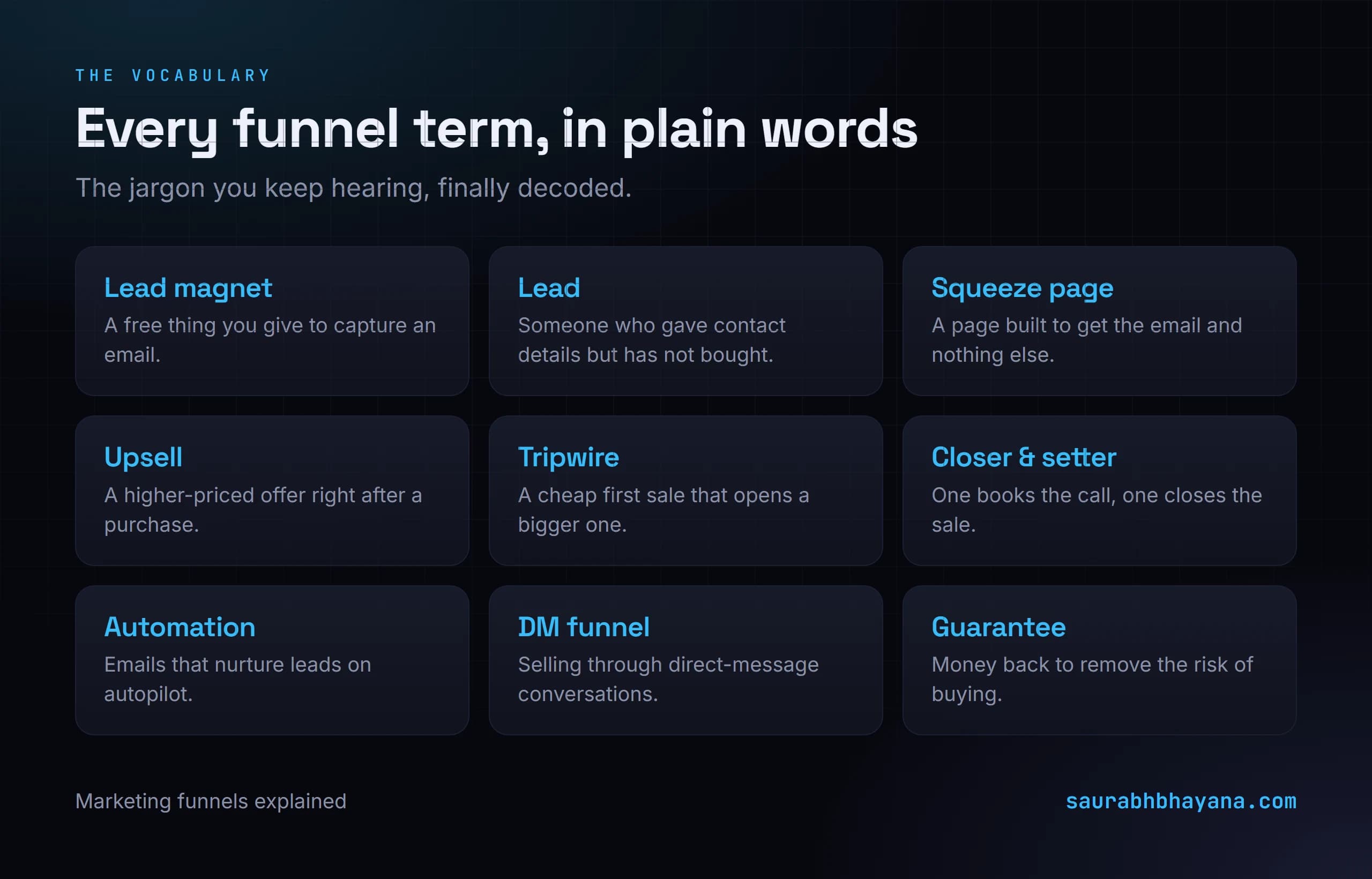
A lead is someone who has not bought from you yet, but you captured their contact details. They signed up for a call, gave you an email, joined a list. You store leads in a CRM (customer relationship manager) so you can see where each one came from and when you last spoke.
A lead magnet is the free thing you give to get people in the door in exchange for their email. An interior designer might offer a "12-step checklist to prepare for your home reno." To get the PDF, you give your email. That is a lead magnet, and almost every business online should have one.
For high-priced offers, a good lead magnet can bring in thousands of leads. You only need a handful to convert over a long sales cycle for the maths to work beautifully.
A powerful point: you do not even need to know exactly what you will sell them yet. You can put out lead magnets, keep nurturing the relationship through email, and accumulate leads for whenever you do launch something. If you publish content, capturing that audience as you go is one of the smartest things you can do.
Squeeze page and thank you page
A squeeze page is the page your lead magnet lives on, designed for one job: get the person to the next step with the highest conversion rate possible. The next step is usually a thank you page, where you deliver the free thing and often move them into the next stage of the funnel.
Upsell
When someone gets something free or buys something cheap, and you immediately offer something at a higher price. You bought the gummies, so "subscribe at a discount" or "add this for X." You booked a service, so "do you want the audit added?" or "for 99 dollars we can turn this into a retainer." Those are all upsells.
Extras and guarantees
Extras are the bonuses you throw in to sweeten the deal: a free community for every client, all your past courses bundled in. They matter because when you are testing why people are not buying, adding extras is one lever you can pull. A guarantee is another: "if you do not like the work, you get your money back," or "if we do not deliver in 30 days, it is free." You do not have to offer one, but it is a common conversion booster worth understanding.
Listicle page
A landing page in article format. Instead of "buy my thing," it reads like "the six reasons it is time for a high-converting website," showcasing value in an article before asking for the sale or the email. It is a softer, content-led way to warm someone up.
Closers and setters
A rule of thumb: anything you sell over roughly 2,000 dollars converts far better when someone actually gets on the phone. The salesperson who takes a lead onto a call and helps them buy is a closer. As a business grows, a second role appears: the setter, whose only job is to take incoming leads, find call times, send reminders, and make sure people actually show up to the closer. Founders usually close their own calls first, then hire this out.
Automation
When someone becomes a lead, they should automatically receive a series of emails that educate them about what they are considering and who is behind it. This runs in the background and does a lot of the nurturing for you.
Top of funnel and bottom of funnel
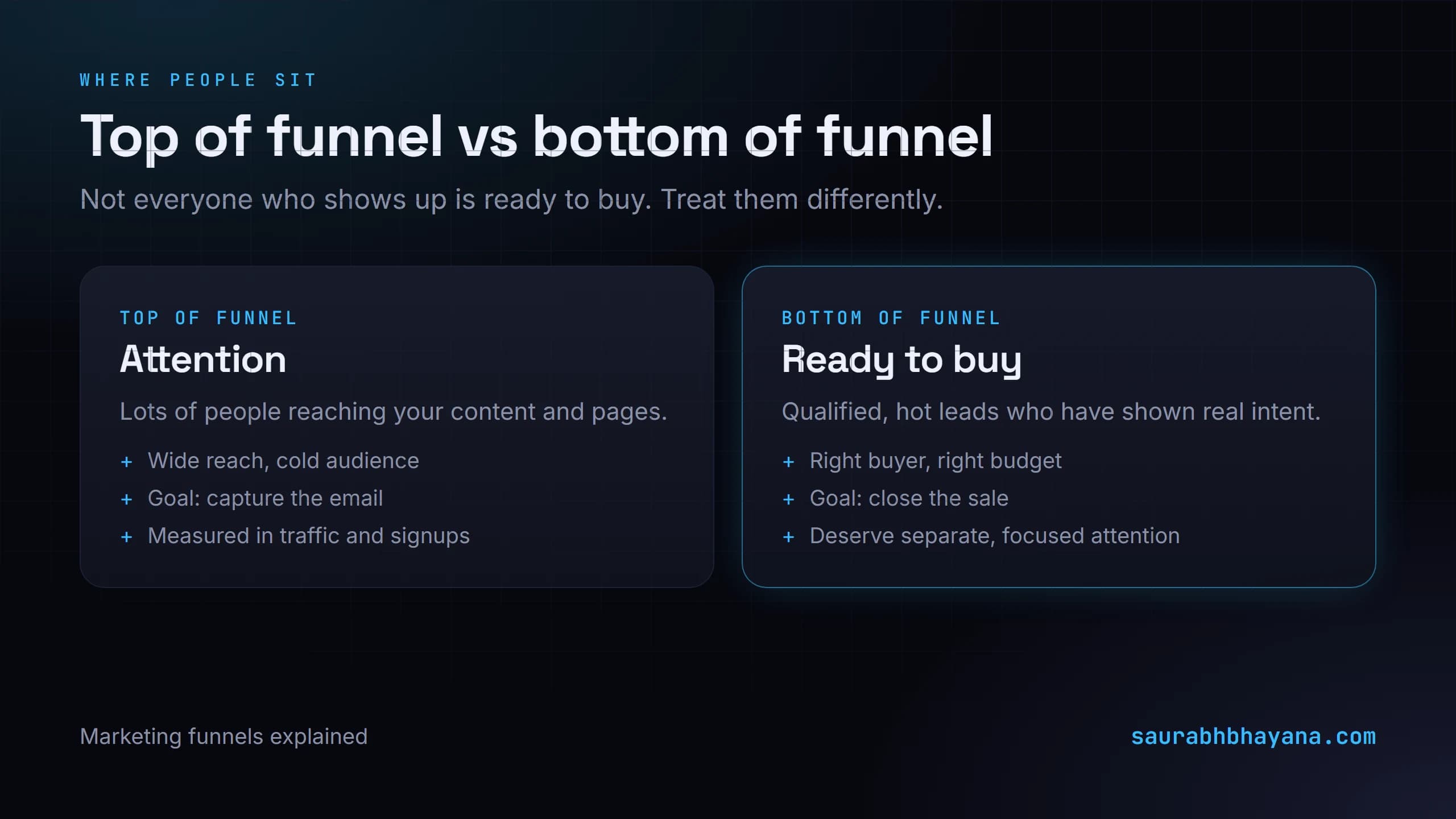
Top of funnel is getting attention: lots of people reaching your pages and content. Bottom of funnel is the people ready to convert, the qualified, hot leads. A qualified lead is the right type of buyer, with the right budget, who has shown real interest. Not everyone at the top makes it to the bottom, and the bottom-of-funnel people deserve extra, separate attention because they are the ones about to buy.
The DM funnel
In the social era, a huge amount of selling happens in direct messages. If you are getting attention but no leads, the missing piece is often that you are not starting enough conversations. If a roofing company sees someone in their area commenting and their profile suggests they own a home, a simple DM ("saw you commenting, thinking about a new roof any time soon? what neighborhood are you in?") starts a high-value conversation. The same works for design, consulting, anything. Whole businesses run entire funnels inside the DMs, managed in their own CRM. Social media is social, so leaning into conversations is not optional if you want to convert your attention.
The four funnel types worth knowing
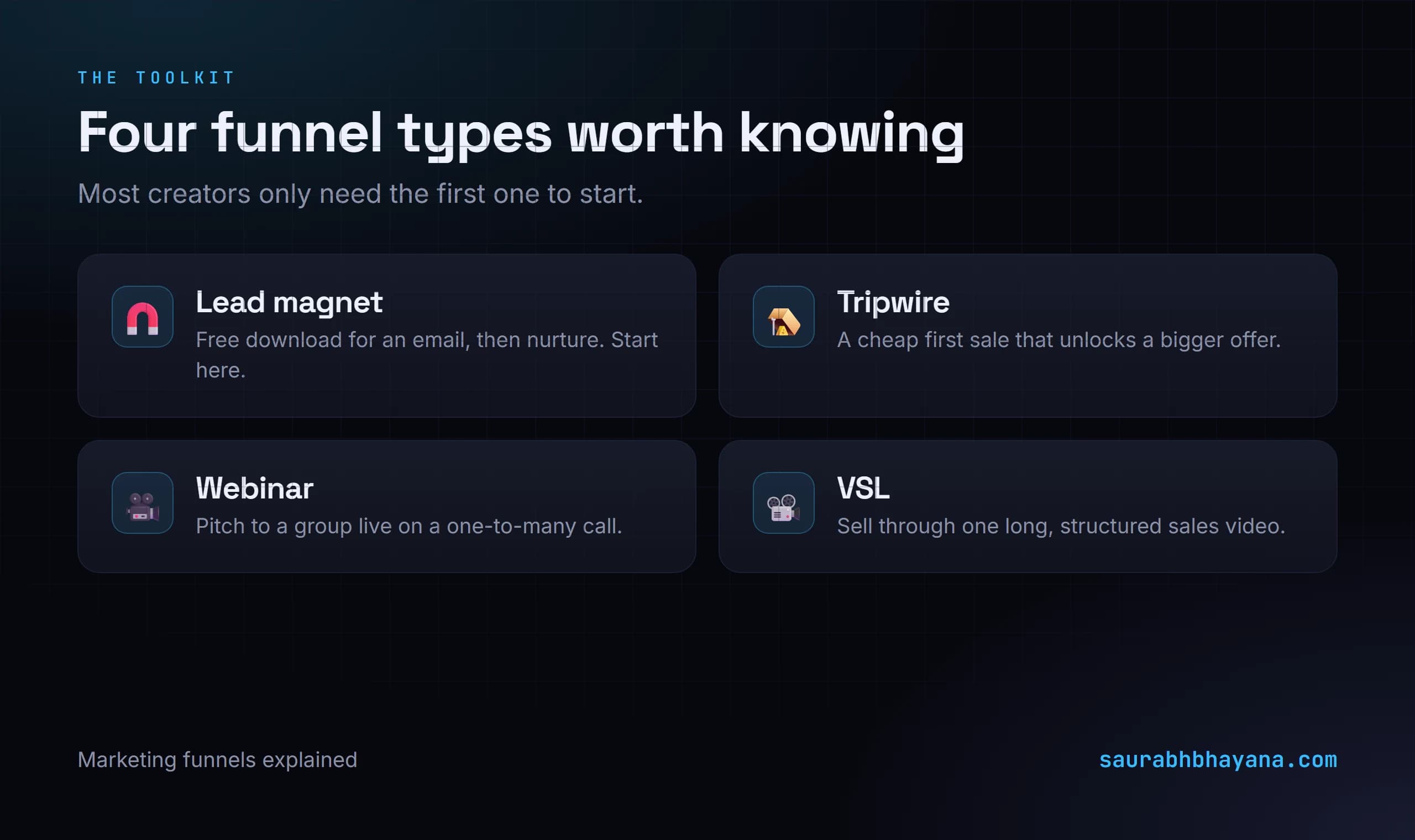
There are many funnel types, but these four cover almost everything a creator, freelancer, or service business needs.
| Funnel | How it works | Best for |
|---|---|---|
| Lead magnet | Free download in exchange for an email, then nurture | Almost every business generating interest online |
| Tripwire | Sell something very cheap, then immediately offer something higher priced | Breaking the buying barrier and funding ad spend |
| Webinar | Get people onto a one-to-many call where you pitch to a group | Charismatic founders without a sales team yet |
| VSL | Sell through one long, structured video sales letter | Offers that need explanation or a strong on-camera presenter |
1. The lead magnet funnel
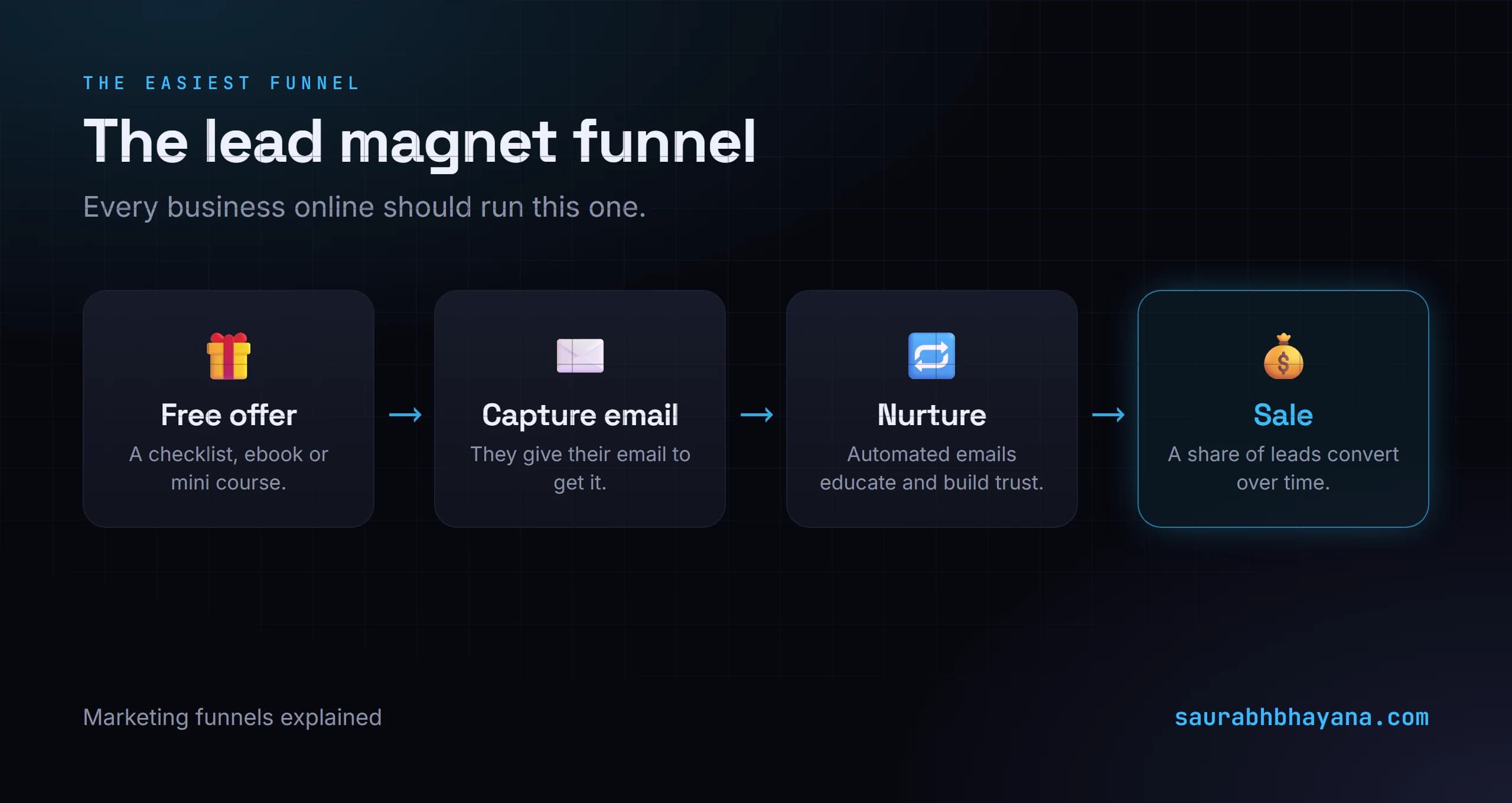
The easiest one, and the one every business online should run. Offer something free, capture the email, and nurture from there. It is also how you put real numbers on social media: you can quantify leads and email signups even when likes feel fuzzy. Make "get this free thing" a call to action in your content and you have a measurable engine. I break down how to build a great lead magnet, the three types, and how to name it, in my full guide to lead magnets.
2. The tripwire funnel
Sell something at a very low price (say 1 to 20 dollars), then immediately present a higher-value offer right after. The classic example is the old "free plus shipping" book: you pay a few dollars, and on the very next page you are offered the software, the extras, the bigger package. It works because once someone has spent money, the card is in the system and a psychological barrier is already broken, which makes the second purchase easier.
Service businesses use this too, with a break-even entry offer (a cheap landing page, a starter pack of ideas) to get people in the door, then grow their value over time. It is also a advertising cheat code: if a cheap 99 dollar product feeds a 5,000 dollar service, you can break even on ad spend at the 99 dollar sale, know what each lead is worth, and then afford to spend far more on ads.
3. The webinar funnel
Get people to a landing page that signs them up for a one-to-many call, where a charismatic presenter pitches the product or service to a whole group and answers questions live. It is great when you do not yet have setters and closers for one-on-one calls, or as a warm-up before them. A simple monthly community call can run on exactly this structure.
4. The VSL (video sales letter) funnel
Instead of packing a page with text, you sell primarily through one long, persuasive video that follows specific beats: a sharp problem, a unique framework, why you are the right person, a walk through common objections, and a clear call to action. Use it when your offer needs explaining or you have someone who is excellent on camera. Search "video sales letter structure" and you will find the exact beats to write to, and you can draft scripts far faster now with an AI assistant.
How to organise and test your funnels
You do not have to invent landing pages from scratch. Build a swipe file: every time an ad or page sells you something well, screenshot it. Those screenshots become templates you can rebuild for your own offer. Modern website tools let you literally describe a layout ("title, subtitle, video, then three testimonials, then an FAQ") and generate it, or hand them a screenshot and say "recreate this for my product."
Then test. Long pages with more information versus short direct ones. Light versus dark. Video versus no video. And test three very different copy angles for every offer:
- •A human, narrative angle told from your perspective.
- •An evidence-driven, data-backed angle.
- •A direct-response angle that names the exact problem, attaches real numbers, and pitches the fix.
Wire up email automation from day one, even minimally. When someone signs up, send an immediate email confirming what they got and introducing you. The next day, send your most popular content on that topic. Those two emails alone are easy wins that most people skip.
Why this matters for your career
Creatives often feel guilty talking about this, but these are the exact mechanics that make the business world work. Understanding how funnels are structured, and not being afraid to do the light work of building one, is what separates people who sell from people who just make things and hope.
The deepest asset here is your email list. It does not have to be huge. A few thousand engaged subscribers in your niche means you can launch almost anything later and have people to sell to. It compounds quietly over years, nobody clicks a thumbnail about it, and it can change your entire creative career. Start capturing leads now, even before you know exactly what you will sell.
One more thing: funnels and search work together. SEO and AI search bring the right people to the top of your funnel; the funnel turns that attention into customers. If you have not sorted the traffic side yet, start with my complete SEO and AI SEO guide for 2026, then come back and build the funnel that catches it.
And if you want to build all of this alongside other website owners instead of alone, that is exactly why I run Rank Together, a free community where people in different niches share what is working and swap genuine links.
Frequently asked questions
What is a marketing funnel in simple terms?+
A funnel is the journey a potential customer takes with you as they turn into a sale. Someone discovers you, lands somewhere you designed, has an experience, and is led step by step toward buying. A weak funnel is a single "call me" page; a real funnel offers value, captures the lead, and moves them toward the sale.
What is the difference between a lead and a lead magnet?+
A lead is a person who has given you their contact details but has not bought yet. A lead magnet is the free thing you offer (a checklist, ebook, or mini course) to capture that lead in exchange for their email.
What is a tripwire funnel?+
A tripwire funnel sells something at a very low price, then immediately offers something higher priced right after. Because the buyer has already spent money and broken the psychological barrier, the second purchase is easier. It is also used to break even on ad spend before selling a bigger offer.
Which funnel should a beginner start with?+
The lead magnet funnel. Offer something free, capture the email, and nurture with automated emails. It is the easiest to build, works for almost any business, and lets you put real numbers on your social media by measuring leads and signups.
Do I really need sales calls?+
For anything priced over roughly 2,000 dollars, a real call usually converts far more people than a page alone. That is why closers (who sell on the call) and setters (who schedule and remind) exist. Below that price, a well-built page and email sequence often do the job.
How do funnels relate to SEO?+
They are two halves of one system. SEO and AI search bring qualified people to the top of your funnel; the funnel converts that attention into leads and customers. Traffic without a funnel is wasted, and a funnel without traffic has nobody to convert.
Read next
I build fast, SEO-ready sites and rank them on Google and AI search. Or join my free community and grow alongside other website owners.