Lead Magnets: How to Generate Thousands of Leads in Any Niche
Most sites send traffic straight to buy now or submit for a quote, and most visitors leave because they are not ready. Offer a free mini solution first and you can capture three to five times more leads from the same traffic. Here is exactly how: the three lead magnet types, four delivery methods, naming formulas, and the CTA that turns leads into sales.
Here is a way to get more leads than you are getting now, and sell more of them, without spending a rupee more on advertising. Most businesses do not do it, and the few that do usually do it wrong. It is one of the highest-leverage changes you can make, because it improves conversion on traffic you already have, which means it drops straight to your bottom line.
The mistake is everywhere: people send traffic to a website and immediately ask visitors to buy something or submit for a quote. The problem is that most visitors are not ready to buy yet, so they leave and never come back. Think about your own behaviour. When you land on a site you just discovered and it says "submit for a quote," it feels like a lot. You bounce.
The fix: offer a free mini solution first
"Buy my thing" only works well if the audience already knows you and has already gotten value from you. For colder or smaller traffic, you need a better reason for people to hand over their contact details. So instead of asking for the sale, you offer a mini offer: a complete solution to a narrow problem, usually free or low cost, just to see who is interested and raises their hand.
Once that mini offer solves its small problem, it reveals another problem that your core offer solves. Leads who take a free or low-cost offer now are more likely to buy a related higher-cost offer later.
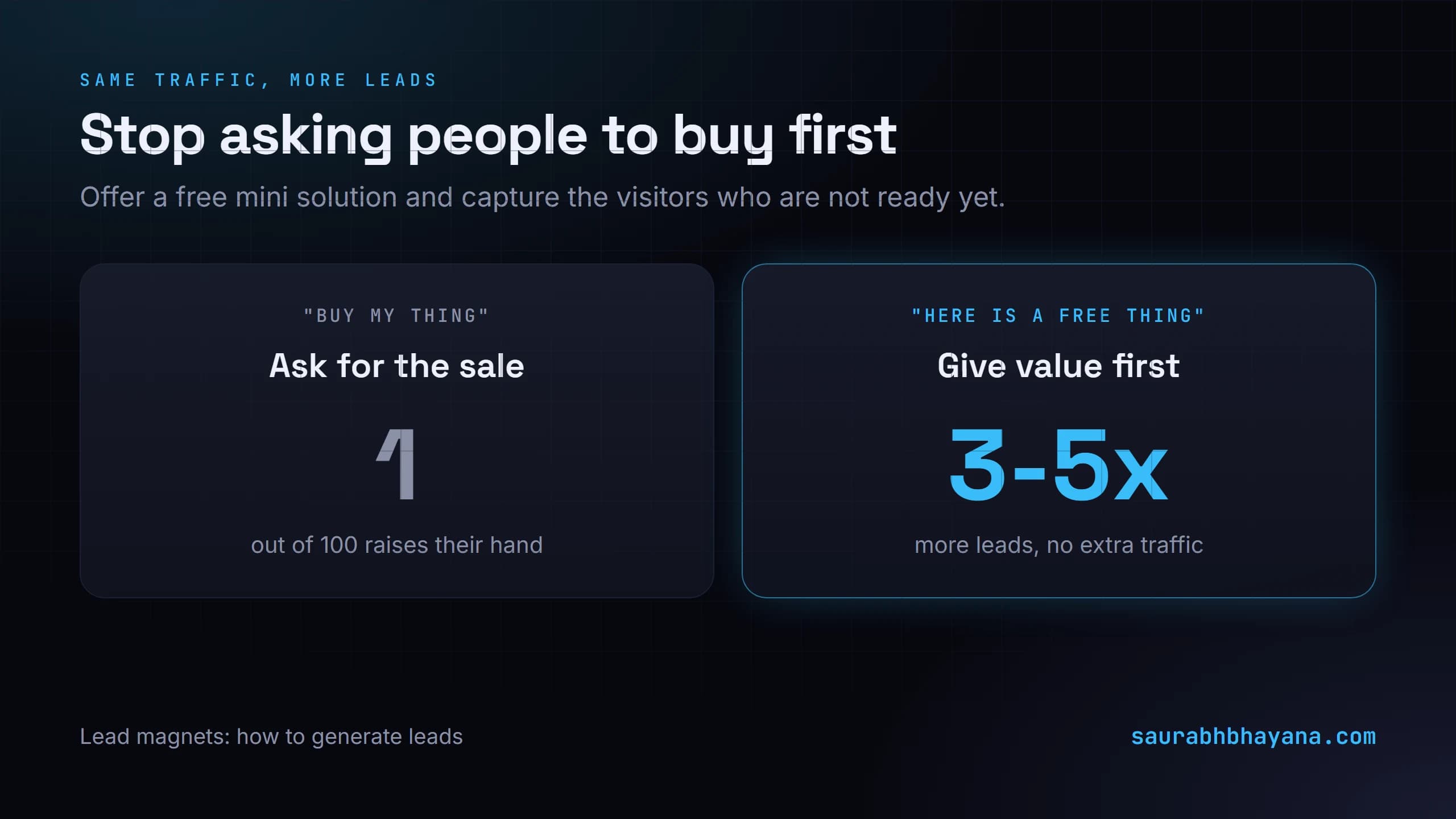
The maths is the whole point. Take 100 people. Say "buy my thing" and maybe one raises their hand. Say "you do not have to buy anything, I just want to help you out," help them, and then ask if they want to buy, and you might get three to five times as many. And the beautiful part is you did not get more traffic. You just converted a higher percentage of the traffic you already had. That is why this is such an easy win: you can do it immediately, with no extra marketing spend.
Why lead magnets work
Think of the free samples at the end of every aisle in a warehouse store. People try the sample, decide they like it, and want more. A lead magnet is that sample: a small piece of something bigger. The deeper reason it works is simple: when someone pays with their time now, they are more likely to pay with money later. You want them to invest, so you make the first investment small and low-barrier, which raises the odds they make a bigger one afterward.
A crucial point: the packaging matters more than the contents. You can change how many people want your lead magnet by two, three, or ten times just by changing its headline, without touching what is inside. So test the wrapping even harder than the filling. If a lead magnet flops, it does not mean lead magnets do not work, any more than one bad ad means ads do not work. It means that one did not work. Bad lead magnets fail; good ones do not.
Worried about freebie seekers and tire kickers? You do not have to give the lead magnet to everyone. Add a qualifying question or dropdown, send qualified people to the real offer and everyone else somewhere more suitable. Qualify the lead and the freebie-seeker objection disappears.
Sell at the point of greatest deprivation
The one rule that ties this together: do not solve the exact problem your core product solves with the free thing. Solve a problem that leads to it. You want the person to be left wanting the thing you sell, and for that wanting to be triggered by the free solution.
Picture a restaurant. You eat a big main course, and they ask if you want another main course. You say no, not because it was bad, but because that need is satisfied. What is not satisfied is dessert. So that is what they sell you next. In business, make the dessert far more expensive than the main, and give the main away free or at cost. Sell water to someone who is thirsty. The moment after you hand them the water tells you nothing about whether it was good; they are just not thirsty anymore. So you sell them the next thing they now want.
The three types of lead magnet
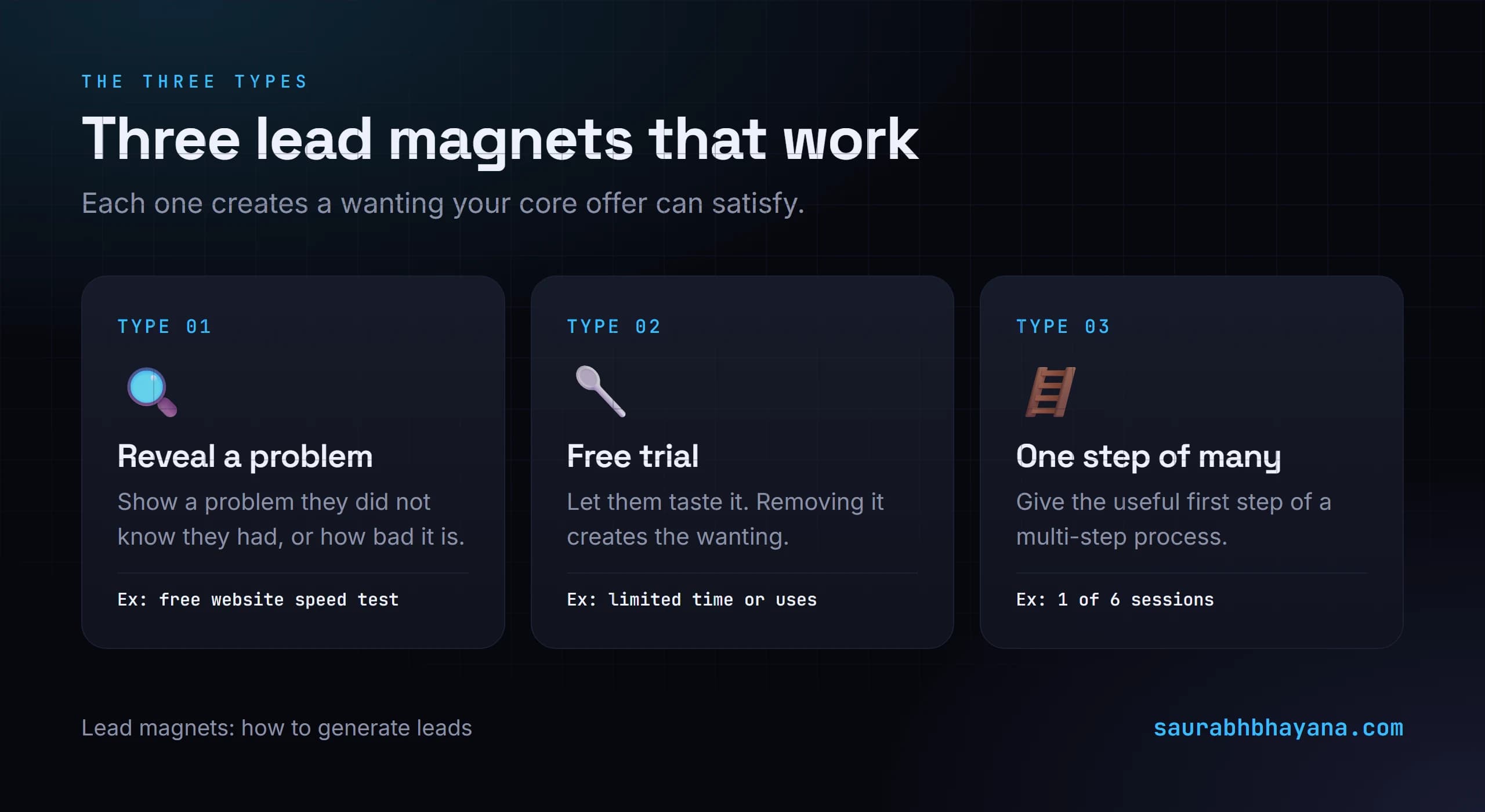
| Type | What it does | Example |
|---|---|---|
| Reveal a problem | Shows a problem they did not know they had, or how bad it is | A free website speed test that shows their site is slow |
| Free trial | Let them taste it, then removing it creates the wanting | A limited trial by time, uses, or quantity |
| One step of many | Solve the first step of a multi-step process | One session of a treatment that needs several |
1. Reveal a problem
These create deprivation directly. You show someone a problem they did not know existed, or how bad the one they know about really is. Bonus points for showing what it would look like solved, and the gap between the two. The classic B2B example: offer a free website speed test. They did not know their site was slow. Then you say that for every second of load time a site loses roughly 3 percent of conversions, and your service can take them from a 9-second load to 3 seconds. Suddenly the cost of your fix looks tiny next to the upside.
This works best for problems that get worse while waiting, because that builds urgency: the deprivation increases with every second after they find out. Think posture analysis, termite inspections, financial audits, back taxes. Be incredibly specific about the negatives, which lets you be vaguer and more realistic about the positives. If you name someone's exact problems, they will assume you can solve them.
2. Free trial
The classic try-before-you-buy. Its power is the lowest possible barrier: will you just try it? The trick is to run a full loop so that when the trial ends, removing it creates the wanting. You give the solution, then take it away, and the absence is what converts. You usually limit something: number of uses, quantity, or time, sometimes combined. Give people a few months of a service dropped into their lap, and when it stops, many will pay to keep it going.
3. One step of many
Especially effective for complex products and services. You give away the first step of a multi-step process that is a bit useless on its own, so it naturally leads to the rest. One coat of paint when several are needed. One session of a treatment that takes six to eight. The first two videos of a full course. The first step delivers real value but leaves an obvious next step to buy.
Four ways to deliver a lead magnet
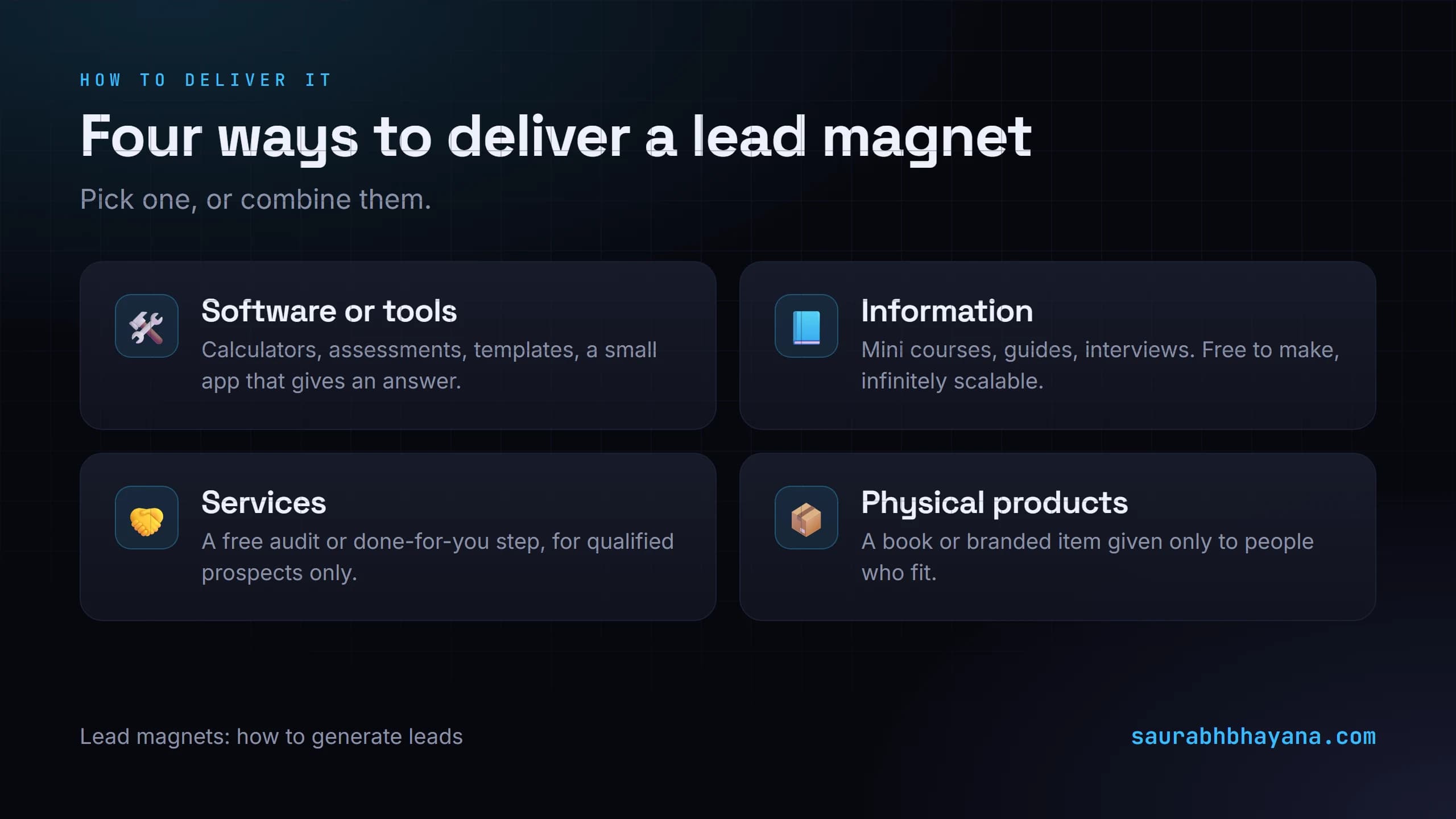
Any of the three types above can be delivered in four ways, and you can combine them.
- 1.Software or tools. A spreadsheet that calculates something, an assessment tool, a template, or a small app. A tool that takes an input and gives an answer, like a checker that assesses a URL, while collecting contact details on the back end.
- 2.Information. A mini course, guide, interview, or working template. It costs almost nothing, is infinitely scalable, delivers real value, and has no operational drag. You are simply teaching them something valuable.
- 3.Services. Free work for qualified prospects only: a free audit with some implementation, same-day delivery, a done-for-you component. Give it only to people who have the budget, the authority, a clear need, and want to act now.
- 4.Physical products. A book, or a branded item given only to people who prove they fit (a shirt handed only to people who show they are a CEO gives you a highly qualified list).
Do the services maths before you dismiss it. If a free service costs you 25 dollars of labour but would normally sell for 250, and one in four who take it become customers, your cost to acquire a customer is about 100 dollars. If a customer is worth far more than 100, that is a great trade. Just give it only to the right prospects.
Name it right (this is the most slept-on step)
How you name your lead magnet influences its engagement rate more than almost anything else. The real secret to naming it is simple: ask your audience. Run small ad tests comparing headlines, or if you have no budget, poll your followers, put options in your stories, or just text people and ask which they prefer. Make sure only the type of person you are targeting answers.
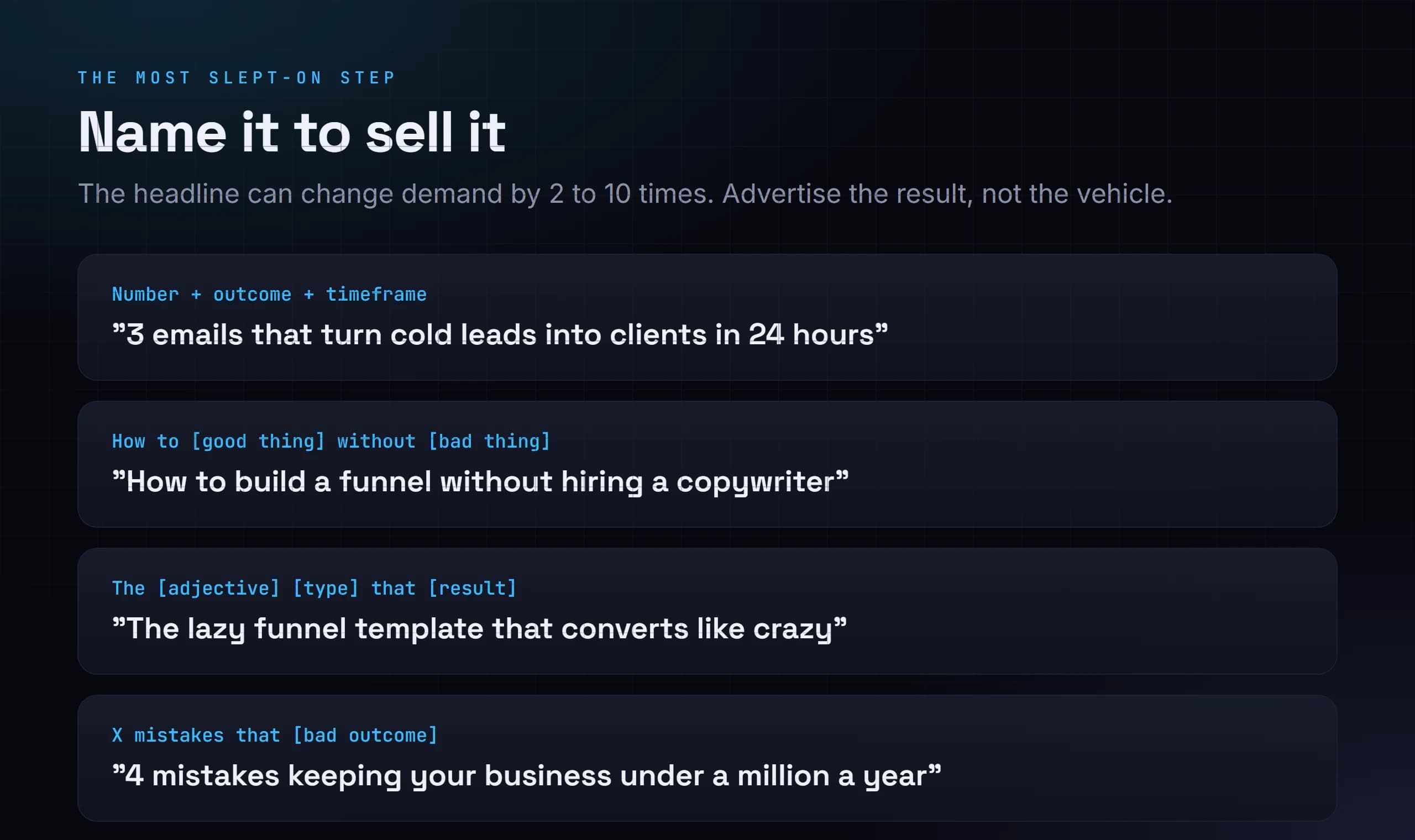
Advertise the result, not the vehicle. A "six-week deadlift and squat seminar" is the same content as a boot camp named after the outcome people actually want, but only one of them converts. Here are naming patterns that work:
- •Number plus outcome plus timeframe: "3 emails that turn cold leads into clients in 24 hours."
- •How to X, or how to get [good thing] without [bad thing]: "How to build a funnel without hiring a copywriter, even if it is your first time."
- •The [adjective] [type] that [good thing]: "The lazy funnel template that converts like crazy."
- •X mistakes: "4 mistakes keeping your business under a million a year," or "5 ad copy mistakes killing your conversion rate."
Now make money with it: the CTA
This is where most people fail. They build a great lead magnet and forget the call to action, or they do it once and never again. Salespeople who ask the most times get the most deals, so in your marketing you want to ask as many times as you can, without turning people off. The way to earn more asks is to keep providing value between them, so people stay willing to hear the next one.
The CTA formula is short:
- 1.Clear, not clever. Say exactly what you want them to do.
- 2.The exact next action. Spell out the single next step.
- 3.A reason to act now. Scarcity or urgency if you have it, but any reason beats no reason.
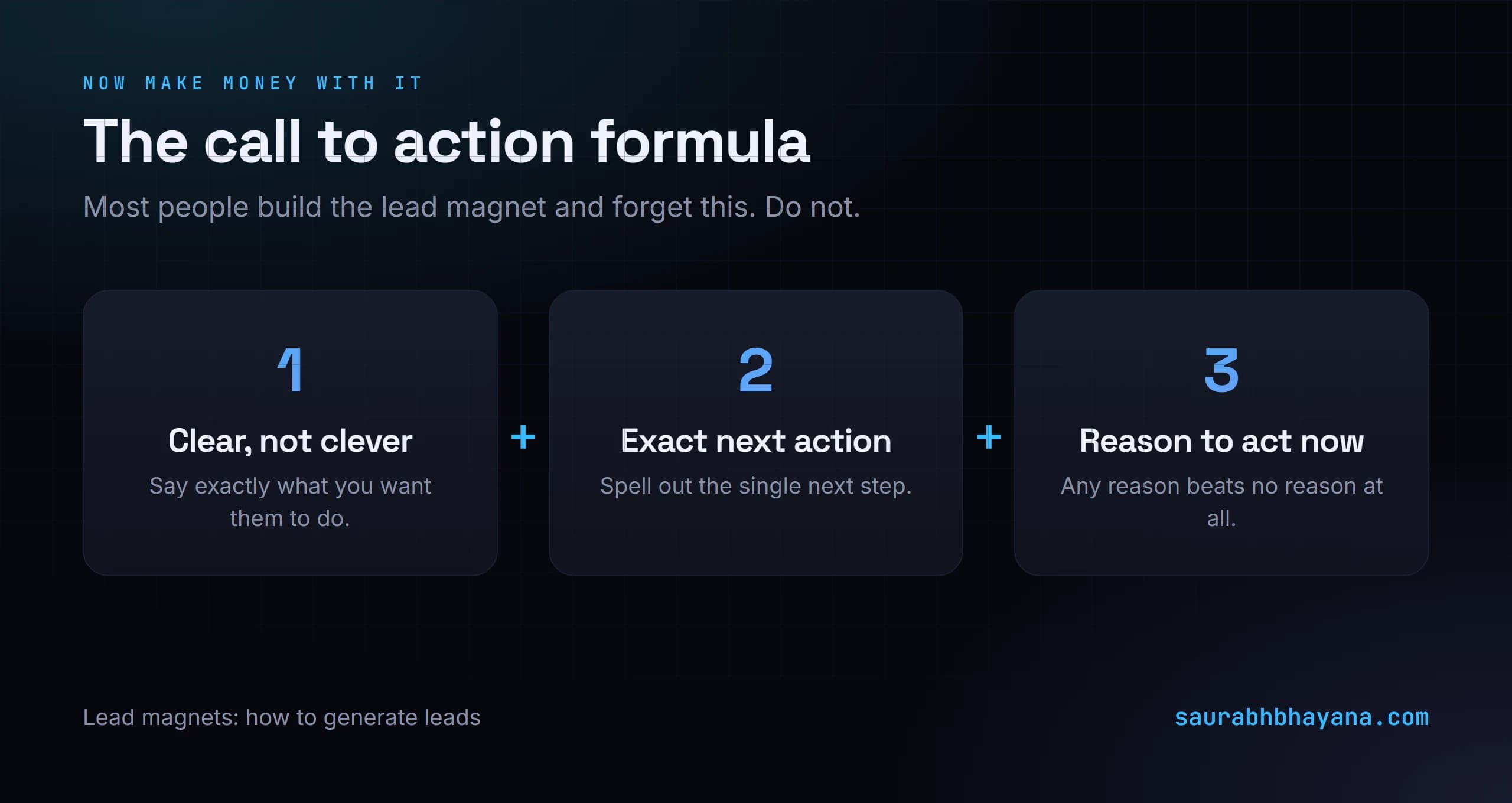
That third part is backed by a famous study: people asking to cut a queue got a yes far more often when they added "because," even when the reason was nonsense. A reason that makes sense is best, but any reason works better than none. "It is my one-year business anniversary, so here is a promotion." And if you run a service business, remember you have real capacity limits, so use them: if four more customers fills you up, say so. That is honest scarcity, and most visitors have no idea how big or small you are unless you tell them.
Where this fits
This is the missing first step of the funnel. It captures the people who are not ready to buy yet, which is most of them. Put together: bring the right people in with search, build the path that converts them, and open that path with a lead magnet that captures the ones who are not ready yet.
If you have not sorted the traffic side, start with my complete SEO and AI SEO guide for 2026. To understand the whole conversion path this lead magnet opens, read my guide to marketing funnels. Once someone is on your list, you need something to actually sell them, and for that see my 35 digital product ideas. And if you want to build all of this alongside other website owners instead of alone, that is exactly why I run Rank Together.
Frequently asked questions
What is a lead magnet?+
A lead magnet is a free or low-cost complete solution to a narrow problem, offered to capture someone's contact details. Solving that small problem reveals a bigger problem that your core paid offer solves, so lead magnet takers are more likely to buy later.
Do lead magnets still work?+
Yes. Bad lead magnets fail, good ones work. Offering a free mini solution first can capture three to five times more leads from the same traffic, because most visitors are not ready to buy on their first visit and a free offer gives them a low-risk reason to engage.
What are the three types of lead magnet?+
Reveal a problem (show a problem they did not know they had, like a free website speed test), a free trial (let them taste it, then removing it creates the wanting), and one step of a multi-step process (give away the useful first step of something that needs several).
How do I deliver a lead magnet?+
Four ways, which you can combine: software or tools (calculators, assessments, templates), information (mini courses, guides), services (a free audit for qualified prospects), and physical products (a book or a branded item given only to people who fit).
How should I name a lead magnet?+
Advertise the result, not the vehicle, and ask your audience which name they prefer. Proven patterns include number plus outcome plus timeframe, how to get a good thing without a bad thing, and X mistakes that cause a bad outcome. The headline can change demand by two to ten times.
How do lead magnets relate to SEO and funnels?+
They are one system. SEO and AI search bring the right people in, a lead magnet captures the ones not ready to buy, and the funnel converts them over time. Traffic without capture is wasted, and a funnel with no entry point has nobody to convert.
Read next
I build fast, SEO-ready sites and rank them on Google and AI search. Or join my free community and grow alongside other website owners.