
Digital Marketing Trends 2026: 7 Rules That Changed (and What a Small Business Should Do)
Ads cost more, Meta is passing Google, and AI assistants now recommend businesses. Here are the seven digital marketing trends that matter in 2026, what Meta's Andromeda update changed, one popular tip we disagree with, and a one-month action plan for a small business.
Imagine running the same Facebook ad that worked in 2023. Same audience, same budget. This year it costs more per click, the leads are weaker, and your competitor who "barely targets anyone" is doing better. Frustrating, right? The rules quietly changed.
Sabri Suby, who runs the agency King Kong and says he has generated more than $10 billion in sales for clients, recently laid out seven new rules of digital marketing in a YouTube video, which we link at the end. Most of them match what we see with small business clients. One of them we strongly disagree with, and we will tell you why.
In this post we go through the seven digital marketing trends that matter in 2026, explain Meta's Andromeda update in plain English, check the claims against Meta's own documents, and finish with a simple one-month plan for a small business.
What are the biggest digital marketing trends in 2026?
- 1.Meta is passing Google in ad revenue, and Meta's AI now does the targeting.
- 2.Your ad copy is your targeting (the Andromeda effect).
- 3.Be in the feed, not only in the search bar.
- 4.Post what AI can't answer.
- 5.Get recommended by AI assistants through reviews and third-party mentions.
- 6.Own one niche before you scale.
- 7.Clone what works for nearby niches, with AI doing the heavy lifting.
Let's take them one by one, starting with the money.
1. Will Meta overtake Google in ad revenue?
For twenty years, Google took the biggest share of digital ad money. That is changing. eMarketer forecasts that in 2026 Meta will earn about $243.5 billion in worldwide net ad revenue against Google's $239.5 billion, the first time Meta comes out on top. Its forecast share is 26.8 percent for Meta and 26.4 percent for Google.
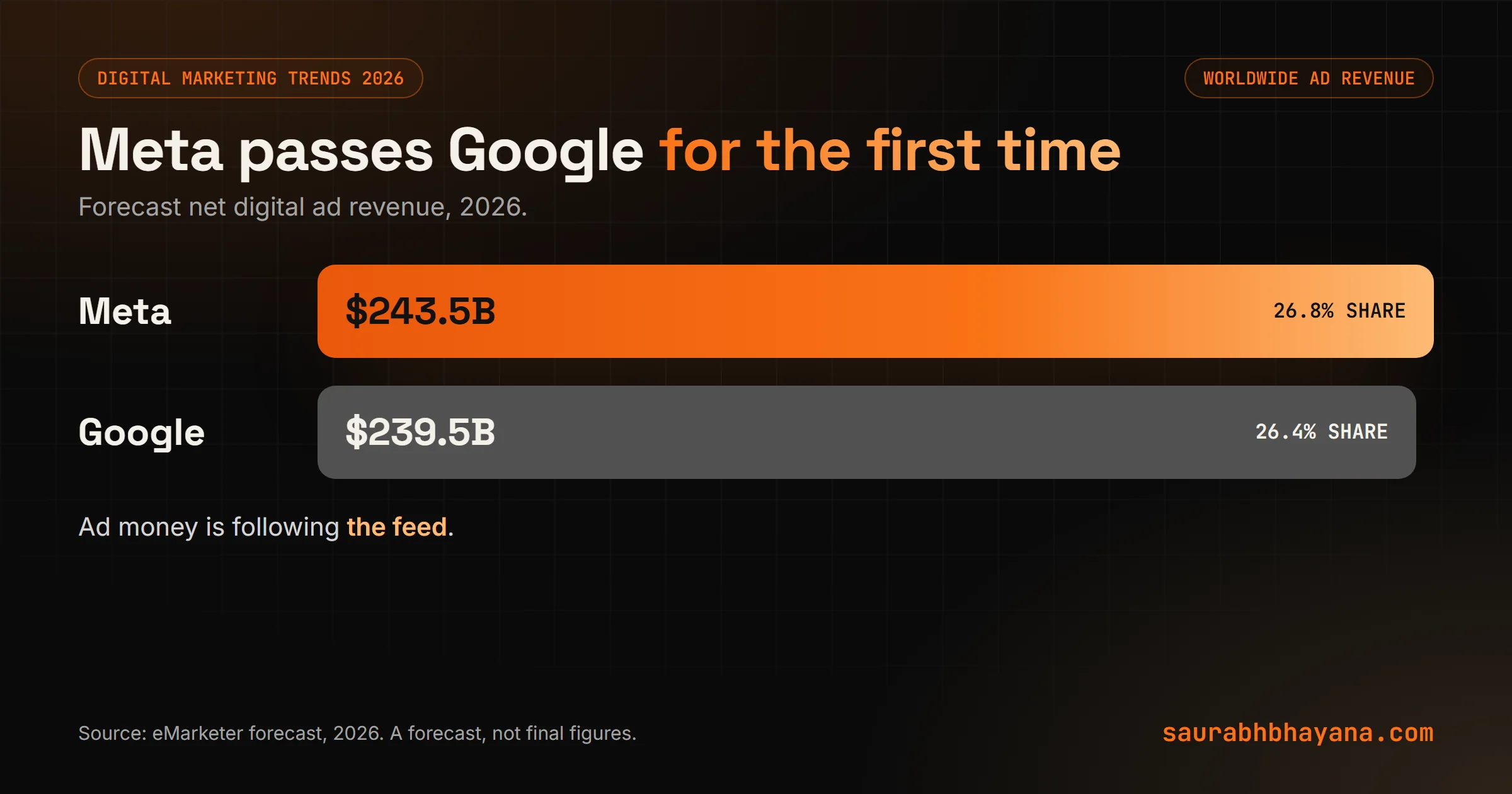
Why? Search is getting split up. People now ask ChatGPT, Claude or Perplexity, speak to their phones, and scroll recommendation feeds. Meanwhile Meta rebuilt its ad system around AI. Which brings us to the update most advertisers felt before they could name it.
2. What is Meta Andromeda?
Andromeda is the machine learning system Meta uses for the first step of choosing ads. Meta's engineering team described it in December 2024: from tens of millions of possible ads, Andromeda picks a few thousand that might suit a person, and later models rank those. Meta reported an 8 percent improvement in ad quality on selected segments when it rolled out.
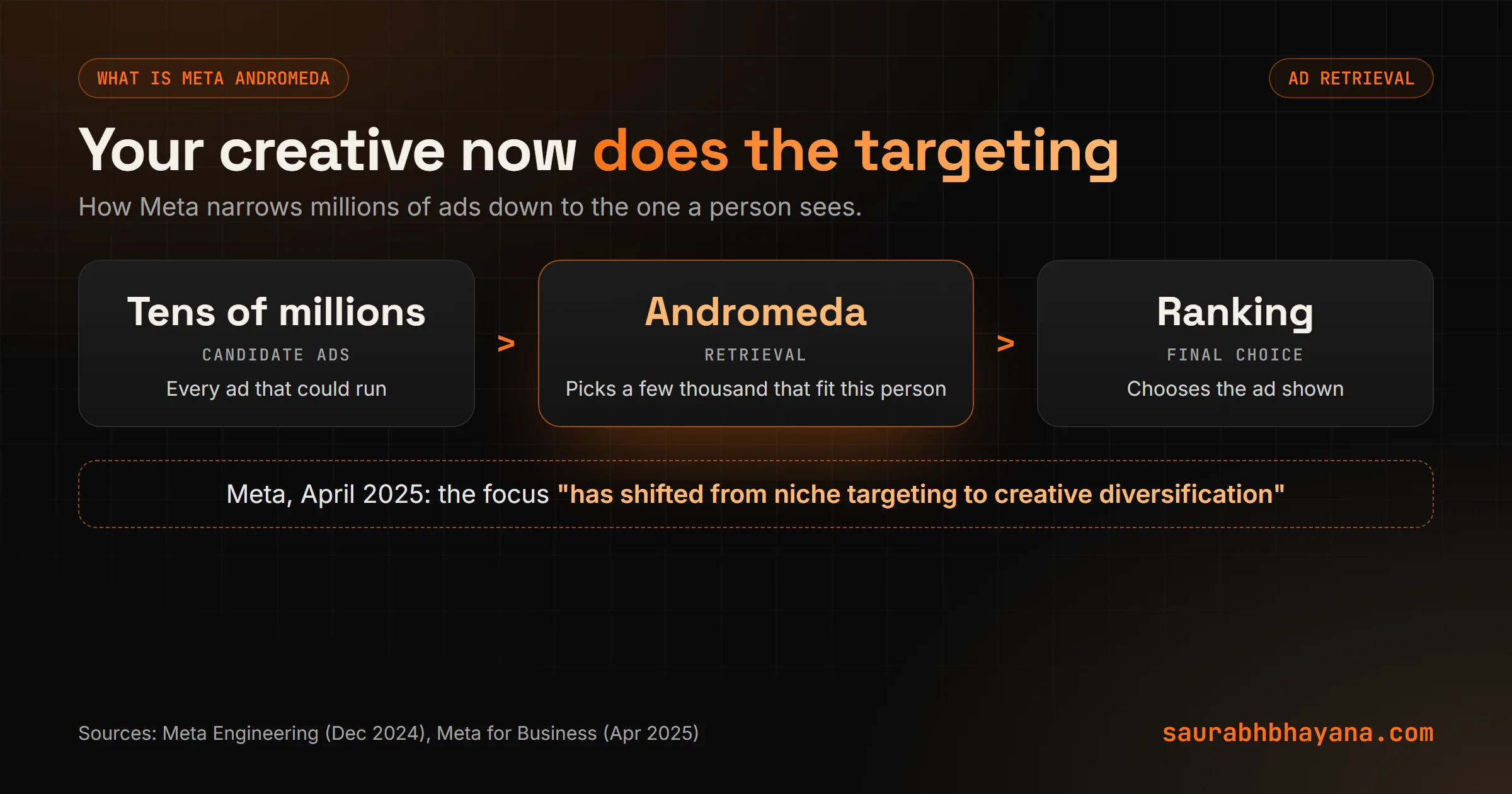
Meta Andromeda update: what changed for advertisers
Meta's own advice to advertisers, published in April 2025, is blunt: the focus "has shifted from niche targeting to creative diversification". In plain English, stop stacking interests in Ads Manager and start giving the system lots of genuinely different ads. Meta reported that advertisers using its AI image generation saw around 11 percent higher click-through rates, and that one brand, Dribbleup, went from three or four new creatives a week to almost 50.
Sabri's practical version: take your best ad, and change only two or three words so it clearly speaks to one group, like "for dentists" or "for women over 40". Keep everything else the same. Meta's system then finds the people that version fits. He calls it: your copy is the targeting.
In 2026 you don't pick the audience. You write ads that tell Meta's AI who the audience is.
Try it this week: duplicate your best ad three times, change two or three words in each to name a different customer type, and run them side by side with broad targeting. Let the numbers pick the winner.
3. Be in the feed, not only in the search bar
A lot of people think customers still start by searching. Many do, but a growing share simply get shown things. TikTok made the recommendation feed the main way people discover content, and Instagram, YouTube and Facebook copied it.
Want proof of how precise those feeds are? Since December 2025, Instagram's Your Algorithm tool shows the topics behind your Reels and lets you edit them. Open Reels and tap the icon in the top right. You will probably be surprised how specific the list is.
Now do the same for your customer. Watch the top videos in your niche on YouTube and note what is suggested next. Look at the subreddits, books and creators your ideal customer follows. Those are the interest pools your ads and content need to fit into.
4. Post what AI can't answer
Picture someone who wants to set up a Facebook pixel. Two years ago they watched a YouTube tutorial. Today they ask ChatGPT and get the steps in ten seconds. If your content is that tutorial, it is losing its audience.
Sabri's test is a good one: look at your last three or four posts and ask honestly, could ChatGPT or Claude have answered this faster and better? If yes, you are making the wrong kind of content. What still works is depth from real experience, things you can show on screen, and opinions you can back up: the context AI doesn't have.
That is how we write this blog: our own builds, our own numbers, and an opinion on every topic. Our AI and content articles cover how to write that way with AI helping, not replacing you.
5. How do you get recommended by ChatGPT?
This is the biggest shift for local and service businesses. AI assistants don't just answer questions, they recommend businesses. In BrightLocal's 2026 survey of US consumers, 45 percent said they used ChatGPT or other AI tools to find local businesses, up from 6 percent a year before.
Good SEO basics and schema on your site are the starting point. But AI tools also weigh what others say about you: reviews on Google and other platforms, press mentions, directory listings and articles that name you. Your brand is mostly what other people say about you.
Sabri suggests moving about 10 percent of your ad budget into PR and a review programme. We agree with the idea. Ask ChatGPT or Claude right now: "Who is the best [your service] in [your city]?" If you are not named, our step-by-step guide shows how to check if ChatGPT mentions your brand and what to fix.
Where we disagree: don't incentivise reviews
In the video, Sabri suggests a review programme "where you incentivise people to give you reviews". Please don't. Google's review policies don't allow offering money, discounts or gifts in exchange for reviews, and the FTC's 2024 rule on fake reviews bans rewards tied to whether a review is positive or negative. A profile caught doing it can lose reviews or worse.
Ask every customer, at the right moment, with a direct link. That works and keeps you safe. Our guide on how to get more Google reviews shows exactly how, and our free Google review link generator makes the link and a printable QR card in a minute.
6. Own one niche before you scale
Most businesses try to speak to everyone. Sabri's rule: if you make less than about $3 million a year, target one niche, with one funnel, solving one problem. Speak to one type of customer about one pain and your click-through rates, conversion rates and close rates all go up, because the customer feels the offer was built for them.
Picture a bookkeeper who markets to "small businesses" against one who markets to "independent dental practices". The second one wins the dentist every time. You probably haven't run out of customers in your niche yet. Most businesses think they have long before they actually have.
7. Clone what works with AI (horizontal scaling)
Once one niche is working and costs start rising, Sabri's move is to copy the whole funnel for a nearby niche: same offer, new wrapper. The vet marketing funnel becomes a dentist marketing funnel. The fitness programme for men over 45 gets a version for women over 45.
That used to need a new copywriter for every version. Now AI can do the first draft in a day: give Claude your best landing pages, video scripts and top ads, tell it the new niche, and ask it to rewrite every headline, benefit and example for that niche, changing nothing else. Then a person checks every page before it goes live.
One warning from Sabri that we agree with: don't do this too early. Under a few million a year, a new niche is usually a distraction from the one that already works.
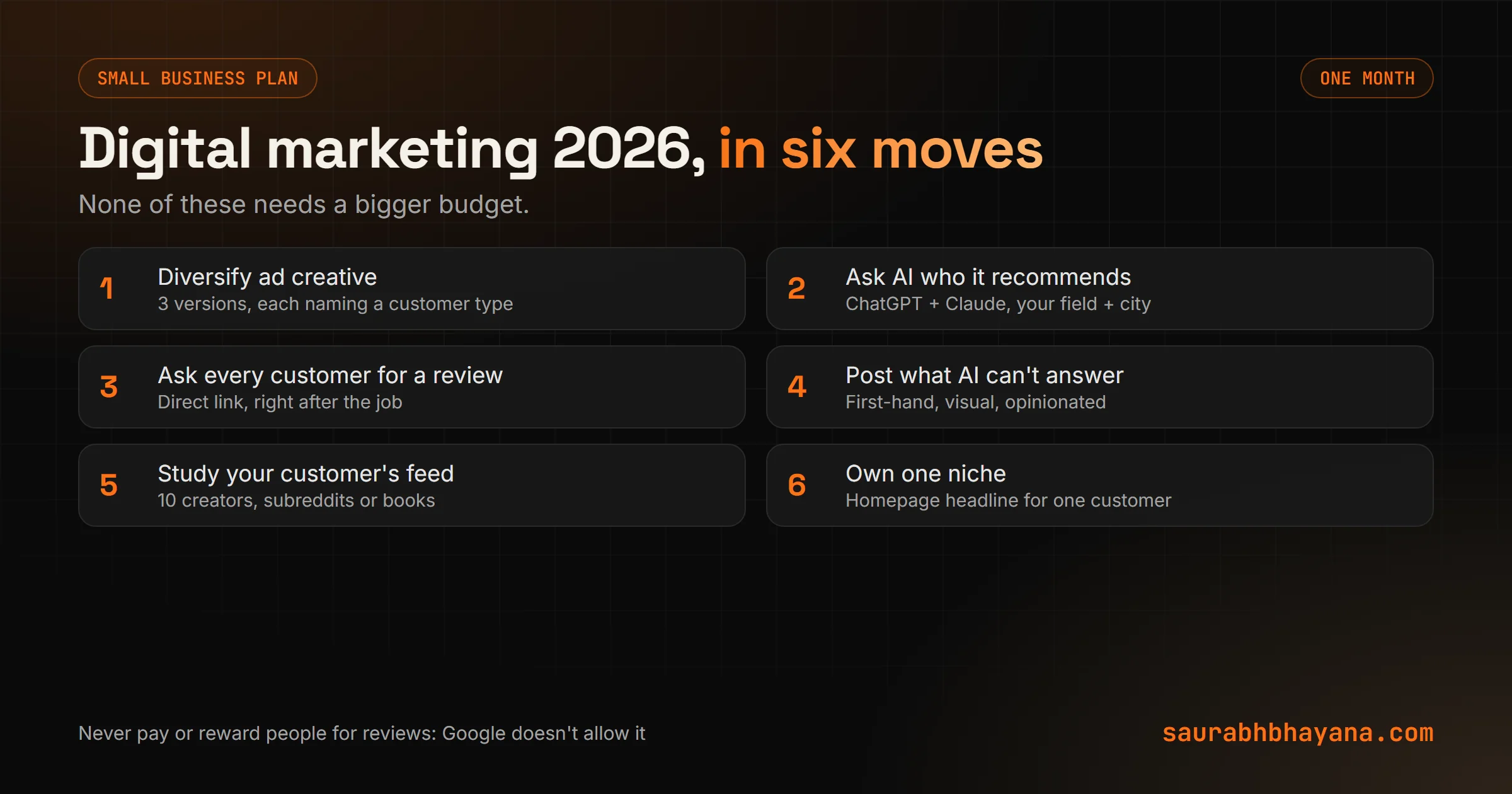
Digital marketing trends for small business 2026: your one-month plan
| Week | Trend | One thing to do |
|---|---|---|
| 1 | Copy is targeting | Make three versions of your best ad, each naming a different customer type |
| 1 | AI recommendations | Ask ChatGPT and Claude who they recommend in your field and city, and note the answer |
| 2 | Reviews and mentions | Send a review request link to every customer from the last 90 days |
| 2 | Post what AI can't answer | Audit your last four posts with the five-second ChatGPT test |
| 3 | Be in the feed | List ten creators, subreddits or books your ideal customer follows |
| 4 | Own one niche | Rewrite your homepage headline for one specific customer |
What hasn't changed
Strip away the new names and one thing is the same as it was in the newspaper ad days: picking the right audience and speaking to them better than anyone else. AI and algorithms just let you reach smaller groups more precisely, and write for each of them faster.
So, if you asked ChatGPT today who the best business like yours is in your city, would it name you? Try it, then pick one trend from this list to act on this week. If you want help with the AI search side, tell us about your business.
Sources: Sabri Suby's video on YouTube at youtube.com/watch?v=xsdoHywBD0I; Meta Engineering, "Meta Andromeda", December 2024; Meta for Business, "The creative advantage: unlocking the power of diversification with Meta Andromeda", April 2025; eMarketer's 2026 worldwide ad revenue forecast, as reported by Marketing Dive; Instagram's Your Algorithm announcement, December 2025; BrightLocal Local Consumer Review Survey 2026.
Frequently asked questions
What are the biggest digital marketing trends in 2026?+
Meta passing Google in ad revenue, Meta's AI doing the targeting so ad creative matters more, recommendation feeds replacing some search, content that AI can't easily answer, AI assistants recommending businesses, owning one niche, and using AI to clone winning funnels for nearby niches.
What is Meta Andromeda?+
Andromeda is the machine learning system Meta uses for the first stage of ad delivery. It narrows tens of millions of possible ads down to a few thousand that might suit a person before ranking models choose the ad shown. Meta described it in December 2024.
What changed with the Meta Andromeda update?+
Meta says the focus has shifted from niche targeting to creative diversification. Advertisers get better results by running many genuinely different ads with broad targeting and letting the system match each ad to the right people.
Will Meta overtake Google in ad revenue?+
eMarketer forecasts that it will in 2026, with Meta at about $243.5 billion in worldwide net ad revenue against Google's $239.5 billion. It is a forecast, so the final numbers may differ.
How do I get my business recommended by ChatGPT?+
Get the SEO basics and schema right on your site, then build what others say about you: steady Google reviews, accurate listings, press and articles that name your business. Ask ChatGPT who it recommends in your field and city to see where you stand.
Can I offer incentives for Google reviews?+
No. Google's policies don't allow offering money, discounts or gifts in exchange for reviews, and the FTC's 2024 rule bans rewards tied to a review's sentiment. Ask every customer the same way with a direct review link instead.
What should a small business focus on in digital marketing in 2026?+
One niche, varied ad creative instead of narrow targeting, honest reviews from every customer, content based on real experience, and checking whether AI assistants recommend you.
Read next
My team and I automate the work that eats your hours with AI, and get your business found on Google, Maps and in AI answers.