
How to Create a High-Ticket Offer for a Small Business (and Why One Expensive Option Can Double Your Profit)
Most small businesses never offer anything expensive, and it costs them. Here is what a high-ticket offer is, the simple maths behind it, price anchoring with real examples, Hormozi's value equation explained, and three ways to design your premium tier.
Imagine you sell a $100 service and a customer asks, "Do you have anything more complete? I'd pay more if you just handled all of it." And you say, "Sorry, this is all we offer." How much money just walked out of the door?
Most small businesses never put an expensive option on the menu. Not because nobody would buy it, but because the owner can't imagine anyone paying that much. Alex Hormozi, who has built and invested in a lot of service businesses, has a blunt line about this: sell something very expensive to a few people, or something very cheap to everyone. The middle is where businesses struggle.
In this post we explain what a high-ticket offer is, the simple maths that makes it worth doing, how price anchoring works, Hormozi's value equation in plain English, and three ways to design a premium tier for your business. The ideas come from one of his YouTube talks, linked at the end. The examples and our take are for small service businesses.
What is a high-ticket offer?
A high-ticket offer is a premium version of what you already sell, priced several times higher. It usually gives the customer more of you, faster results and less work on their side. For a lot of small businesses it simply means the owner's personal time, sold at a premium and capped.
- •A lawn care company: standard weekly mowing, plus a premium tier where the owner designs the whole garden and the client gets his mobile number.
- •A web design studio: a $1,500 template site, plus a premium build with strategy calls, copywriting and priority changes for a year.
- •A personal trainer: group classes, plus a few one-to-one clients at a much higher hourly rate.
Hormozi points to Tesla as the big-company version. Tesla's 2006 master plan was to start with an expensive, high-performance sports car, then use what it learned and earned to build cheaper family cars. The first Roadster sold for around $100,000. The cheaper models came years later.
Why one expensive option can double your profit
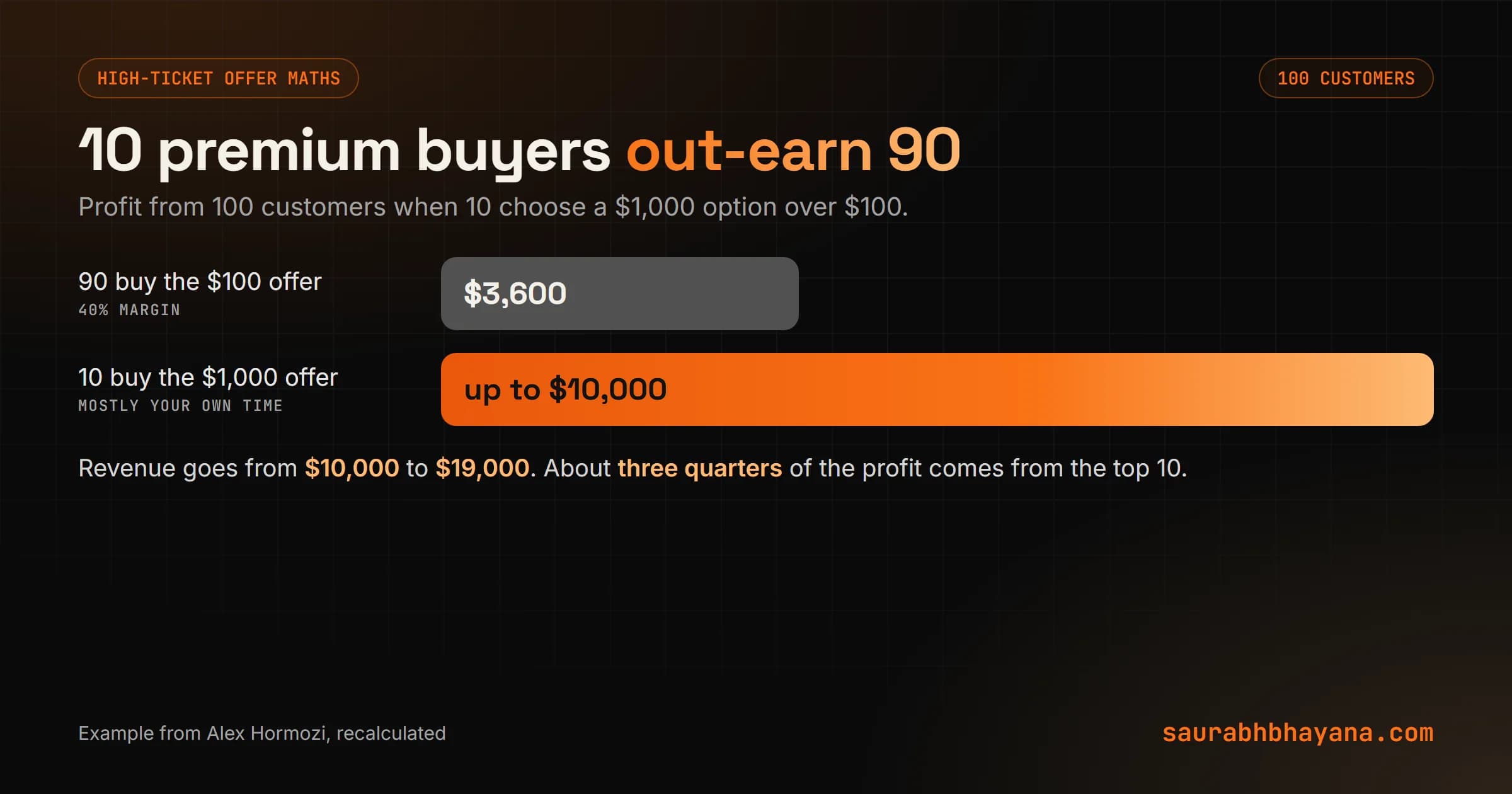
A lot of owners think a premium tier only matters if lots of people buy it. Not really. Here is Hormozi's example, worked through.
| Only the $100 offer | Add a $1,000 option | |
|---|---|---|
| Customers | 100 buy at $100 | 90 buy at $100, 10 buy at $1,000 |
| Revenue | $10,000 | $19,000 |
| Profit at 40% margin on $100 | $4,000 | $3,600 + up to $10,000 |
| Share of profit from the top 10 | None | About three quarters |
Revenue almost doubles, and because the premium tier is mostly your own time, nearly all of that extra money is margin. Hormozi treats it as close to 100 percent, which is generous since your time has a cost too, but even at half that the premium tier still earns more than the other 90 sales combined.
There is a cash flow bonus too. Hormozi describes how one premium training client early on paid enough to cover his living costs, so all the gym's money could go back into growth. A few premium clients can fund the scalable part of your business.
Price anchoring: why the expensive option helps sell the cheap one
Price anchoring means the first price people see shapes how they judge every price after it. If the first number is $10,000, then $1,000 feels sensible. If the first number is $100, then $1,000 feels outrageous.
Hormozi adds a second effect: the story. When you can honestly say, "Working with me one-to-one is $10,000, but most people don't need that, so I put the main lessons into a $500 program," the cheaper offer borrows value from the expensive one. It becomes the smart choice, not the cheap one.
Even if nobody buys the top tier, it changes how everyone sees the rest of your menu.
How to use it in a conversation:
- 1.Put the premium price where people can see it: on your pricing page, in your proposal, or say it out loud on the call.
- 2.Say it plainly and let them think about it. "Working with me directly is $10,000. That is the most likely way to get you there fast."
- 3.Then stop talking. Silence gives them room to say yes.
- 4.If they hesitate: "No problem. I can take out a couple of parts and give you most of the value in a smaller package."
Don't mumble the premium price and move on. An anchor only works if the buyer actually considers it.
Alex Hormozi value equation explained
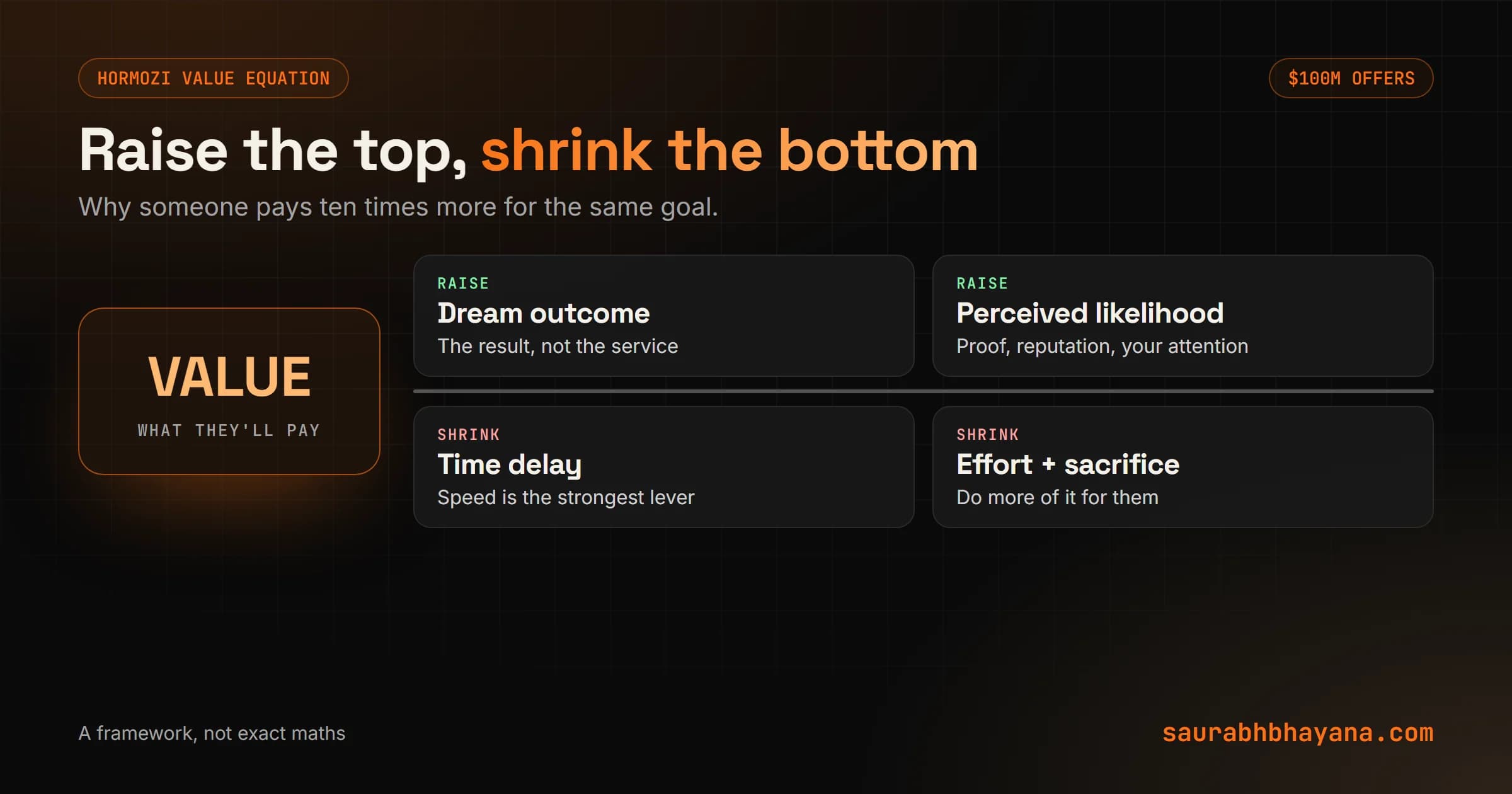
So what makes someone pay ten times more? Hormozi's answer, from his book $100M Offers, is a simple framework. Value goes up with two things and down with two things:
- •Dream outcome (up): what the customer really wants. Not your service, the result. Not "a website", but "enquiries every week".
- •Perceived likelihood (up): how sure they are it will work. Your reputation, proof and personal attention all raise this. One-to-one work feels more certain than a PDF.
- •Time delay (down): how long until they see the result. Hormozi says speed is the single strongest lever, especially for wealthy buyers, who value their time more than their money.
- •Effort and sacrifice (down): how much work it takes on their side. The more you do for them, the more it is worth.
Picture two offers for the same goal, losing weight. One is a meal-plan PDF. The other is a daily check-in with a coach who adjusts the plan every week. The outcome is the same. The likelihood is higher and the effort is lower in the second, so people will pay many times more for it.
How to create a high-ticket offer: 3 ways to design it
Hormozi gives three thinking exercises. Try each for ten minutes.
- 1.The 10x test. If a customer paid you ten or a hundred times your current price, what would you include? List everything, cross out what costs real money, and look at what is left. You will often find you'd happily do the rest for $1,000 or $10,000.
- 2.The word-of-mouth test. If this one customer telling their friends was your only way to get new customers, what would their experience have to be? Write that down. That is your premium tier.
- 3.The scalable 10x test. Take out everything that needs your personal time, but still make it worth ten times more. This is how you later build premium offers that don't depend only on you.
Then build the tier around the two cheapest levers to add: speed and ease. Halve your delivery time. Offer priority: first in line, first to see anything new, first response in an emergency. Then walk through every step your customer takes and remove as many as you can. Every step you take off their plate adds value.
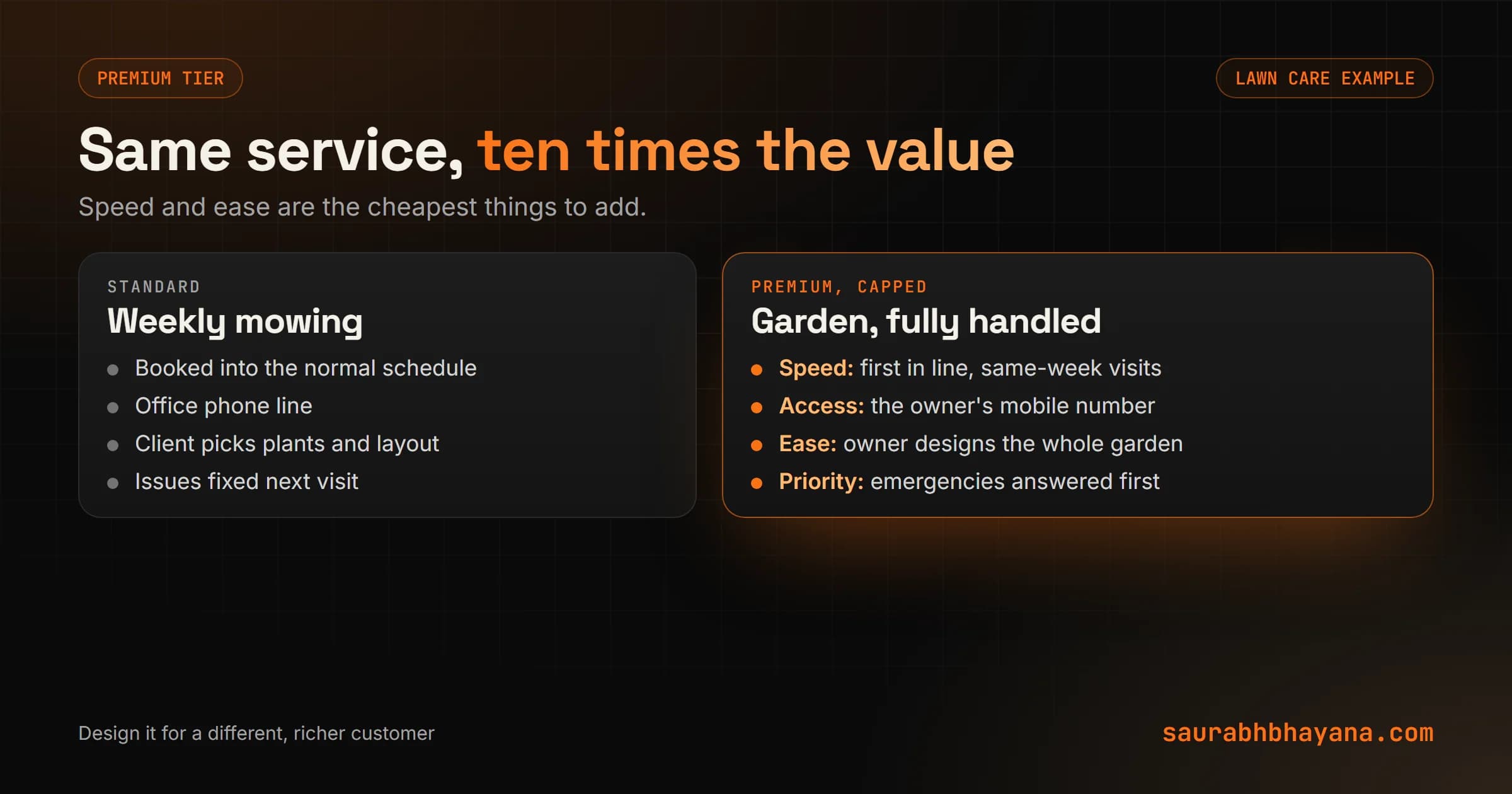
One more step people skip: design it for a different customer. Don't ask what your $100 buyer would pay $1,000 for. The $1,000 buyer is usually a different person, with more money and a more urgent problem. Describe their pain in their own words, better than they can. Hormozi suggests reading reviews of the books your customers buy and pulling out the exact phrases they use. AI is very good at sorting hundreds of reviews into the top complaints.
Not sure the premium idea will sell? Test it the cheap way first, as we describe in how to validate a business idea with AI.
How to raise prices without losing customers
Adding a premium tier is the gentlest way to raise prices, because nobody is forced to pay more. Existing customers keep their option, and the ones who want more finally can buy it. A few more rules we follow:
- •Cap your premium time. Five or ten percent of your week is enough. When demand grows, raise the price rather than the hours.
- •Use the extra margin to pay your suppliers better, so they put your premium customers first.
- •Share what you learn from premium clients. They usually give you your best case studies.
- •Raise standard prices in small steps, and add something new when you do.
Freelancers can use exactly the same approach. Our guide on how to start freelancing covers pricing your first offer before you get to this stage.
Is selling your time a bad idea?
A lot of people think selling your time is a trap. Hormozi disagrees, at least at the start. Everyone earns per hour in the end, he argues: divide what you made last year by the hours you worked. One-to-one work also teaches you faster, because you can change things for each client without retraining a team or rebuilding a system.
Our honest caveat: it is a starting move, not the end state. Cap it, price it high, and use what you learn and earn to build something that doesn't need you in every hour.
The bigger picture
Most small businesses compete on the price of their cheapest option and never test the top. Adding one premium tier costs almost nothing, and at worst it makes your main offer look better. At best, a handful of buyers changes your whole year.
So, what would you include if a customer paid you ten times your current price? Write the list tonight and put the best version on your menu this week. If you want AI to take over the repetitive parts so you have time for premium clients, tell us what eats your week.
Sources: the Alex Hormozi talk on YouTube that inspired this post, at youtube.com/watch?v=uWdIgftpvBI; Tesla, "The Secret Tesla Motors Master Plan", 2006; Alex Hormozi, $100M Offers.
Frequently asked questions
What is a high-ticket offer?+
A premium version of what you already sell, priced several times higher, usually with more personal access, faster results and less effort for the customer. For many small businesses it is the owner's time, sold at a premium and capped.
How do I create a high-ticket offer?+
Design it for a richer customer with an urgent problem, list what you would include for ten times your price, add speed and ease through priority and done-for-you work, cap the time it takes, and state the price clearly.
What is price anchoring?+
Price anchoring means the first price people see shapes how they judge later prices. Showing a premium price first makes the standard price feel reasonable, even if few people buy the premium option.
What is the Alex Hormozi value equation?+
A framework from his book $100M Offers: value rises with the dream outcome and the buyer's belief that it will happen, and falls with the time delay and the effort or sacrifice required.
How can I raise prices without losing customers?+
Add a premium tier instead of forcing everyone onto a higher price, raise standard prices in small steps, and add something new each time you do.
Does a premium tier work if nobody buys it?+
Yes. It still acts as a price anchor that makes your main offer look better value, and it lifts how customers see your brand.
Is selling your time a bad business model?+
Not at the start. Premium one-to-one work earns high margins, teaches you fast and can fund growth. Cap it and use it to build offers that don't depend on your hours.
Read next
My team and I automate the work that eats your hours with AI, and get your business found on Google, Maps and in AI answers.