
How to Start Freelancing in 2026 With No Experience (a 30-Day Plan, Plus How We Pick Upwork Jobs)
Is freelancing dead in 2026? Not even close, but the beginner path has changed. Here is how to pick a skill, build a portfolio with no clients, price your work, land your first client, and the exact checks we run before spending Connects on an Upwork job.
Imagine sending 40 proposals in a month and hearing nothing back. Not a no. Just silence. Frustrating, right? Most new freelancers go through exactly this, and most of them blame the wrong thing.
It is rarely about talent. It is usually about the offer, the jobs they choose to bid on, and how fast they expect results. Fix those three and the silence starts to break.
This post is a beginner's roadmap: how to pick a skill, build a portfolio with no clients, price your work, find your first client, and grow from there. It builds on a good guide by a long-time freelancer and agency owner on YouTube, linked at the end. We have added the part we know best: the checks we run before we spend money bidding on an Upwork job.
Is freelancing dead in 2026?
A lot of people think freelancing is dead because of AI and too much competition. Not really. Upwork's Freelance Forward study found that 64 million Americans did freelance work in 2023, about 38 percent of the US workforce, an all-time high at the time.
What has changed is which work pays. Basic manual tasks, like cutting a few clips or making a simple banner, are getting cheaper because AI does a lot of them. Work that needs judgment, strategy or a clear business result still pays well. The freelancers doing best use AI to work faster and sell the result, not the hours.
AI is not your competition. A freelancer who uses AI better than you is.
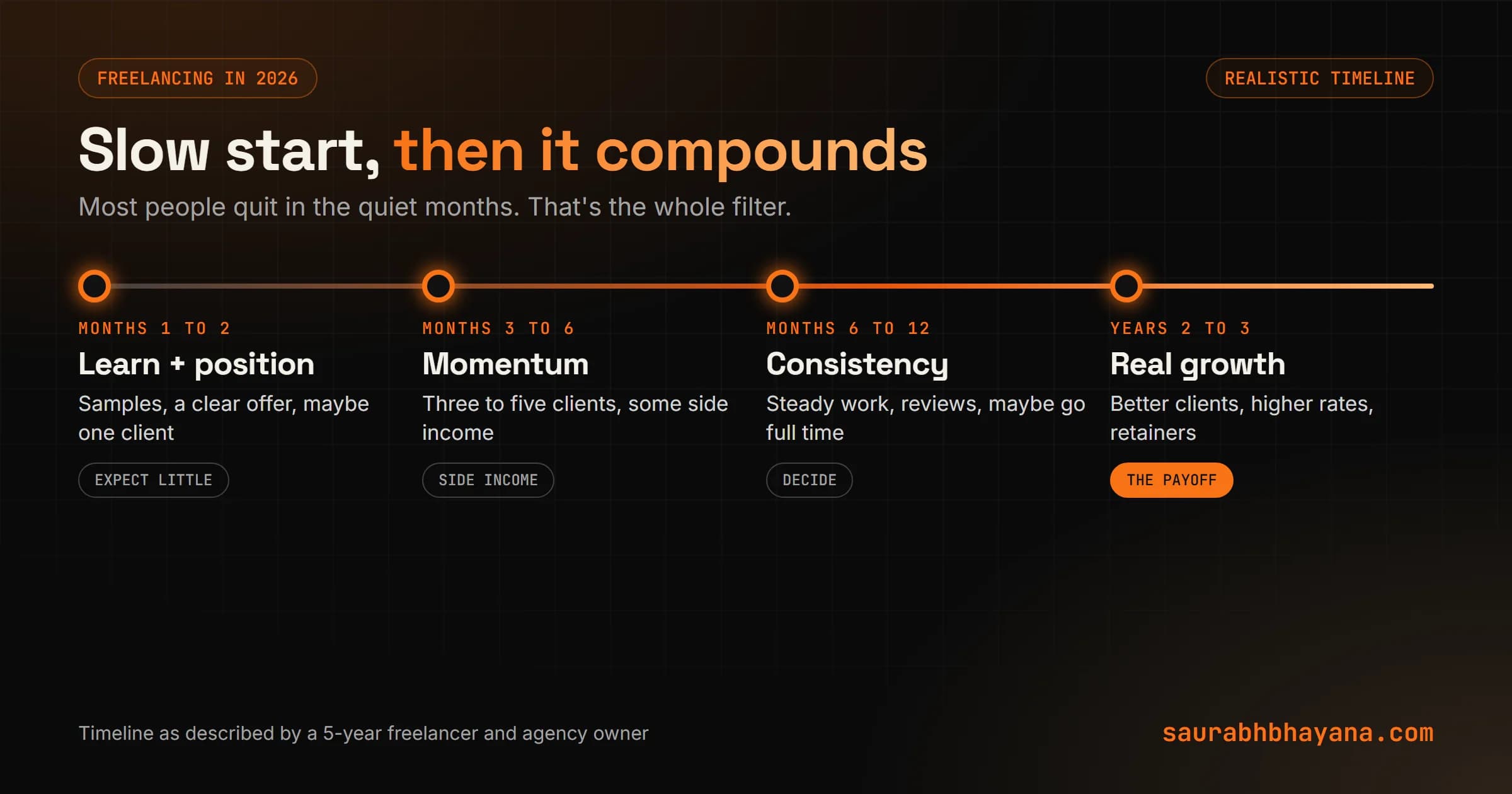
Be honest about the timeline too. The creator of the video puts it roughly like this: months one and two are for learning and maybe a first client, months three to six bring a handful of clients and some side income, and real growth with better clients and higher rates usually comes in years two and three. That matches what we have seen.
How to start freelancing with no experience
Step 1: turn one skill into an offer
Try a few things, then pick one skill. Then stop describing the skill and start describing the result. Use this line: I help [who] do [what] using [how].
- •Weak: "I do video editing, design and websites."
- •Clear: "I help YouTubers edit videos so they can post every week without stress."
- •Clear, with AI: "I help dental clinics reply to every new enquiry in under a minute using an AI follow-up system."
That last kind of offer is where a lot of 2026 demand sits. Our guide to speed to lead shows the sort of business result clients will pay for.
Step 2: check the demand is real
Start offline. Walk into a few local businesses, like a gym, a cafe or a dentist, and ask whether they need help with your skill. The video's creator makes a sharp point here: if you can't pitch in person, pitching online will be harder.
Then look online. On Upwork and Fiverr, note which services are requested often, which niches hire again and again, what people charge, how fast they deliver and how many revisions they offer. Pick a narrow niche from what you find.
Step 3: build a portfolio before you have clients
A portfolio answers one question: can you actually do this? Clients don't care whether a sample was paid. Make two or three sample projects for made-up or friendly businesses, and present them cleanly, not as a messy shared folder.
- •A short intro: who you are and who you help.
- •Your services, written as offers.
- •Two or three samples, with before and after if you can.
- •One or two testimonials, even from a free first project.
- •A professional email and a clear way to contact you.
A simple one-page site does this job well. Before you send people to it, run our five-second website test on it.
How much should I charge as a freelancer?
First, define the offer so the price has something to stand on. The video's example: one minute of finished edited video, with motion graphics, transitions, effects and subtitles, delivered in two days with five revisions, for $80. What is included, what isn't, how fast and how many changes: that is an offer.
Starting out, price for reviews rather than income. The creator says he began at $5, not because the work was bad but because he needed his first reviews. Once you have three to five happy clients, raise prices slowly, by 10 to 20 percent at a time. Good signs it is time: you are booked up, clients compliment the work, or they start sending referrals.
| Pricing trap | Do this instead |
|---|---|
| Staying cheap forever | Raise 10 to 20% each time you are fully booked |
| Pricing by hours of effort | Price the result the client gets |
| Unlimited revisions once established | A fixed number of revisions in the offer |
| Copying a competitor's price | Start from your offer and your target client |
| Saying yes to every request | Say no to work outside your offer |
If you are packaging an AI service rather than a manual one, our guide on how to price an AI product goes deeper on value-based pricing.
How to get your first freelance client
The video's creator gives one piece of advice that sounds odd in a freelancing guide: if you have zero experience, work under someone first, even an internship or helping a freelancer in your niche. You learn how real projects, deadlines, files and client communication work far faster than from tutorials. We agree.
Your first paying client will most likely be someone close: a local business owner, a friend's company, a creator you already follow. After that, there are two ways to find clients:
| Outbound (you reach out) | Inbound (they find you) | |
|---|---|---|
| Examples | Cold emails, Instagram or LinkedIn messages, local visits, comments on creators' posts | Upwork and Fiverr search, your website on Google, content, referrals |
| Speed | Fast to start | Slow to build, then steady |
| Best for | Your first few clients | Months 6 onwards |
Marketplaces are the easiest inbound channel for beginners, because clients arrive ready to buy and the platform handles payment protection, contracts and disputes. Pick one or two and give them 90 days.
How to get your first client on Upwork: how we pick jobs
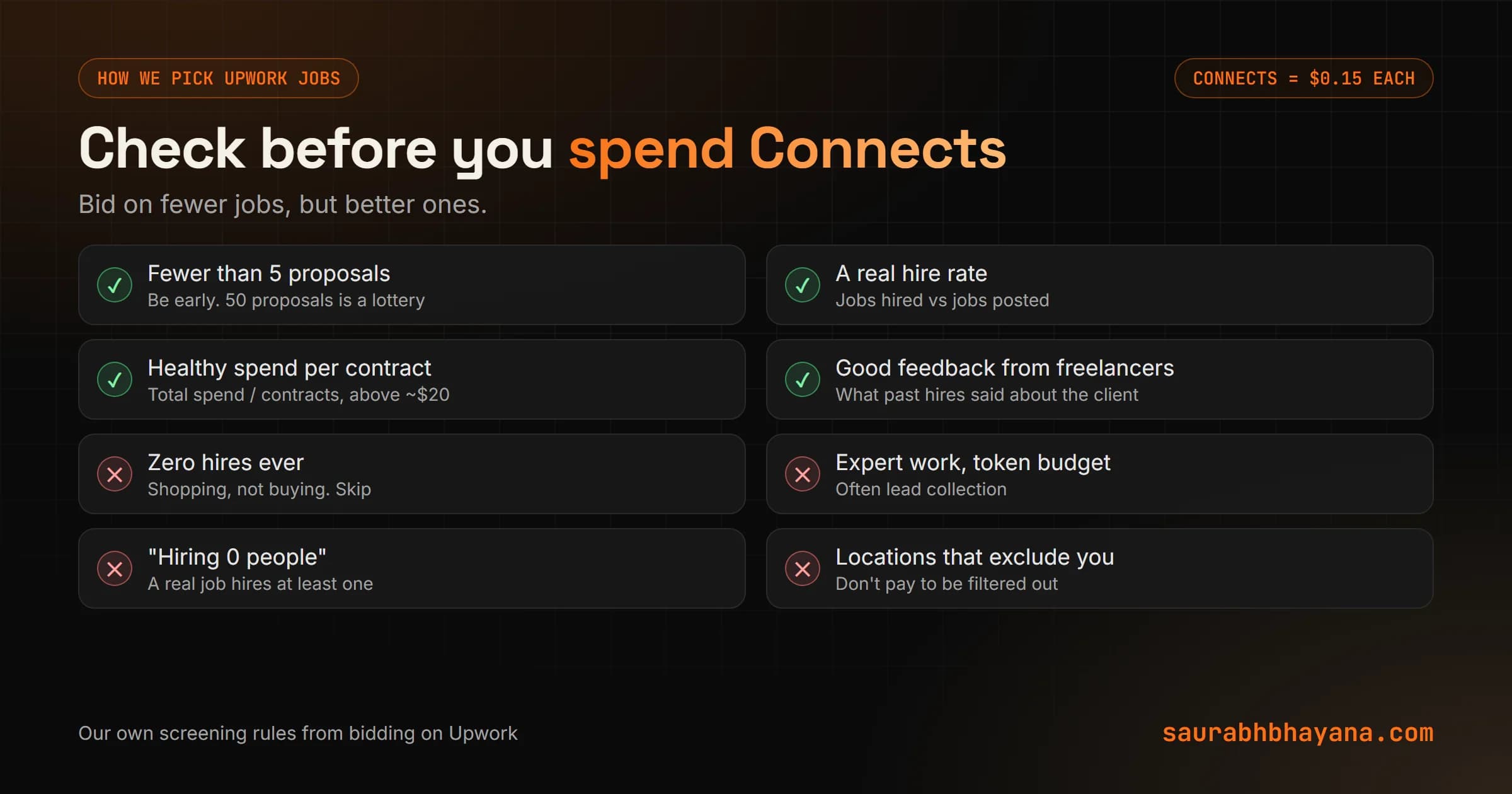
Here is the part most guides skip. On Upwork, every proposal costs Connects, which cost $0.15 each, and a single proposal can use several. Bid on the wrong jobs and you are paying to be ignored. These are the checks we run before we bid:
- 1.Fewer than 5 proposals. Be early. A job with 50 proposals is a lottery.
- 2.A real hire rate. Compare the jobs the client posted with the jobs where they actually hired someone. A low rate means they are shopping, not hiring.
- 3.Never a client with zero hires. However good the job looks, a client who has posted several jobs and hired nobody is not ready to buy.
- 4.Average spend per contract. Divide total spend by number of contracts. If it is tiny, around $20 or less, it is micro-task churn, not real projects.
- 5.What other freelancers said. Read the feedback freelancers left for the client. Repeated low scores mean trouble.
- 6.Fake posting signs. Expert-level work for a token budget, or a posting that says it is hiring zero people, is often lead collection. Skip it.
- 7.Location settings. If the client limited the job to countries you are not in, don't spend the Connects.
Then the proposal itself. Our rules are simple: open with their problem in your own words, not your life story; show one sample that matches their job; make one specific suggestion or ask one sharp question about the project; and keep it short. Don't paste the same template into every job. Clients can tell in two lines.
Read the client's past job titles in their history. They often reveal the business or website, which lets you open with something specific about their situation.
Don't depend on one platform
Platforms change their algorithms, accounts get suspended, rankings drop and seasons slow down. The creator of the video gets most of his revenue from Fiverr, yet he still built a personal brand on Instagram and YouTube, an agency website for retainer clients, and outreach as a backup. That is the right instinct.
A personal brand doesn't mean a million followers. It means a clean profile, your portfolio on your own site, and regular posts about what you are building and learning. Even a few hundred engaged followers in your niche can send you more work than a platform where nobody can see you.
How to start freelancing in 2026: a 30-day plan
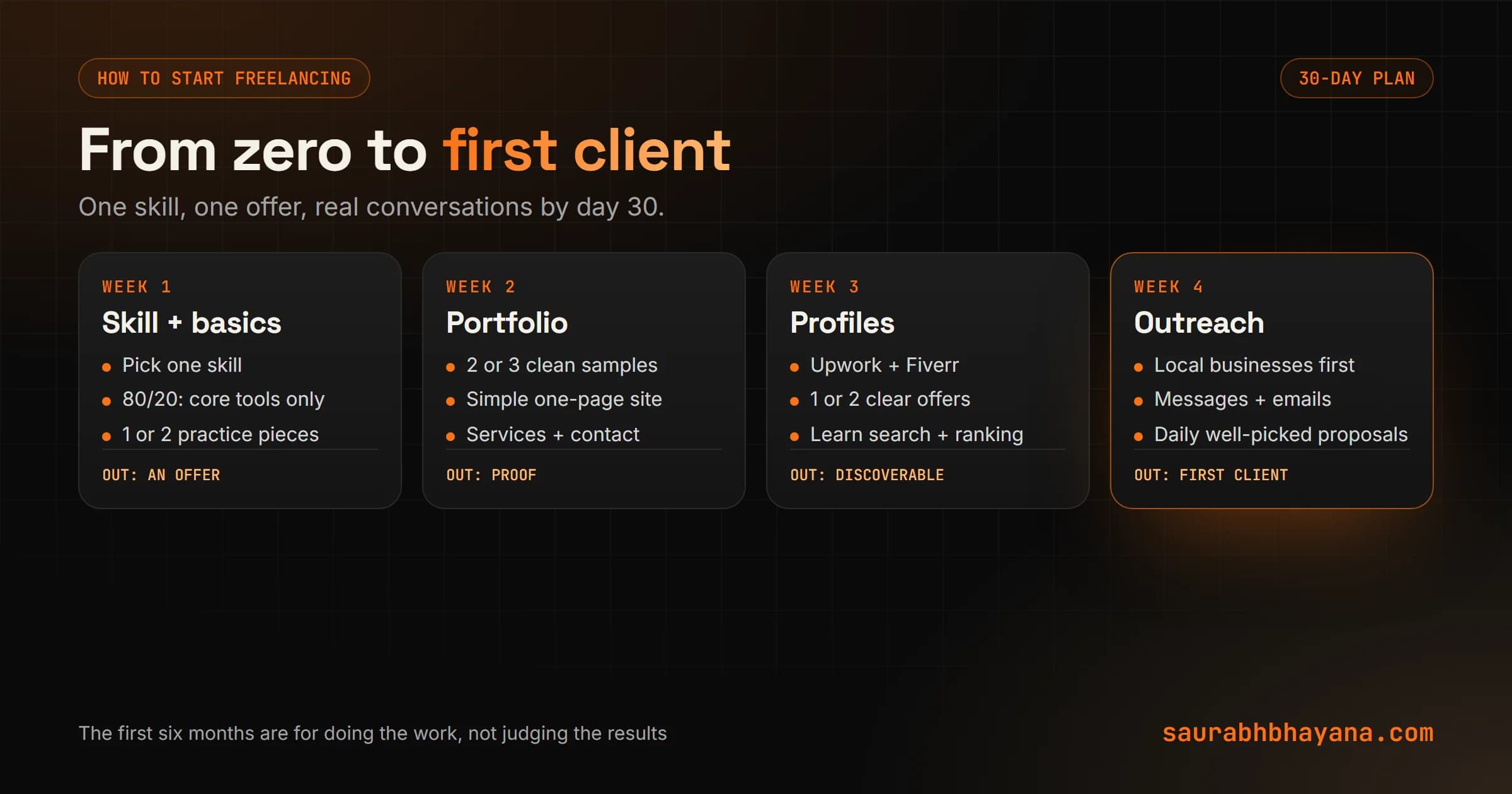
- 1.Week 1: pick one skill and learn the fundamentals. Use the 80/20 rule: the core tools and techniques, not fancy effects. Make one or two practice pieces.
- 2.Week 2: build two or three clean samples and a simple portfolio site with your intro, services, samples and contact details.
- 3.Week 3: set up your Upwork and Fiverr profiles. One or two clear offers, your samples, and time spent learning how search and ranking work on each.
- 4.Week 4: outreach. Local businesses first, then messages and emails online. Send a few well-chosen Upwork proposals a day, using the checks above, and track which ones get viewed.
From freelancer to agency
Once the work is steady, the video suggests freelancing solo for a year or two before thinking about an agency. When you do grow, it comes down to four things:
- •Systems: a standard welcome message, project checklist, folder structure, revision process and templates for proposals and contracts.
- •Smart scaling: raise prices, get faster and better, and hire part-time help only when you need it.
- •Retainers: monthly clients paying for ongoing work. The creator says about half his revenue now comes from repeat clients.
- •More income streams: retainers, agency work, content, templates or courses, so one slow month doesn't sink you.
Want to see what an AI-first version of this looks like? Our list of AI businesses you can start with zero employees covers several service ideas built this way.
The bigger picture
Freelancing in 2026 rewards the same things it always did, just faster: a clear offer, proof you can deliver, and the patience to keep showing up. AI raised the floor, so ordinary work got cheaper. It also raised the ceiling for freelancers who use it to deliver results nobody could deliver alone a few years ago.
So, what is the one sentence offer you could send to a local business this week? Write it, send it to three people, and see what comes back. If you are building an AI service and want a second opinion on your offer, send it to us.
Sources: the freelancing guide on YouTube that inspired this post, at youtube.com/watch?v=apVFrq7YklA; Upwork, Freelance Forward 2023.
Frequently asked questions
How do I start freelancing with no experience?+
Pick one skill, turn it into a clear offer, build two or three sample projects, put them on a simple portfolio site, and reach out to local businesses before setting up Upwork or Fiverr profiles. If you have never worked on a real project, a short internship or helping another freelancer first saves months.
Is freelancing dead in 2026?+
No. Upwork's Freelance Forward study found 64 million Americans freelanced in 2023, 38% of the US workforce. AI has made simple manual tasks cheaper, but work that needs judgment, strategy or a business result is still in demand.
How do I get my first client on Upwork?+
Bid early on jobs with fewer than 5 proposals, choose clients with a real hire rate and history, avoid clients with zero hires or tiny spend per contract, and write short proposals that open with the client's problem and show one matching sample.
How much should I charge as a freelancer?+
Define your offer first: what is included, delivery time and revisions. Start at a price that wins your first reviews, then raise it 10 to 20 percent at a time once you are fully booked or getting referrals. Price the result, not your hours.
How much do Upwork Connects cost?+
Connects cost $0.15 each, and a proposal can use several, so each bid has a real cost. That is why it pays to bid on fewer, better jobs.
How long does it take to make money freelancing?+
Most beginners spend the first one or two months learning and landing a first client, reach a few clients and some side income in months three to six, and see real growth in years two and three.
What are the best freelancing skills in 2026?+
Skills that deliver a clear business result and use AI well tend to pay best, such as AI automation, web development, video editing with strategy, and marketing tied to leads or sales. Pure manual tasks are getting cheaper.
Read next
My team and I automate the work that eats your hours with AI, and get your business found on Google, Maps and in AI answers.