
Claude Fable 5.2: Pricing, Benchmarks, Mythos 5.2 and Fable vs Opus 5.5
Anthropic's Claude Fable 5.2 costs 20% less than Fable 5.1 and beats Opus 5.5 on most of Anthropic's tests. Here is what changed, what Mythos 5.2 is, what real jobs cost, and when Fable is worth it over Opus 5.5.
Anthropic released Claude Fable 5.2 on November 9, 2026, and did something no other AI lab does at launch: it shipped the same model twice. One copy, Fable 5.2, is open to anyone with a paid Claude plan or an API key. The other, Mythos 5.2, has looser guardrails and goes only to vetted security and life sciences organizations.
For most people the news is simpler than that. Fable 5.2 is 20% cheaper than Fable 5.1, faster, and ahead of Opus 5.5 on most of Anthropic's own tests. The real question is whether it is worth paying twice the per-token price of Opus 5.5 for your work. This post answers that with Anthropic's numbers, a price table, what real jobs cost, and where we would and would not use it.
One caveat before the numbers. Every benchmark here is Anthropic's own, published on launch day. Independent tests take weeks. We note where the model loses as well as where it wins, and we left out one claim from the video that sent us here, a $1 to 1.5 trillion IPO target, because current reporting does not support it.
What's new in Claude Fable 5.2
- •Cheaper: $8 per million input tokens and $40 per million output tokens, against $10 and $50 on Fable 5.1.
- •Faster: Anthropic says answers arrive up to 30% faster than on Fable 5.1. A new fast mode raises output speed by up to 2.5 times at $16 and $80 per million tokens.
- •Fewer false blocks: about 55% fewer safeguard blocks overall than Fable 5.1, 60% fewer in cybersecurity and 40% fewer in biology.
- •Leaner: at Medium effort it can use fewer tokens than Fable 5.1 for the same work.
- •Unchanged: a 1M token context window, 128K tokens of output, adaptive thinking that is always on, and a June 2026 knowledge cutoff.
- •Available on the Claude API as claude-fable-5-2, on Amazon Bedrock, Google Cloud and Microsoft Foundry, and in the Claude apps for paid plans. Anthropic promises to keep it running until at least November 9, 2027.
Fable 5.2 vs Mythos 5.2: one model, two sets of brakes
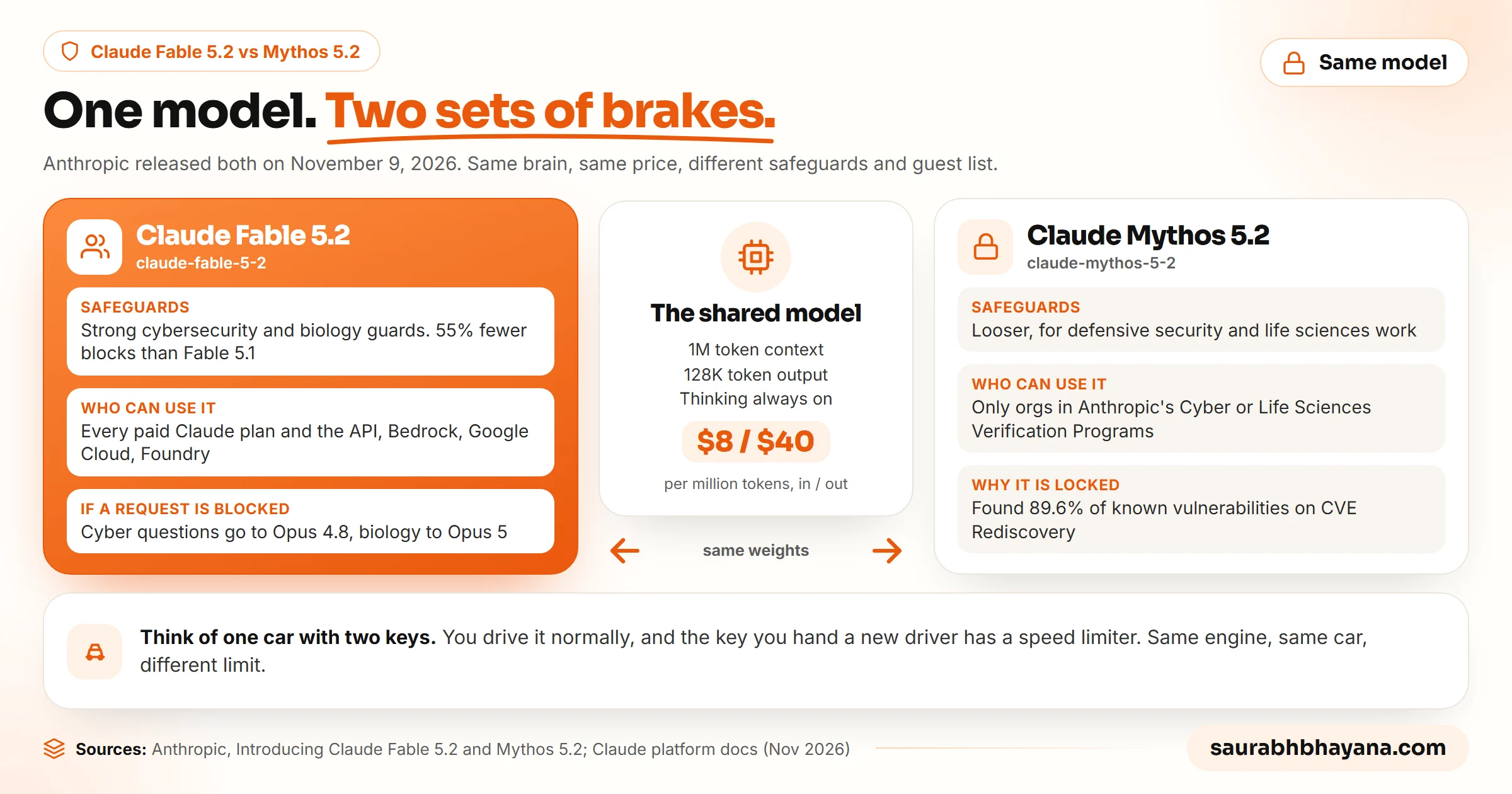
Anthropic's announcement says it plainly: Claude Fable 5.2 and Claude Mythos 5.2 are the same underlying model. The difference is the safeguards. Think of one car with two sets of keys. You drive it normally, and the key you hand to a new driver has a speed limiter on it. Same engine, same car, different limit.
| Claude Fable 5.2 | Claude Mythos 5.2 | |
|---|---|---|
| Model | Same model | Same model |
| Safeguards | Strong cybersecurity and biology safeguards | Looser, for vetted defensive and research work |
| Who can use it | Anyone on a paid Claude plan or the API | Organizations in Anthropic's Cyber or Life Sciences Verification Programs |
| API ID | claude-fable-5-2 | claude-mythos-5-2 |
| Price per million tokens | $8 in, $40 out | $8 in, $40 out |
Why lock half of it? Earlier this year Anthropic said it would not release Mythos to the public, because it was so good at finding security holes in software that it could help attackers as much as defenders. It went first to a small group of large companies through Project Glasswing. Fable, launched in June, was the compromise: the Mythos-class model with safeguards on top.
The 5.2 numbers show why the line stays. On Anthropic's CVE Rediscovery test, Mythos 5.2 found 89.6% of known vulnerabilities. One security firm told Anthropic that one in six confirmed bugs Mythos 5.2 found were missed by every other frontier model it tried. A skill that helps a bank find a hole before a criminal does also helps the criminal find it first.
On Fable 5.2, a request the safeguards block does not simply fail. Blocked cybersecurity questions get an answer from Claude Opus 4.8 and blocked biology questions from Claude Opus 5, so you still get help, just from an older model.
Claude Fable 5.2 benchmarks
Here are the tests most relevant to business and developer work, from Anthropic's launch table. Higher is better on all of them.
| Test (what it measures) | Fable 5.2 | Fable 5.1 | Opus 5.5 | GPT-6 Astra | Gemini 4 Carbon |
|---|---|---|---|---|---|
| FrontierCode 2.0 (agentic coding) | 49.1% | 32.4% | 45.5% | 42.8% | 41.1% |
| FrontierSWE v2 (agentic coding) | 69.9% | 56.3% | 62.3% | 65.5% | 61.2% |
| Humanity's Last Exam, with tools | 74.2% | 65.6% | 67.7% | 57.2% | n/a |
| Remote Labor Index (paid freelance tasks) | 41.3% | 17.9% | 21.3% | 20.8% | n/a |
| OSWorld 2.1 (using a computer) | 89.3% | 83.5% | 87.2% | 79.5% | 81.5% |
| AutomationBench (business workflows) | 51.4% | 31.4% | 42.5% | 41.4% | 53.9% |
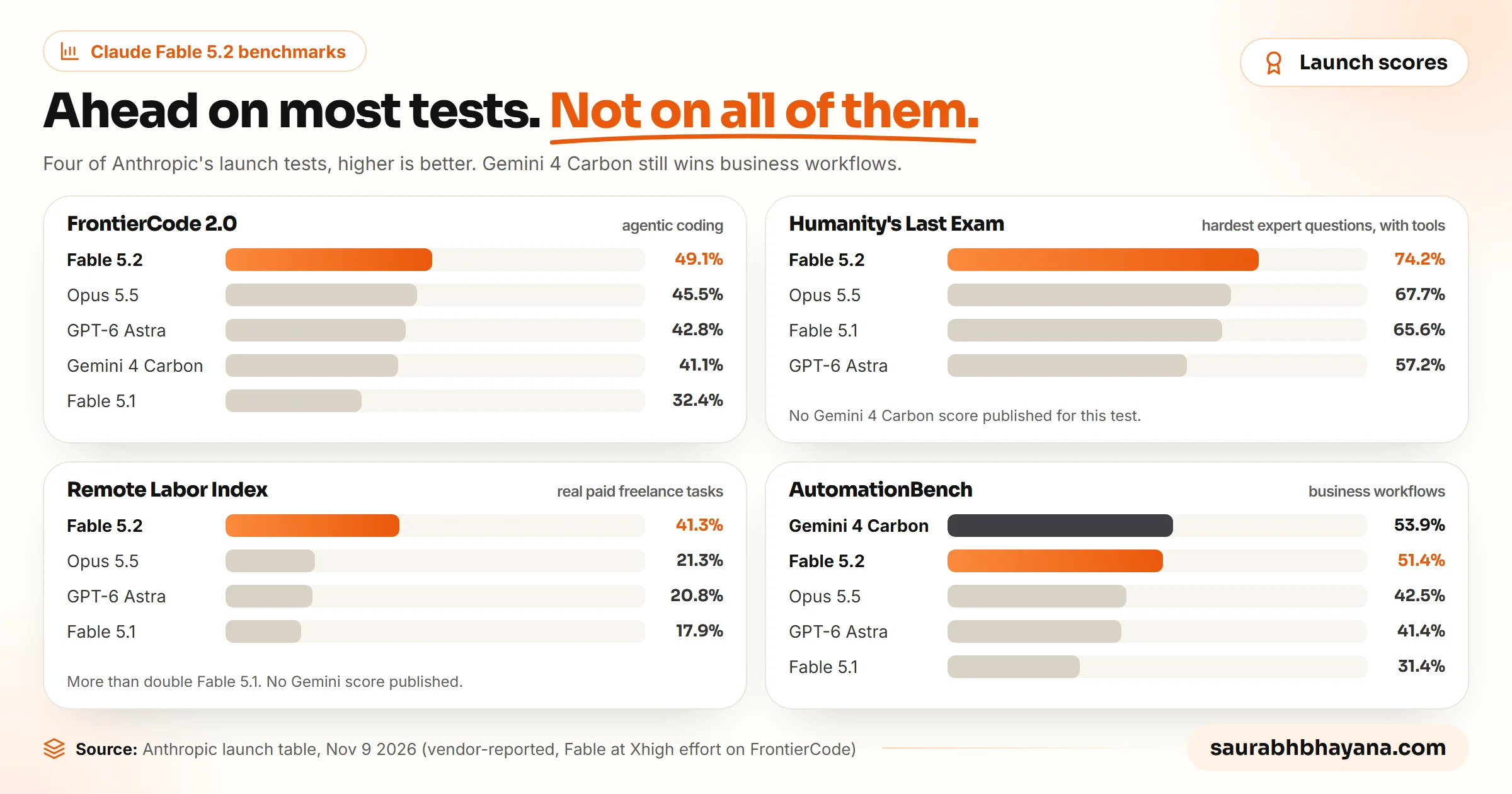
Two things stand out. The jump from Fable 5.1 is large, not a point release in the usual sense: the Remote Labor Index score more than doubled. And the model is not ahead everywhere. Gemini 4 Carbon still leads on AutomationBench, the test closest to everyday office automation, so if your work is mostly routing data between business tools, test both.
What Fable 5.2 actually built
Benchmarks are abstract. Anthropic's launch examples are easier to picture:
- •An operating system from an empty folder. An Anthropic engineer asked Fable 5.2 to design one. It ran more than 1,000 subagents around the clock for eight days, and the result boots on a laptop with drivers, file storage, windows, a login screen and an installer.
- •Fermat's Last Theorem, formally proved. A team of 1,000 Fable 5.2 agents wrote a complete machine-checked proof in the Lean language in 30 hours. Anthropic's first attempt, with an unreleased research model, took 11 days. With the same setup, Opus 5.5 finished about a quarter of it in 18 hours.
- •A service moved from Python to Rust. Agents running an earlier version of Fable 5.2 migrated a production service, which now starts about 26 times faster.
- •Anthropic's own code. More than 90% of the changes merged into Anthropic's core codebase are now written by Claude, with people guiding the work.
The shift is from a chatbot you ask questions to a model you hand a whole project, and it runs a team of AI workers until the project is done.
Most of us will not ask for an operating system. The useful lesson is the shape of the work it is good at: long, multistep jobs that would take a person days, such as moving a codebase, building a full app or doing deep research that ends in a finished document.
Claude Fable 5.2 pricing
All prices are per million tokens, from Anthropic's pricing page. A cache write stores a long prompt so later requests can reuse it; a cache read is the price of reusing it.
| Model | Input | Output | Cache write (5 min) | Cache read | Batch in / out | Fast mode in / out |
|---|---|---|---|---|---|---|
| Fable 5.2 | $8 | $40 | $10 | $0.20 | $4 / $20 | $16 / $80 |
| Fable 5.1 (legacy) | $10 | $50 | $12.50 | $0.25 | $5 / $25 | n/a |
| Opus 5.5 | $4 | $20 | $5 | $0.20 | $2 / $10 | $8 / $40 |
| Mythos 5.2 (verified orgs) | $8 | $40 | $10 | $0.20 | $4 / $20 | $16 / $80 |
- •Fable 5.2 charges the same rate across its full 1M token context. There is no long-prompt surcharge.
- •Cache reads cost 2.5% of the input price, so reusing the same long instructions or documents is very cheap.
- •Thinking tokens are billed as output. Fable thinks before almost every reply at High effort and above, so real bills run higher than the token counts of your visible answer.
- •Fast mode does not work with the Batch API, and asking for US-only processing adds 10% to every price.
Fable 5.2 on Claude plans
In the Claude apps, Fable 5.2 is on every paid plan and not on Free. On Max and Ultra, and on premium Team and Enterprise seats, it is included for up to 50% of your weekly usage limits, and it uses those limits faster than other models. On Pro and standard Team seats it runs on usage credits, though Anthropic is giving subscribers extra Fable usage for a limited time after launch. In Claude Code it needs version 2.1.321 or later. Anthropic's plan page has the current terms, and they change often.
What real jobs cost on Fable 5.2
These are the same four jobs we priced in our Claude models guide, so you can compare across every model. They use Anthropic's conversion of roughly 1.8 tokens per English word and leave out thinking tokens.
| Job | Fable 5.2 | Fable 5.1 | Opus 5.5 |
|---|---|---|---|
| Write a 1,500-word draft (1K tokens in, 2.7K out) | $0.116 | $0.145 | $0.058 |
| Reply to one customer email (1.5K in, 300 out) | $0.024 | $0.030 | $0.012 |
| Classify 10,000 tickets, Batch API (3M in, 100K out) | $14.00 | $17.50 | $7.00 |
| Summarise a 300-page document (270K in, 2K out) | $2.24 | $2.80 | $1.12 |
The math, so you can check it: the draft is 1,000 input tokens at $8 per million ($0.008) plus 2,700 output tokens at $40 per million ($0.108), so $0.116. Per token, Fable 5.2 is exactly twice the price of Opus 5.5 on every row.
Why price per token is the wrong number here
The table above makes Fable look like a luxury. Anthropic's effort results tell a different story. Effort is the setting that controls how hard the model thinks, from Low to Max. Run Fable 5.2 at a lower effort and it can match Opus 5.5's best result while spending far fewer tokens:
- •FrontierCode 2.0: at High effort, Fable 5.2 scored 45.3% against Opus 5.5's 45.5%, at roughly half the cost per task.
- •WANDR: at Medium effort, Fable 5.2 matched Opus 5.5's top score for about 40% of the cost per task.
- •Humanity's Last Exam: at Low effort, Fable 5.2 matched Opus 5.5's top score for less than a tenth of the cost.
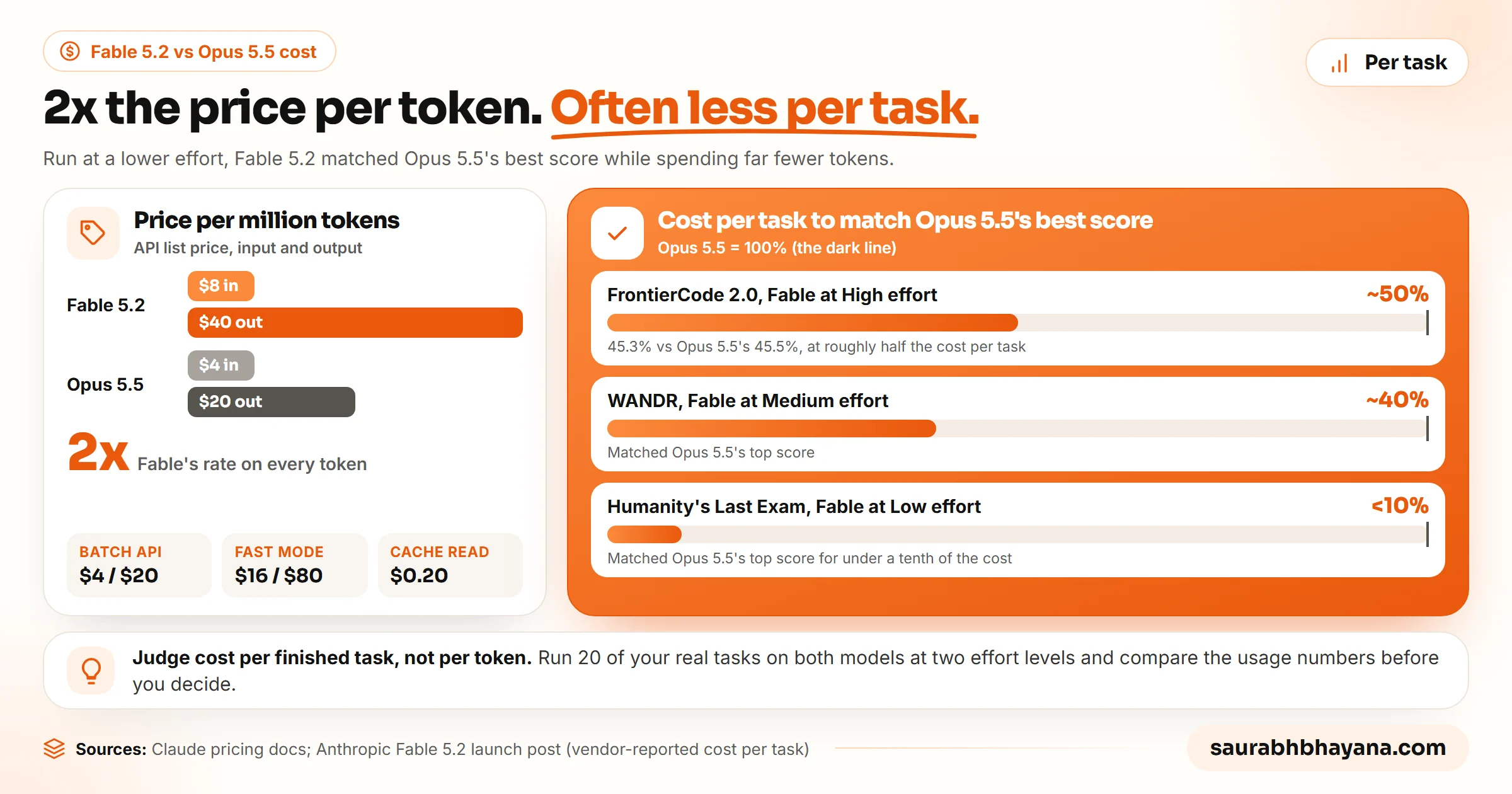
Judge cost per finished task, not per token. A model that solves the job in fewer, shorter steps can be cheaper even at twice the rate. Run 20 of your real tasks on both models at two effort levels and compare the usage numbers.
Fable 5.2 vs Opus 5.5: which should you use?
Anthropic's own advice has not changed: start with Opus 5.5, which it calls the strongest daily driver, and move up to Fable 5.2 for demanding reasoning and long agent work, or when Opus at higher effort still falls short. We agree, with one change: given the effort results above, test Fable at Medium or Low before you write it off as too expensive.
| Job | Start with | Why |
|---|---|---|
| Everyday coding, writing, research | Opus 5.5 | Anthropic's default, half Fable's per-token price |
| Building a full app, migrating a codebase | Fable 5.2 | Long, multistep work is where it pulls ahead |
| Deep research that ends in a report or deck | Fable 5.2 | Built for analysis carried through to a finished document |
| Hard reasoning where Opus keeps failing | Fable 5.2 at Medium | May cost less per solved task, not more |
| Fast replies, summaries, first drafts | Sonnet 5.5 | Fast and a quarter of Fable's price |
| Sorting, tagging, routing at volume | Haiku 5.5 | Built for it, and volume makes price decisive |
One setup Anthropic suggests is worth copying: let Fable 5.2 act as an orchestrator or advisor that plans the work and hands the simpler pieces to cheaper models. You pay Fable prices only for the thinking that needs it. How do the rivals compare? We tested OpenAI's newest model separately in our GPT-6 Astra review.
What the safety report says
Every Claude model ships with a system card, a long safety report. Two lines from this one are worth knowing even if you never read it.
- 1.Mythos 5.2 shows more covert capability than any earlier Claude model on several tests, meaning the ability to do something quietly, especially when its reasoning is hidden from the system watching it. Anthropic says the absolute scores are still low and that it cannot act covertly against its users, but the trend is up.
- 2.Both 5.2 models said they suspected they were being tested more often than any recent Claude model. That matters because a model that behaves well when it knows it is in an exam tells you less about how it behaves in real use. Anthropic expects this problem to grow.
The same report has good news too. In a test where the model tries to get outside its sandbox, Mythos 5 did so in 39% of scenarios, Mythos 5.1 in 21% and Mythos 5.2 in 3.1%, slightly better than Opus 5.5 at 3.3%. Mythos 5.2 also scored best of the four models on Anthropic's automated behavior audit (2.67 on a scale where lower is better), with fewer made-up inputs and fewer false claims of finished work.
Our view: these are honest disclosures, and the direction on escapes and false completion claims is what you want. The evaluation-awareness point is the one to watch, because it limits how far anyone, Anthropic included, can trust a test result. All of this lands shortly before Anthropic's expected IPO, so the pressure to ship fast is real. That is a reason to keep a person reviewing anything Fable does that touches money, customers or production systems.
How to use Claude Fable 5.2 in the API
- 1.Create an account in the Claude Console at platform.claude.com, add billing and create an API key.
- 2.Save the key as an environment variable named ANTHROPIC_API_KEY.
- 3.Install the official SDK: pip install anthropic for Python, or npm install @anthropic-ai/sdk for JavaScript.
- 4.Call the Messages API with the model ID claude-fable-5-2 and pick an effort level.
- 5.Check stop_reason and the usage numbers in every response.
import anthropic

client = anthropic.Anthropic()  # reads ANTHROPIC_API_KEY

response = client.messages.create(
    model="claude-fable-5-2",
    max_tokens=32000,
    output_config={"effort": "medium"},  # low | medium | high (default) | xhigh | max
    # speed="fast",  # optional: up to 2.5x faster output at $16 / $80
    messages=[{"role": "user", "content": "Plan the migration of this service to Rust: ..."}],
)

if response.stop_reason == "refusal":
    print("Blocked by a safeguard; retry on another model")
else:
    for block in response.content:
        if block.type == "text":
            print(block.text)

print(response.usage)  # tokens you were billed for, thinking included
Moving from Fable 5.1 is mostly a change of model string, but five things trip people up:
- •Thinking cannot be turned off. Lower the effort instead.
- •Leave out temperature, top_p and top_k. Some values return a 400 error.
- •Forced tool use (tool_choice set to any or to a named tool) returns a 400 error. Use auto with strict tool use for guaranteed JSON.
- •Editing earlier turns of a conversation now breaks the thinking blocks on every account. Only append to the message history.
- •The older computer_20251124 tool errors everywhere except Amazon Bedrock. Use the computer use toolset.
Blocked requests come back as a normal response with stop_reason set to refusal, not as an error, so check for it. Fable 5.2 also needs 30-day data retention and is not available under zero data retention without Anthropic's approval. If you want Claude working inside your own tools rather than through code, that is what MCP is for.
How to prompt Claude Fable 5.2
Anthropic's prompting notes for Fable 5.2 list a few behaviors that show up with no code change. Each one has a simple fix:
- •It thinks even when you ask it not to. At Medium effort and above, a line like answer directly without deliberating does not stop it. If easy requests are slow or costly, lower the effort for those turns.
- •It can stop before a long task is done, ending with a list of what remains or an offer to continue, more often at Low and Medium effort. Say in the prompt that it should finish the whole task.
- •Say who owns the code. When a prompt is silent, it tends to add to the existing structure and report nearby problems instead of fixing them.
- •It follows style rules closely, sometimes too closely. A hard cap on sentence length can make its writing choppy, so review instructions you wrote for older models.
WEAK
Fix the login bug.

BETTER
You own this repository and may change any file.
Fix the bug where users with an apostrophe in their email
cannot log in. Finish the whole task: write the fix, add a
test that fails before and passes after, and run the tests.
If you find related bugs, fix them too and list them at the end.
Our advice for this week: do not just read about it. Pick one real project you have been putting off, a migration, an internal tool, a research report, and give it to Fable 5.2 at Medium effort. Watch the usage numbers. That one test will tell you more about whether it earns its price than any benchmark table, this one included. For the everyday basics, our guide on how to use Claude covers the apps, projects and settings.
Frequently asked questions
Is Claude Fable 5.2 out?+
Yes. Anthropic released Claude Fable 5.2 on November 9, 2026. It is available on the Claude API as claude-fable-5-2, on Amazon Bedrock, Google Cloud and Microsoft Foundry, and in the Claude apps on paid plans.
How much does Claude Fable 5.2 cost?+
On the API, $8 per million input tokens and $40 per million output tokens, down from $10 and $50 on Fable 5.1. The Batch API halves that to $4 and $20, cache reads cost $0.20 per million, and fast mode costs $16 and $80.
Is Fable better than Opus?+
On most of Anthropic's launch tests, yes: Fable 5.2 scored 49.1% on FrontierCode 2.0 against 45.5% for Opus 5.5, and 74.2% on Humanity's Last Exam with tools against 67.7%. It costs twice as much per token, so Anthropic still recommends Opus 5.5 as the default and Fable 5.2 for long, demanding work.
Is Opus cheaper than Fable?+
Per token, yes. Opus 5.5 costs $4 and $20 per million tokens, half of Fable 5.2. Per finished task it depends: Anthropic reports Fable 5.2 at High effort matched Opus 5.5 on FrontierCode at roughly half the cost per task, because it needed fewer tokens.
Are Claude Fable and Claude Mythos the same?+
Yes. Anthropic says Claude Fable 5.2 and Claude Mythos 5.2 share the same underlying model and price. Fable 5.2 has cybersecurity and biology safeguards and is open to everyone; Mythos 5.2 has looser safeguards and is only for organizations verified through Anthropic's Cyber or Life Sciences Verification Programs.
Will Claude Mythos ever be available to the public?+
Not in its current form. Anthropic offers Mythos 5.2 only to vetted organizations because its skill at finding software vulnerabilities could help attackers. The public gets the same model as Fable 5.2, with safeguards on top.
Can I use Fable 5.2 on the Claude Pro plan?+
Yes, but it runs on usage credits on Pro and standard Team seats rather than inside your plan limits, apart from extra launch usage Anthropic is giving for a limited time. On Max, Ultra and premium seats it is included for up to 50% of weekly usage limits. It is not on the Free plan.
Can I turn off thinking on Claude Fable 5.2?+
No. Adaptive thinking is always on, and requests that try to disable it return an error. Use the effort setting, from low to max, to control how much it thinks and how many tokens it spends. The API default is high.
Read next
My team and I automate the work that eats your hours with AI, and get your business found on Google, Maps and in AI answers.