MCP vs APIs: The Real Difference, Explained for AI Agents
If APIs have worked for years, why is everyone suddenly talking about MCP? Here is the honest difference between MCP and APIs, why AI agents need it, and why MCP does not replace APIs at all.
APIs have worked fine for twenty years. So when people started saying every AI agent needs MCP, the fair question was: why? If an API already lets software talk to software, what is MCP actually adding? The short answer is that MCP is not a replacement for APIs. It is a standard layer on top of them, built for one specific job: letting an AI model use many tools without a custom integration for each one.
This is MCP versus APIs explained plainly, with a real example. One honest caveat up front: if you are building a single app that talks to a single service, you do not need MCP, a normal API is simpler and better. MCP earns its place the moment an AI agent has to reach many different tools and decide which one to use. Here is why.
First, what an API actually is
An API (Application Programming Interface) is how two pieces of software talk to each other. When your weather app shows the forecast, it is calling a weather service's API: it sends a request, the service sends back data. APIs run almost everything online, and they are not going anywhere.
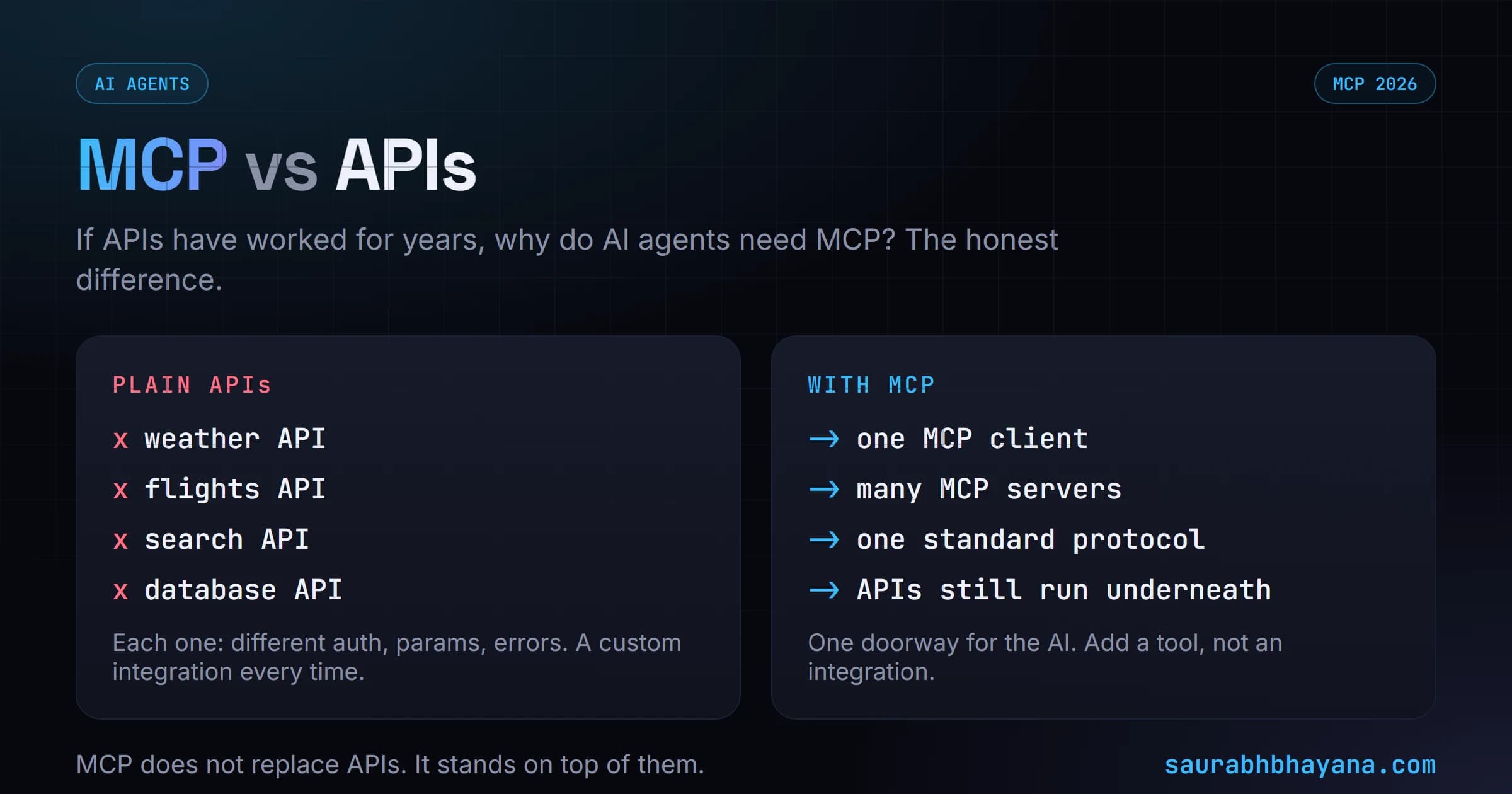
So an AI application can already use APIs. If you want your AI to check the weather, you connect it to a weather API. Want it to search the web, book flights, or read a database? Connect it to each of those APIs too. This works. The trouble starts when you add up how many of them you need.
The fix comes later. First you have to feel the problem, so let us add the services one at a time.
The problem: every API is different
Say your AI assistant needs five things: weather, flights, web search, a database, and your email. That is five APIs. And here is the catch that nobody mentions until they are deep in it: no two APIs work the same way.
- •Authentication is different: one uses an API key, another OAuth, another a token in a header.
- •Parameters are different: each one names and shapes its inputs its own way.
- •Request formats are different: one wants JSON, another form data, another a query string.
- •Responses are different: each returns its data in its own structure.
- •Errors are different: each has its own codes and its own way of saying something went wrong.
So connecting your AI to five services is not one job, it is five separate custom integrations. Ten services is ten. And every time an API changes, you fix the glue code by hand. For a normal app that is manageable. For an AI agent that should be able to reach dozens of tools, it becomes the whole project.
With plain APIs, every new tool your AI can use is another custom integration you have to build and maintain. That is the wall MCP was made to remove.
The fix: instead of teaching the AI five different languages, give it one. That is exactly what MCP does.
What MCP is
MCP stands for Model Context Protocol. It is an open standard, created by Anthropic and now widely adopted, that defines one consistent way for an AI application to talk to tools and data. Think of it as a universal adapter. Instead of the AI learning each API's quirks, every tool is exposed through the same protocol, so they all look the same to the model.
The analogy that makes it click: before USB, every device had its own plug and its own cable. USB gave everything one shape, so any device could plug into any port. MCP is USB for AI tools. One standard, and suddenly the model can plug into anything that speaks it.
The fix in one line: MCP replaces many custom integrations with one shared protocol, so adding a new tool no longer means writing new glue code.
The two pieces: MCP client and MCP server
MCP has just two parts, and once you see them the whole thing makes sense:
| Piece | What it is | Example |
|---|---|---|
| MCP client | Lives inside the AI application and speaks the protocol. | Claude, or an AI agent you build. |
| MCP server | Exposes a set of tools the AI can use, over the same protocol. | A server for WordPress, for GitHub, for a database. |
One MCP client can connect to many MCP servers at once. So a single AI app can reach a WordPress server, a payments server, and a search server together, and every one of them speaks the same protocol. The AI does not care how each server works inside. It just sees a clean list of tools it can call.
The fix: split the mess. The MCP server absorbs the messy, per-service details once, and hands the AI a clean, uniform set of tools.
The key point: MCP does not replace APIs
This is where most explanations go wrong, so it matters. MCP does not kill APIs. In almost every case, an MCP server calls normal APIs behind the scenes. If you build an MCP server for a weather tool, that server still talks to the weather company's API underneath. MCP just wraps it in the standard protocol so the AI never has to deal with the raw API directly.
So the relationship is a stack, not a fight:
- •The AI application talks to MCP servers through the MCP protocol (one standard way).
- •Each MCP server talks to the real services through their normal APIs (the messy part, handled once).
- •The AI never sees the messy part. It only sees clean, uniform tools.
MCP and APIs are not rivals. APIs are how the work gets done; MCP is how the AI asks for it. The server is the translator in between.
The fix: stop thinking MCP versus APIs as either-or. It is MCP on top of APIs. The API does the work; MCP standardises how the AI reaches it.
The real difference, side by side
Here is the whole comparison in one place:
| Plain API | MCP | |
|---|---|---|
| What it connects | One app to one service | An AI app to many tools |
| Integration work | Custom code per service | One protocol for all |
| Who writes the glue | The developer, every time | The MCP server, once |
| Finding tools | Hardcoded by the developer | The model can discover them at runtime |
| Adding a new tool | Build another integration | Point the client at another server |
| Best for | Fixed app-to-service links | AI agents that use many tools |
The fix: match the tool to the job. A fixed integration is fine for a fixed link. MCP wins when the set of tools is large or growing and an AI has to choose between them.
Why this matters so much for AI agents
An AI agent is only as useful as the number of things it can safely do. A chatbot that can only talk is limited; an agent that can read your calendar, send an email, update a database and post to your site is genuinely useful. Every one of those abilities is a tool.
With plain APIs, each new ability is a new custom integration, so agents stay small because expanding them is expensive. With MCP, you add an ability by connecting one more server, and the agent can discover and use it without being rebuilt. That is why MCP took off exactly as AI agents did: it is the piece that lets an agent keep growing what it can do.
The fix: if you are building anything agentic, design around MCP from the start. It is the difference between an agent you have to rewire for every new feature and one you can extend by plugging in another server.
The short version
An API is how software talks to software, and it is not going away. MCP (Model Context Protocol) is a standard layer on top of APIs that lets an AI application reach many tools through one consistent protocol, instead of a custom integration for each. An MCP client lives in the AI app, MCP servers expose tools, and those servers usually call normal APIs behind the scenes. Use a plain API for a fixed app-to-service link. Use MCP when an AI agent needs to use many tools and pick the right one itself. They are not rivals, they are a stack.
If you want to see the API side of this more deeply, the design rules that make any API easy to build on are worth knowing first.
Frequently asked questions
What is MCP (Model Context Protocol)?+
MCP, or Model Context Protocol, is an open standard created by Anthropic that defines one consistent way for an AI application to connect to tools and data. Instead of the AI learning every service's API separately, tools are exposed through the same protocol, so they all look the same to the model. It is often described as USB for AI tools.
What is the difference between MCP and an API?+
An API is how two pieces of software talk to each other, with each service having its own auth, parameters and formats. MCP is a standard layer on top that lets an AI application reach many tools through one consistent protocol. In short: an API connects one app to one service; MCP connects an AI app to many tools without custom code for each.
Does MCP replace APIs?+
No. MCP does not replace APIs. In almost every case an MCP server calls normal APIs behind the scenes; MCP just wraps them in a standard protocol so the AI does not have to deal with each raw API directly. They form a stack: APIs do the work, and MCP standardises how the AI asks for it.
What is an MCP client and an MCP server?+
An MCP client lives inside the AI application (like Claude or an agent you build) and speaks the protocol. An MCP server exposes a set of tools the AI can use over that same protocol, and usually calls real services' APIs behind the scenes. One client can connect to many servers at once, so a single AI app can reach many tools uniformly.
Why do AI agents need MCP?+
An AI agent is only as useful as the number of things it can safely do, and each ability is a tool. With plain APIs, every new tool is a new custom integration, so agents stay small. With MCP you add an ability by connecting one more server, and the agent can discover and use it without being rebuilt. MCP is what lets an agent keep growing what it can do.
When should I use MCP instead of a plain API?+
Use a plain API when one app talks to one service in a fixed way; it is simpler and there is no reason to add a layer. Use MCP when an AI agent needs to reach many tools and decide which to use on its own, or when the set of tools is large or growing. MCP pays off through standardisation, which only matters at scale.
Read next
I build fast, SEO-ready sites and rank them on Google and AI search. Or join my free community and grow alongside other website owners.