What Is RAG? Retrieval Augmented Generation, Explained Simply
An LLM only knows what it was trained on. RAG fixes that by letting it look things up before it answers. Here is how retrieval augmented generation works, the full pipeline, and when to use it.
Ask a plain chatbot about your company's refund policy and it will either guess or tell you it does not know. It was never trained on your documents, and its knowledge stops at some cutoff date. RAG is how you fix that without retraining anything: you let the model look up the right information first, then answer using it. That is the whole idea, and it is behind most serious AI products today.
RAG stands for Retrieval Augmented Generation. This is how it works in plain terms: the pipeline, the pieces that make it tick, and when it is the right tool. One honest caveat first: RAG is powerful but it is not magic. The answer is only ever as good as the information you manage to retrieve, so most of the real work is in the data, not the model.
The problem RAG solves
A large language model is trained once on a huge pile of text, and then it is frozen. That creates three problems the moment you try to use it for real work:
- •Outdated knowledge: it only knows what existed up to its training cutoff. Ask about anything newer and it cannot help.
- •No access to your data: it has never seen your internal docs, your product manuals, your support tickets or your policies.
- •Hallucination: when it does not know, it often makes something up and says it with total confidence, which is worse than saying nothing.
The fix: instead of expecting the model to know everything, give it the relevant information at the moment it answers. That is exactly what RAG does, and it is why RAG beats a plain LLM for any task that depends on specific or current knowledge.
RAG vs fine tuning (the common confusion)
People often ask whether they should fine tune a model instead. The difference is simple:
| Fine tuning | RAG | |
|---|---|---|
| What it changes | The model's weights (retraining) | Nothing; it adds context at answer time |
| Keeping it current | Retrain to update, slow and costly | Just update the documents |
| Best for | Teaching a style or skill | Answering from specific, changing facts |
| Cost to run | Training cost up front | Cheaper, no training |
Fine tuning changes how the model talks. RAG changes what it knows at the moment you ask. For facts that change, RAG wins almost every time.
The fix: reach for RAG when the answers come from a body of knowledge that must be accurate and current. Fine tune only when you need the model to adopt a particular behaviour or style it cannot get from context alone.
The RAG pipeline, step by step
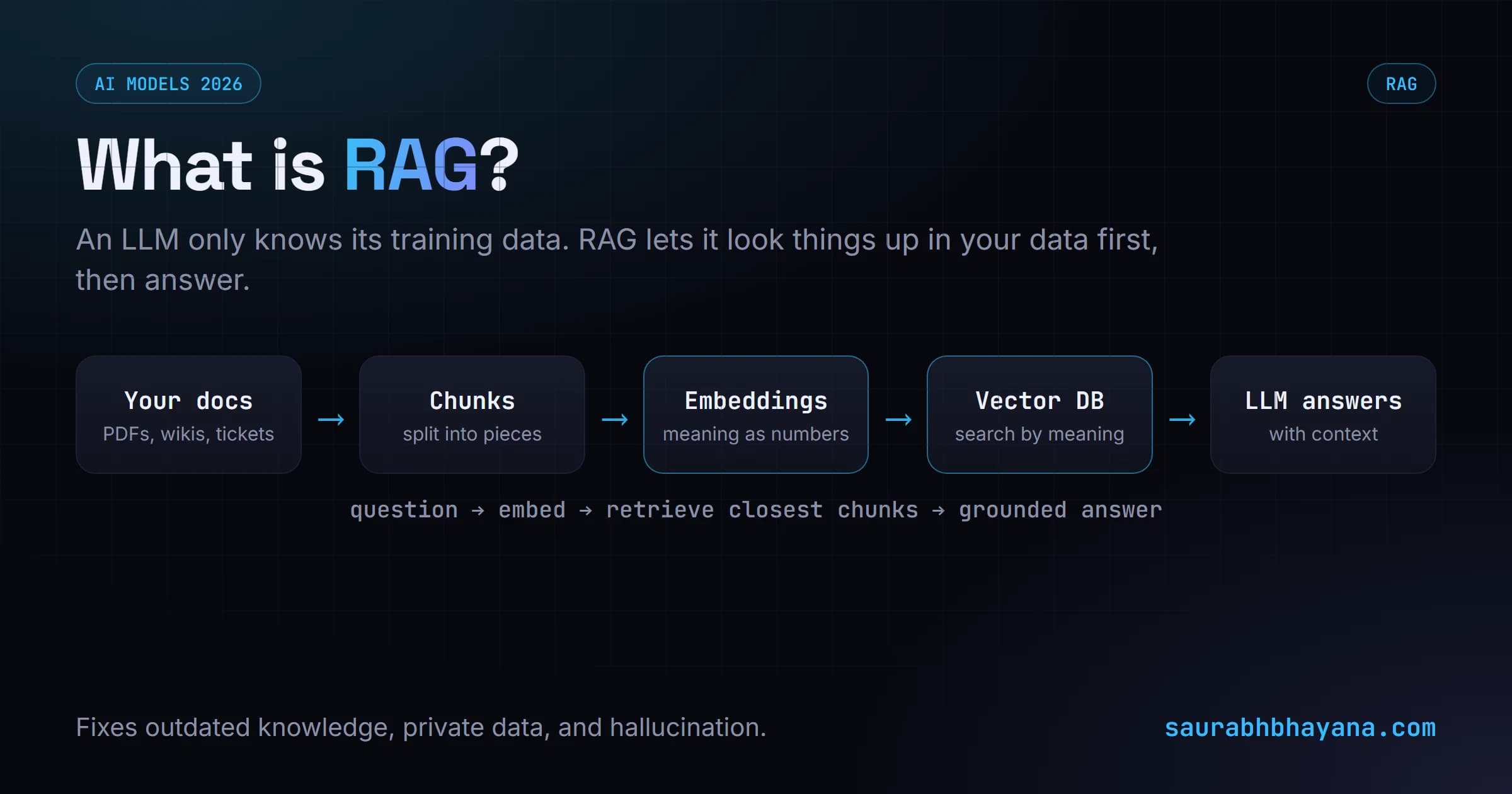
RAG works in two phases. The first is done once (or whenever your data changes). The second happens every time someone asks a question.
Phase 1: Indexing (done once)
- 1.Load your documents: the PDFs, pages, tickets, manuals, whatever holds the knowledge.
- 2.Chunk them: split each document into smaller pieces, because you want to retrieve the relevant paragraph, not a whole 50-page file.
- 3.Embed each chunk: turn every chunk into an embedding, a list of numbers that captures its meaning.
- 4.Store them: save all those embeddings in a vector database so they can be searched by meaning.
Phase 2: Retrieval and generation (per question)
- 1.Embed the question: turn the user's question into an embedding the same way.
- 2.Retrieve: ask the vector database for the chunks whose embeddings are closest to the question, the most relevant pieces of your data.
- 3.Augment: paste those retrieved chunks into the prompt as context, alongside the question.
- 4.Generate: the LLM writes an answer grounded in that context, not from memory alone.
The fix: separate the slow, one-time work (indexing) from the fast, per-question work (retrieval and generation). That is what makes RAG both accurate and quick enough for real use.
The two pieces that make it work: embeddings and vector databases
Two concepts do the heavy lifting, and they are worth understanding clearly.
An embedding turns text into a list of numbers that captures its meaning. The key property: text with similar meaning produces similar numbers, so they sit close together in that number space. This is why RAG can match a question to the right chunk even when they share no exact words. Ask about getting your money back and it can find the chunk about refunds, because the meanings are close.
A vector database stores all those embeddings and is built to answer one question fast: which stored items are closest to this one? It can do that across millions of chunks in milliseconds, which is what makes retrieval practical at scale.
Embeddings turn meaning into numbers. The vector database finds the closest numbers. Together they let a question pull back the exact passages that answer it.
The fix: think of retrieval as search by meaning, not by keyword. That is the upgrade embeddings give you over old-style text search, and it is why RAG retrieval feels so much smarter.
What makes a RAG system good or bad
The model gets the attention, but the quality of a RAG system is mostly decided by the retrieval side. Get these right:
- •Clean, well-structured data: garbage in, garbage out. If the source docs are messy or wrong, the answers will be too.
- •Sensible chunk sizes: too big and you retrieve noise, too small and you lose context. The chunk should hold one coherent idea.
- •Good retrieval: returning the truly relevant chunks matters more than which LLM writes the final answer.
- •Grounding the answer: a well-built RAG system answers from the retrieved context and can cite it, which cuts hallucination sharply.
A simple quality check: if the answer is wrong, look at what was retrieved before blaming the model. Most RAG failures are retrieval failures, the model was handed the wrong context and did its best with it.
The fix: invest in the data and the retrieval, not just the model. A great model on bad retrieval loses to an average model on great retrieval.
Where RAG is used
RAG fits anywhere the answers must come from specific, current, or private knowledge:
- •Customer support bots that answer from your actual help docs and policies.
- •Internal knowledge assistants that search company wikis, handbooks and reports.
- •Product and documentation search that answers questions instead of returning a list of links.
- •Research and analysis tools that ground answers in a specific set of documents.
The fix: whenever you catch yourself wishing the chatbot just knew your stuff, that is a RAG use case. You are not trying to make the model smarter, you are giving it the right pages to read.
The short version
RAG, retrieval augmented generation, lets a language model look things up before it answers. You index your documents once by chunking them, turning each chunk into an embedding, and storing those in a vector database. Then for every question you embed the question, retrieve the closest chunks, and hand them to the LLM as context. It fixes outdated knowledge, gives the model access to your private data, and cuts hallucination, all without retraining. The answer is only as good as what you retrieve, so the real work is in clean data and solid retrieval. Use it any time the answers need to come from specific, current, or private knowledge.
If you are building AI systems that reach many tools and data sources, it helps to understand how models connect to them in a standard way.
Frequently asked questions
What is RAG (Retrieval Augmented Generation)?+
RAG stands for Retrieval Augmented Generation. It is a technique that lets a language model look up relevant information from your own data before it answers, instead of relying only on what it was trained on. The model retrieves the most relevant pieces of your documents and uses them as context to generate a grounded, accurate answer.
How does RAG work?+
RAG works in two phases. First, indexing (done once): your documents are split into chunks, each chunk is turned into an embedding, and those are stored in a vector database. Then, per question: the question is embedded, the closest chunks are retrieved from the vector database, and those chunks are added to the prompt so the LLM answers using them as context.
What problems does RAG solve?+
Three big ones. Outdated knowledge: an LLM only knows up to its training cutoff, while RAG can pull in current data. No access to your data: the base model has never seen your private documents, but RAG can. And hallucination: by grounding the answer in retrieved context, RAG sharply reduces the model making things up.
What is the difference between RAG and fine tuning?+
Fine tuning changes the model's weights by retraining it, which is good for teaching a style or skill but slow and costly to keep current. RAG changes nothing in the model; it adds relevant context at answer time, which is cheaper and easy to keep up to date by just updating your documents. For facts that change, RAG is usually the better choice.
What are embeddings and vector databases in RAG?+
An embedding turns text into a list of numbers that captures its meaning, so text with similar meaning sits close together. A vector database stores those embeddings and quickly finds the ones closest to a question. Together they let RAG retrieve the right passages by meaning rather than exact keywords, even across millions of chunks.
When should I use RAG?+
Use RAG whenever answers must come from specific, current, or private knowledge that the base model was not trained on: customer support from your help docs, internal knowledge assistants over company wikis, product and documentation search, or research tools grounded in a document set. If you wish the chatbot just knew your own content, that is a RAG use case.
Why is my RAG system giving wrong answers?+
Most RAG failures are retrieval failures, not model failures. If the answer is wrong, check what was retrieved before blaming the LLM. Common causes are messy source data, chunk sizes that are too large (noise) or too small (lost context), and weak retrieval returning the wrong passages. Fixing the data and retrieval usually fixes the answers.
Read next
I build fast, SEO-ready sites and rank them on Google and AI search. Or join my free community and grow alongside other website owners.