Jev: The AI Model That Does Not Generate Text (System 1 AI, Explained)
Not every AI decision needs a chatbot. Jev is a System 1 AI model that skips text entirely and returns calibrated probabilities, fast and cheap. Here is what it is, how it works, and when to use it instead of an LLM.
Almost every AI tool you have used writes something back. You ask, it generates text, one word at a time. But a huge number of decisions inside software are not really writing problems, they are quick judgment calls: is this a refund request, which team should handle it, how urgent is it. You do not need a chatbot to essay its way to those answers. That is the gap Jev was built for.
Jev is an AI model from a startup called TypeSafe, and it is unusual because it does not generate any text at all. Instead it picks from a list of options and gives a probability for each one. It was explained well in a recent IBM Technology video by Martin Keen, and it is worth understanding, because it points at a different shape of AI than the one everyone is chasing. One honest caveat first: Jev is new, and TypeSafe has not published much about its architecture, so this sticks to what is actually known and avoids guessing at the internals.
System 1 and System 2: where Jev fits
The idea behind Jev borrows from Daniel Kahneman's book Thinking, Fast and Slow. Kahneman describes two modes of human thinking. System 1 is fast and automatic: ask what is two times two and you just know it is four. System 2 is slow and deliberate: ask what is 17 times 24 and you have to work it out step by step (it is 408).
Most AI models we use are System 2 wannabes. A chatbot writes its answer one token at a time. A reasoning model goes further and writes out its chain of thought, which is about as close to System 2 as AI gets. That is powerful for hard problems, but it is overkill for a quick judgment call, and it is slow and expensive when all you needed was a yes or no.
Most of what software decides is System 1 work: fast, automatic judgment calls. Jev is a model built for exactly that, instead of forcing a System 2 chatbot to do it.
The fix: match the model to the thinking. Use a reasoning model for the hard, deliberate work, and a System 1 model like Jev for the fast calls that make up most of the decisions in an app.
A real example: the support email
Say a customer support email comes in: I was charged twice this month, please fix it. The software handling it has to answer three quick questions:
- •Is this a refund request? A yes or no.
- •Which team should process it? Billing, technical support, or sales. Pick one.
- •How urgent is it? A score from low to critical.
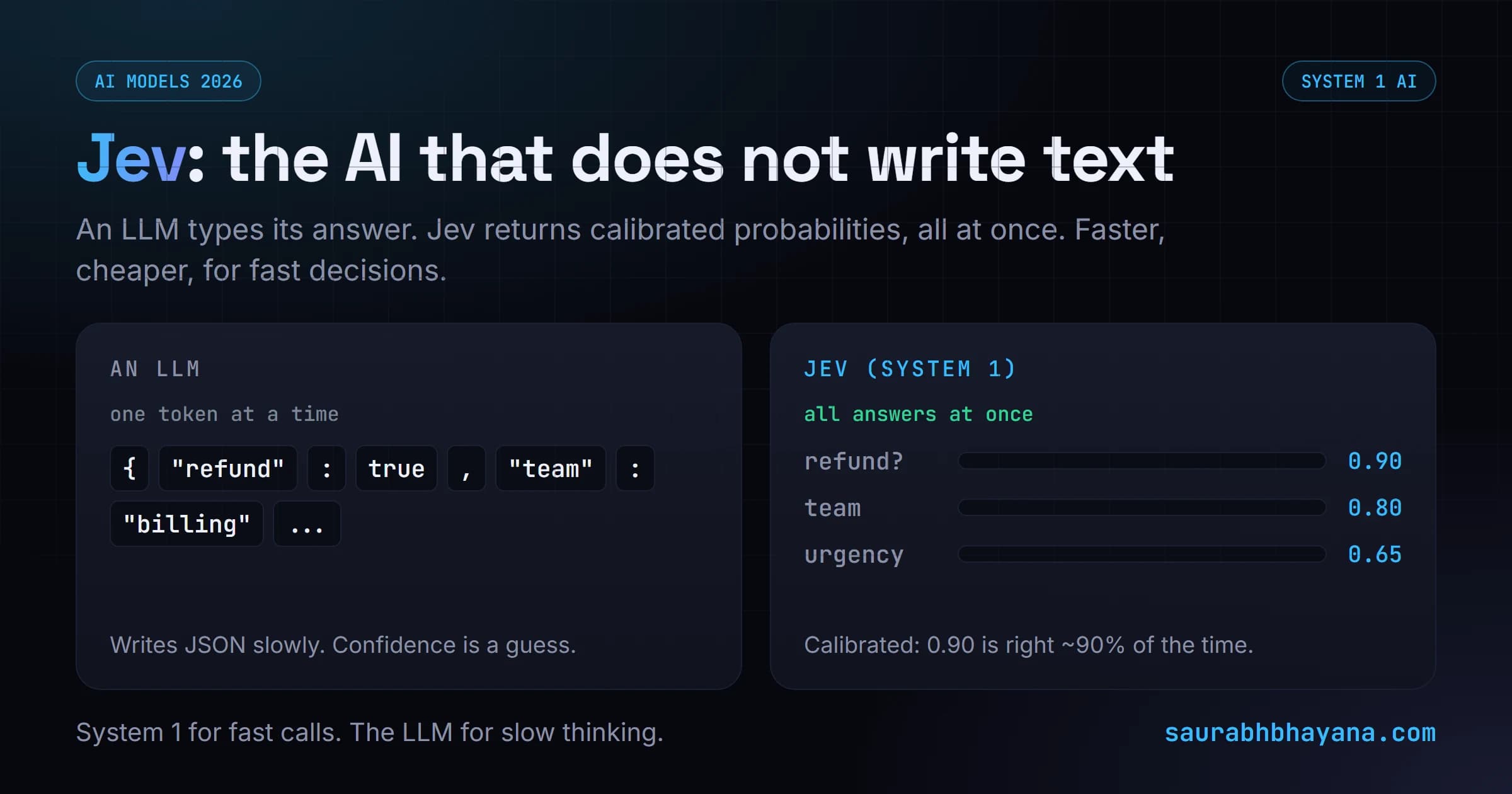
A person skimming that email answers all three instantly. That is System 1 work, and it is exactly what Jev is for. The common way to automate this today is to send the email to an LLM and ask for the answers back in a structured format like JSON. That mostly works, but it comes with a quiet problem: the LLM does not give you a reliable sense of how sure it is. You can ask it for a confidence number, but whatever it says does not necessarily match the real probability behind its answer.
The fix: for structured decisions where confidence matters, a model that returns real probabilities beats one that writes a guess and a made-up confidence score next to it.
How Jev actually answers
Jev takes in two things. First, the state: the data the decision is about, such as the support email plus maybe the customer's recent charges. Second, the questions themselves. Both go in as input, in a single request.
The three questions map to three answer shapes:
| Question | Shape | Example answer |
|---|---|---|
| Is this a refund? | Boolean (yes or no) | 0.9 (90 percent yes) |
| Which team? | Choice (one from a list) | Billing: 0.8, Support: 0.15, Sales: 0.05 |
| How urgent? | Score (low to critical) | a calibrated value on the scale |
Here is the key difference. An LLM would write that JSON out one token at a time. Jev generates no text, so all three answers come back at once, as probabilities. That is a big part of why it is so much faster and cheaper than an LLM on this kind of work.
The fix: when you need several structured answers from the same input, a model that returns them together as numbers is cheaper and quicker than one that types out a document.
The important part: calibration
A probability is only useful if you can trust it. Jev's probabilities are calibrated, which has a precise meaning: when the model says there is an 80 percent chance, it is correct about 80 percent of the time. Plot probability against how often the model is right, and a well-calibrated model draws a straight diagonal line.
TypeSafe says Jev is trained with a method they call RLCD, reinforcement learning for calibrated decisions. Most reasoning models are trained to be right on the final answer (did the code pass its tests, did it get the math right), which made them strong at math and coding. But that reward only checks the answer, not whether the model knew how sure it should be. RLCD rewards the model when its stated probabilities turn out to match reality. That is the whole point: not just a good guess, but an honest confidence.
An LLM can tell you it is 90 percent sure and be wrong half the time. A calibrated model's 90 percent actually means 90 percent. That is what makes the number safe to build on.
The fix: if you are going to let software act on a confidence score automatically, that score has to be calibrated, or you are automating on a number that does not mean what it says.
Turning probabilities into decisions with thresholds
Because the numbers are trustworthy, you can wire them straight into code with thresholds. Take the refund question:
- •Above 0.9: treat it as a real refund request and send it straight to the refund queue.
- •Between roughly 0.1 and 0.9: there is genuine uncertainty, so route it to a human to check.
- •Below 0.1: it is not a refund request, so do nothing with it.
Because the probabilities are calibrated, the threshold also tells you roughly how often the automatic path will be wrong. The more a mistake would cost, the higher you set the threshold. A cheap mistake can run on a lower bar; an expensive one waits for more certainty or a human.
The fix: let the threshold encode your risk. Automate the confident cases, escalate the uncertain middle, and set the cutoff by how much a wrong call costs you.
Jev as a guardrail, and alongside LLMs
This pattern works far beyond support emails. Jev can act as a guardrail: a fast classifier wrapped around a chatbot, checking messages going in and out for things like jailbreak attempts, cheaply enough to run on every message.
And it does not replace LLMs, it teams up with them. A realistic workflow looks like this:
- 1.Jev makes the fast call: is this incoming email a refund request, and which team gets it.
- 2.The LLM does the slow, careful work: actually writing the reply to the customer.
- 3.Jev classifies the customer's response when it comes back, and the loop continues.
That is almost exactly how Kahneman described human thinking: fast automatic System 1 handles most of it, and slow deliberate System 2 only kicks in when something needs real thought. Here Jev is System 1 and the LLM is System 2.
The fix: do not pick one. Put the System 1 model on the fast, high-volume judgment calls and save the LLM for the work that genuinely needs reasoning or writing.
The limits (be honest about these)
Jev is not magic, and the honest limits matter:
- •It only takes text as input today. No images or other data types yet.
- •It is not good at math or even counting, so leave that to another tool.
- •Like any AI model, it can be tricked by instructions hidden inside the data it is reading (prompt injection).
- •TypeSafe has not published much on the architecture, so treat the internals as unknown for now.
The fix: use Jev for what it is, fast calibrated classification on text, and do not stretch it into jobs (math, image understanding, writing) it was never built for.
Why the name, and why it might matter
Jev is named after William Stanley Jevons, an economist who noticed in 1865 that as steam engines got more efficient, Britain used more coal, not less. That is Jevons paradox: making something cheaper and faster often means we use far more of it. The bet behind System 1 models is the same. When a judgment call becomes super fast and super cheap, it can go into places an LLM would be too slow or expensive for: every row of a database, every line of a log file, every message in a stream.
The short version: Jev is a System 1 AI model that does not generate text. It returns calibrated probabilities for quick decisions, all at once, which makes it fast and cheap. You turn those probabilities into actions with thresholds, use it for routing, classification and guardrails, and pair it with an LLM for the slow work. It does not replace large language models, it handles the fast calls they are wasteful at.
If you are weighing up which AI model fits which job more broadly, it helps to understand how models connect to tools and data in the first place.
Frequently asked questions
What is Jev?+
Jev is an AI model from a startup called TypeSafe that does not generate text. Instead of writing an answer, it picks from a list of options and returns a probability for each one. It is designed for fast decisions like classification and routing, rather than for writing like a chatbot.
What is a System 1 AI model?+
System 1 is a term borrowed from Daniel Kahneman's Thinking, Fast and Slow. System 1 thinking is fast and automatic, System 2 is slow and deliberate. A System 1 AI model like Jev is built for the fast, automatic judgment calls, while most LLMs and reasoning models aim at slower System 2 style work.
How is Jev different from an LLM?+
An LLM generates text one token at a time, including when you ask for structured answers in JSON, and its stated confidence may not match reality. Jev generates no text; it returns calibrated probabilities for all the questions at once, so it is faster, cheaper, and its confidence numbers are trustworthy. Jev is for fast decisions, an LLM is for writing and reasoning.
What does calibrated probability mean?+
A calibrated probability means the number reflects reality: when the model says 80 percent, it is right about 80 percent of the time. Jev is trained with RLCD (reinforcement learning for calibrated decisions), which rewards it when its stated probabilities turn out to be accurate, not just when its final pick is right.
Does Jev replace large language models?+
No. Jev and LLMs work together. A typical workflow uses Jev for the fast calls, like deciding whether an email is a refund request and which team should handle it, then hands the slow work, like writing the actual reply, to an LLM. This mirrors how System 1 and System 2 thinking combine in people.
What can you use Jev for?+
Routing, classification, and AI guardrails. Examples: triaging support emails (refund or not, which team, how urgent), and sitting around a chatbot to catch jailbreak attempts on every message cheaply. You convert its probabilities into actions with thresholds, automating confident cases and sending uncertain ones to a human.
What are Jev's limitations?+
Jev currently takes only text as input, is weak at math and counting, and like any model can be fooled by instructions hidden in the data it reads. TypeSafe has also not published much about its architecture. So it is best used for fast, calibrated text classification, with other tools handling math, images, and writing.
Read next
I build fast, SEO-ready sites and rank them on Google and AI search. Or join my free community and grow alongside other website owners.