Small Apps That Make Money: 11 Real Examples and What They Share
A receipt scanner, a prayer-based screen blocker, a cat-themed timer: small apps earning $40,000 a month and more. What each one does, why it works, how it charges, and the five patterns you can copy.
Some of the apps making the most money look almost too simple. A timer with a cat on it. A screen-time blocker that asks you to pray before opening Instagram. A receipt scanner in a market full of receipt scanners. Each one does one job, and each one is reported to earn tens of thousands of dollars a month.
We pulled together the examples from three recent videos, by Jason Lee, Superwall's app growth team and Starter Story, and looked for what the apps have in common. If you are deciding what to build, the patterns matter more than any single app. And if you have not picked an idea yet, start with our guide on how to find app ideas people will pay for.
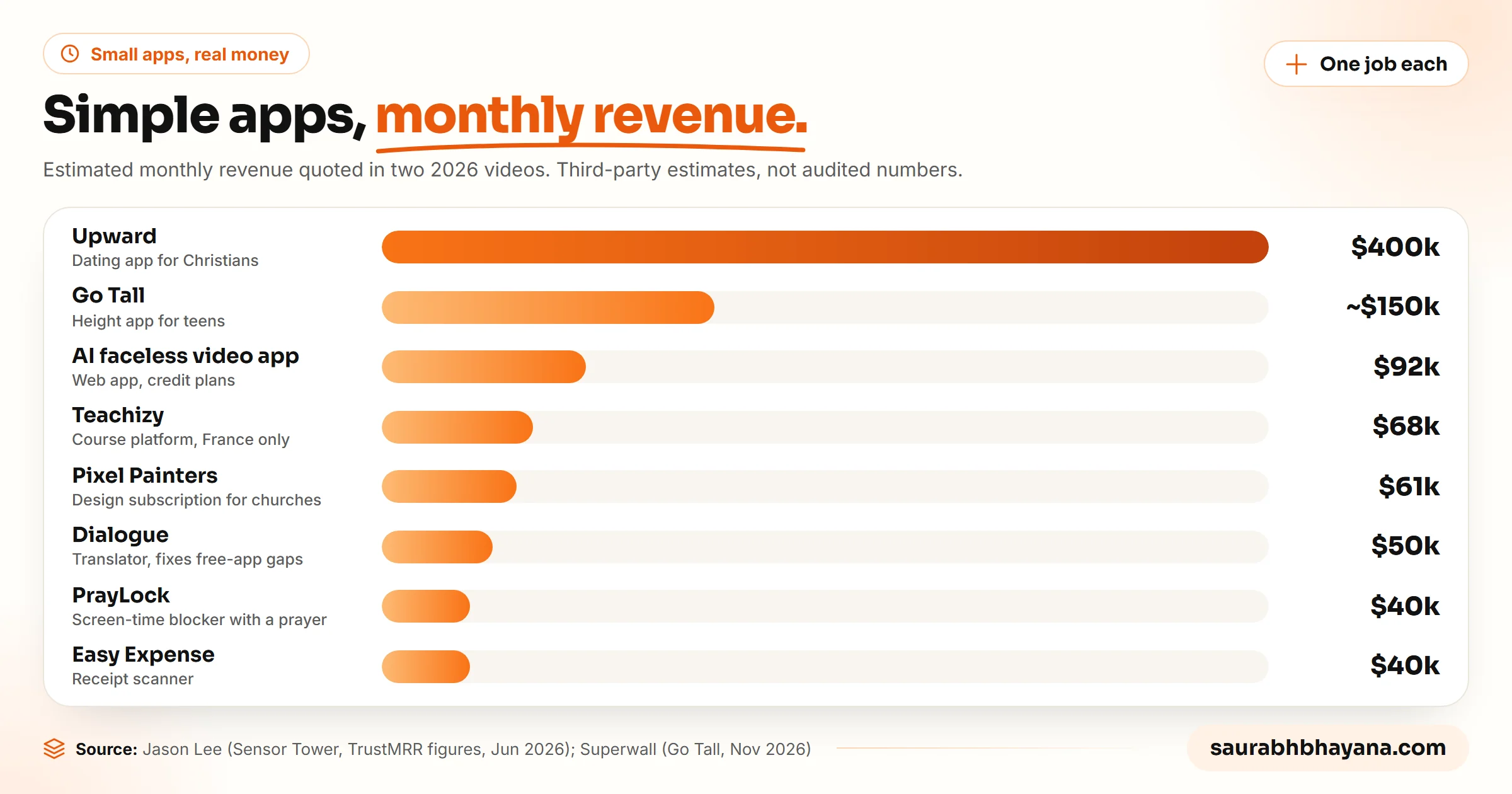
A word on the numbers. App revenue figures usually come from estimate tools such as Sensor Tower or from founders who connect their payment account to sites like TrustMRR. They are useful for scale, not precision. They also show only the winners. For every app on this list there are many that never earn a dollar.
11 small apps that make money
1. Dialogue: a translator that fixes what free apps miss ($50k a month)
Google Translate is free and good enough for most people, which makes a paid translator sound pointless. Dialogue started from the complaints instead: people find the free app's design clumsy and its translations sometimes wrong. Dialogue focused on better translations, added AI that tidies up grammar, and built an Apple Watch app for travellers who do not want to pull out a phone. It charges a monthly subscription and is marketed with short videos from creators on TikTok. The lesson: a free product used by millions still leaves room for a better paid one for the people it annoys.
2. PrayLock: a screen-time blocker with a twist ($40k a month)
Screen-time blockers are everywhere. PrayLock adds one rule: before you open Instagram, TikTok or a game, you complete a short prayer. It is built for one community and tied to a habit those users already want to build. Same mechanics as a generic blocker, very different reason to pay.
3. Pixel Painters: design for churches ($61k a month)
This one is not an app. It is a design subscription with real human designers, sold only to churches, which need graphics every week for services, events and social posts. Reported revenue grew to $61,000 a month with a peak of $82,000. Churches stay for years once they like the work, and the price is a fraction of a $3,000 to $5,000 a month in-house designer.
4. Easy Expense: a receipt scanner in a crowded market ($40k a month)
Take a photo of a receipt and the app reads it, sorts it and saves it for bookkeeping. There are dozens of competitors, and it still reaches a reported $40,000 a month. Demand is so large that a solid product with good marketing gets a share. Jason Lee's suggestion for copying it is to narrow further: a receipt scanner for freelancers or for builders, named and designed for that group.
5. An AI faceless-video app ($92k a month)
A web app that turns a topic into a narrated video for channels where nobody appears on camera. It sells credit plans: the one shown costs $67 a month for 500 credits, enough for around 100 short videos. The app pays the AI model providers per video and keeps the margin. Credits are a common and sensible way to price AI products, because your own costs rise with use.
6. Upward: dating for Christians ($400k a month)
Everyone says dating apps are too crowded. Upward built one for Christians and is reported at around $400,000 a month. A saturated market is not a closed one. It is proof of demand, and one group with shared values is a big enough market on its own.
7. Teachizy: a course platform for France ($68k a month)
Course platforms like Teachable already exist. Teachizy built one for French coaches: French language, hosting in France and a strong message about GDPR, the European privacy law. Big global players rarely bother with that level of local fit. Rebuilding a proven product for one country and its rules is one of the most repeatable ideas on this list.
8. Cat on Chair: a Pomodoro timer for cat lovers
A focus timer for 25-minute work sessions, themed around a little cat. Superwall says it made over $40,000 in two months and passed 100,000 downloads in eight months. On features alone it makes no sense; there are free timers everywhere. People pay because they love cats. It is the clearest example of a passion app.
9. Go Tall: one segment of a big category (about $150k a month)
Looksmaxxing apps help people improve their appearance; Umax, one of the best known, reached around $700,000 a month at its peak, according to its founder Blake Anderson. Go Tall took one slice of that category, height, for teenagers, and was around $150,000 a month when Superwall last checked. A narrower promise is easier to explain and cheaper to market.
10. MagicSlides and its siblings: one-feature add-ons
Sanskar, a solo founder from Bangalore, has built more than 30 small products and 8 make money, crossing $1 million in total over six years. Most are Chrome extensions or Google Workspace add-ons that do one thing. MagicSlides turns a document, PDF or YouTube video into a slide deck. SendSimple sends personalised Gmail from a Google Sheet. Living inside tools people already use means there is nothing new to learn.
11. Cal AI: one killer feature
Calorie counters have existed for years. Cal AI made logging food as easy as taking a photo. It has other features, but Superwall points to the photo scan as the reason people pick it. One feature that removes the most annoying step can be enough to win a crowded category.
What these small apps have in common
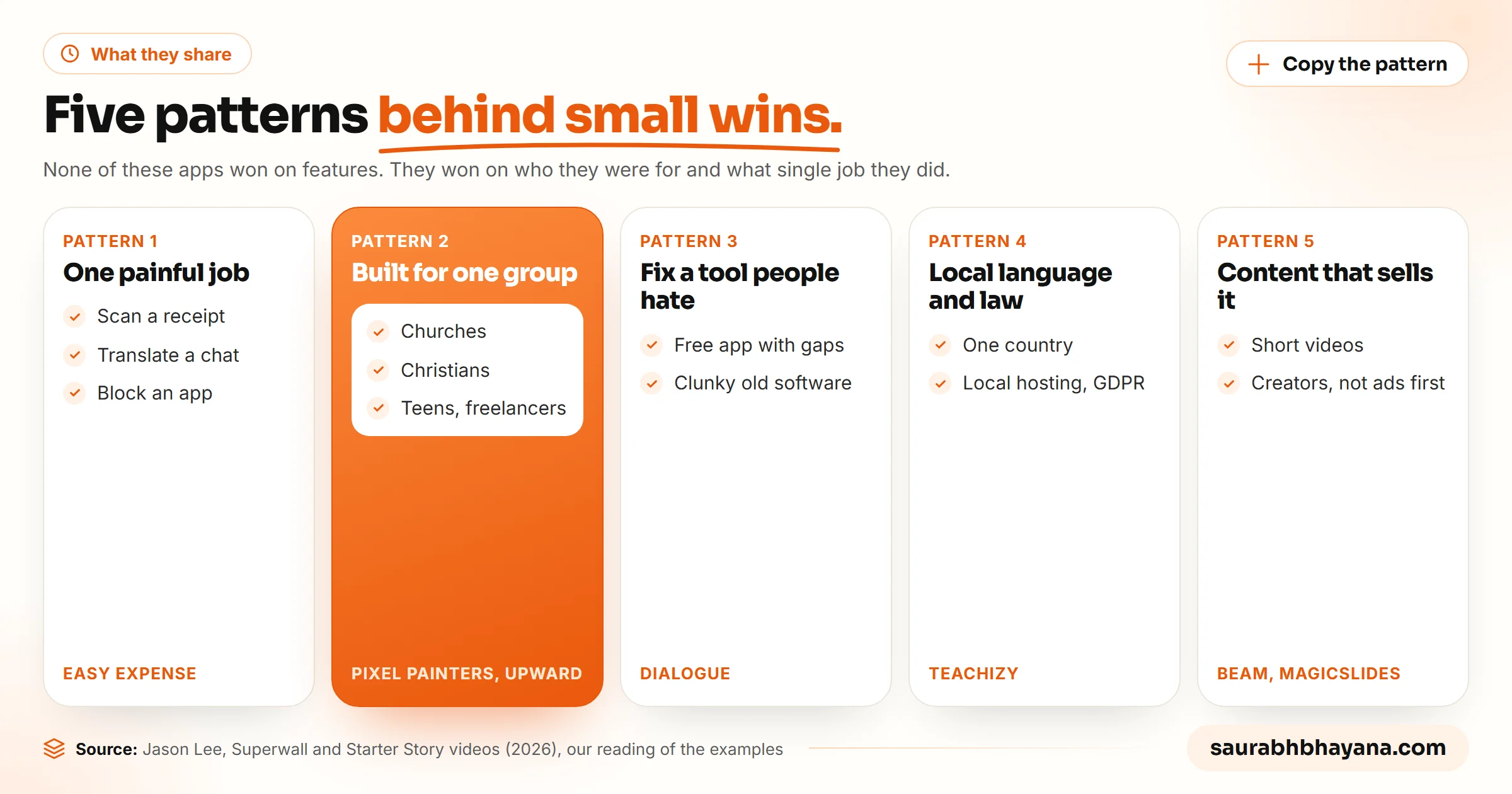
- 1.One painful job. Scan a receipt, translate a conversation, block an app. The user can explain the app in one sentence.
- 2.Built for one group. Churches, Christians, teenagers, French coaches. The audience sees the name and knows it is for them.
- 3.A better version of something people dislike. Free tools with gaps and old software people tolerate are both openings.
- 4.Local language and local rules. One country, its language and its laws is a market the global players under-serve.
- 5.Content does the selling. Short videos, often by creators, explain these apps faster than any ad.
Pain apps, passion apps and sub-niches
Superwall sorts apps into two kinds. Pain apps remove a problem, such as expenses or translation. Passion apps feed something people love, such as cats, faith or their looks. The line blurs, since Cat on Chair also helps with focus, but the difference changes how you sell. Pain apps sell the time or money saved. Passion apps sell identity and fun, and the features matter less than the feeling.
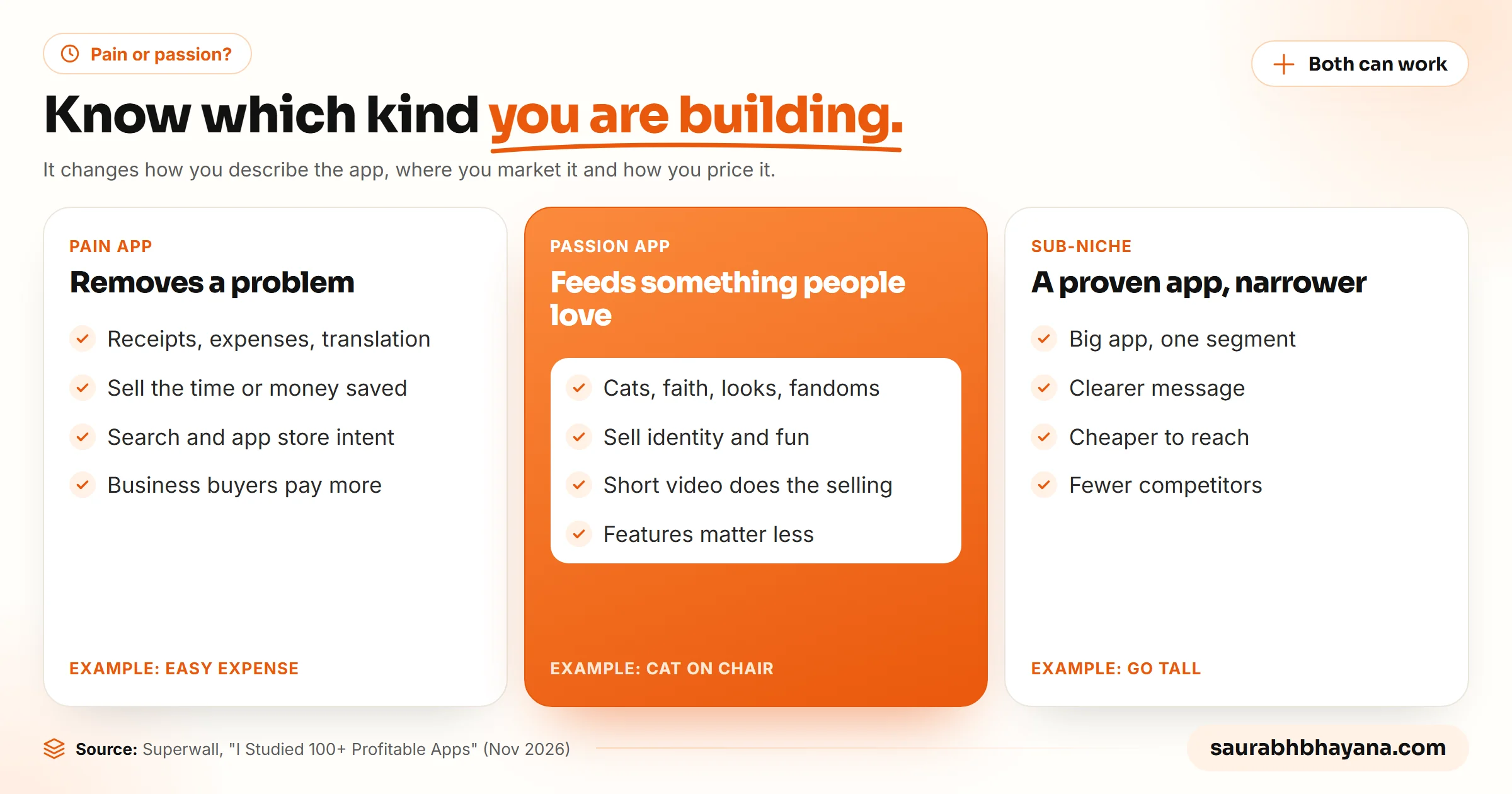
A third route sits between them: take a category that already works and serve one segment of it. Go Tall within looksmaxxing and a receipt scanner for freelancers are both examples. You inherit the proof of demand and get a message that is easier to aim.
How small apps charge
- •Subscriptions, not one-off sales. Nearly every example charges monthly or yearly, because the app keeps delivering.
- •Weekly plans as an anchor. Superwall sees founders make weekly plans cheap in the hope people keep paying. Most cancel after a week or two. Use the weekly price to make the annual plan look like the better deal.
- •Annual plans for revenue. According to Superwall, apps making more than $1 million a year earn most of their revenue from annual plans.
- •Credits for AI products. When every use costs you money, a monthly credit allowance protects your margin, as the faceless-video app does.
- •Price against the alternative. Pixel Painters compares itself with hiring a designer, not with other design apps.
We price our own product the same way: wptaskify sells monthly and yearly plans, and AI-heavy work draws from credits so our costs never outrun what a customer pays.
How small apps get their first users
Very few of these apps started with large ad budgets. Dialogue spreads through creator videos on TikTok. Sanskar runs a separate YouTube channel for each product, and one MagicForm video has around 145,000 organic views. He also posts in Facebook groups and launched on AppSumo. Lily's notes app got 4,000 waitlist sign-ups from a single TikTok before launch.
Superwall adds a lesson about who you attract. Verba, an AI video editor they advised, had a video with around 3 million views, but the viewers were mostly professional video editors, not the people Verba was for. When the content was reshaped around personal branding, the right users started arriving. The creative decides who shows up, so aim it at the person who will pay.
How much money do small apps make?
Most make little or nothing. The apps above are the top of a very large pile. Sanskar's record is a realistic picture of a good outcome: no revenue for his first two years, then 8 earners out of more than 30 products, adding up to more than $1 million over six years. That works out to a solid living from a portfolio of small bets, not one overnight hit.
So the practical goal for a first app is modest: the first paying user, then the first $1,000 a month. Small apps reach real money by finding a group that pays and then improving retention and pricing, not by adding features.
Simple app ideas that make money: templates to copy
Rather than a list of ideas someone else will also build, here are the patterns turned into prompts you can fill in for your own field.
- •A [popular app] for [one community]: a fitness tracker for nurses on night shifts, a budgeting app for wedding planners.
- •A [tool people pay for] in [one language and country]: a booking system built for one country's tax and privacy rules.
- •The missing feature from [paid app]'s 1 to 3 star reviews, shipped as a separate add-on.
- •A Chrome extension or Workspace add-on that removes one copy-paste step from a daily task.
- •A done-for-you subscription for [one industry] with a recurring need: weekly social graphics for gyms, monthly reports for landlords.
- •A passion version of a utility: a habit tracker, timer or journal built around something a group loves.
Run whatever you fill in through the five-question test and a pre-order page before you build. The apps above look simple from the outside. What made them work was choosing the right group and the right single job, and that part you can test in a week.
Frequently asked questions
What small apps make the most money?+
Among the examples quoted in 2026, Upward, a dating app for Christians, is reported at about $400,000 a month, Go Tall at about $150,000, an AI faceless-video web app at $92,000, and several single-purpose apps such as Dialogue, PrayLock and Easy Expense at $40,000 to $50,000. These are estimates from tools like Sensor Tower and TrustMRR.
How much money do small apps make?+
Most make little or nothing. The ones that work can earn from a few hundred to tens of thousands of dollars a month. Solo founder Sanskar built more than 30 products, 8 make money, and together they passed $1 million over six years after two years with no revenue.
What simple app ideas make money?+
Apps that do one painful job for one group: a receipt scanner for freelancers, a translator that fixes free-app gaps, a localised version of a proven tool for one country, or a passion version of a utility like a cat-themed focus timer. Validate with a pre-order page before you build.
Do small apps need a lot of features to make money?+
No. Most of the examples win on one feature that removes the most annoying step, such as Cal AI's photo food logging or MagicSlides turning a document into slides. Extra features often make an app harder to understand.
Should I charge weekly, monthly or yearly for my app?+
Offer monthly and yearly plans. Superwall finds most weekly subscribers cancel within a week or two, so a weekly price works best as an anchor that makes the annual plan look better value. Apps above $1 million a year earn most of their revenue from annual plans.
Is a crowded app category a bad sign?+
Not necessarily. Crowded categories such as dating, receipt scanning and translation still produced the earners on this list. Crowding proves demand; you win by serving one group better or fixing what users of the big apps complain about.
How do small apps get users without ads?+
Mostly short-form video, often made by creators, plus communities and launch platforms. Sanskar runs a YouTube channel per product, posts in Facebook groups and launched on AppSumo; another founder got 4,000 waitlist sign-ups from one TikTok.
Read next
My team and I automate the work that eats your hours with AI, and get your business found on Google, Maps and in AI answers.