
How to Find App Ideas People Will Actually Pay For
Stop inventing app ideas. Find problems people already pay to solve: where to look, the phrases to search for, a five-question test, and why a buy button before the build beats any amount of positive feedback.
Building an app has never been cheaper. With tools like Claude Code, one person can ship in a weekend what used to take a small team a month. That changes where the hard part is. Writing the code is now the easy bit. The hard bit is knowing what to build, because an app nobody pays for costs the same weekend as one that does.
We watched four recent videos from people who make real money from small apps: SJCodes, whose browser extension Fast Folders passed $10,000; Sanskar, who built more than 30 micro-apps and crossed $1 million over six years; and Superwall's app growth team, who have looked at more than 100 profitable apps. Their methods line up closely. Below is the process they share, with what we have learned building our own products.
How to find app ideas: the short answer
Do not try to invent an idea. Find a problem people already describe in public, check that they already spend money or time on it, and offer the smallest useful fix before you build the full thing. In practice that means reading complaints, not brainstorming, and asking for payment, not compliments.
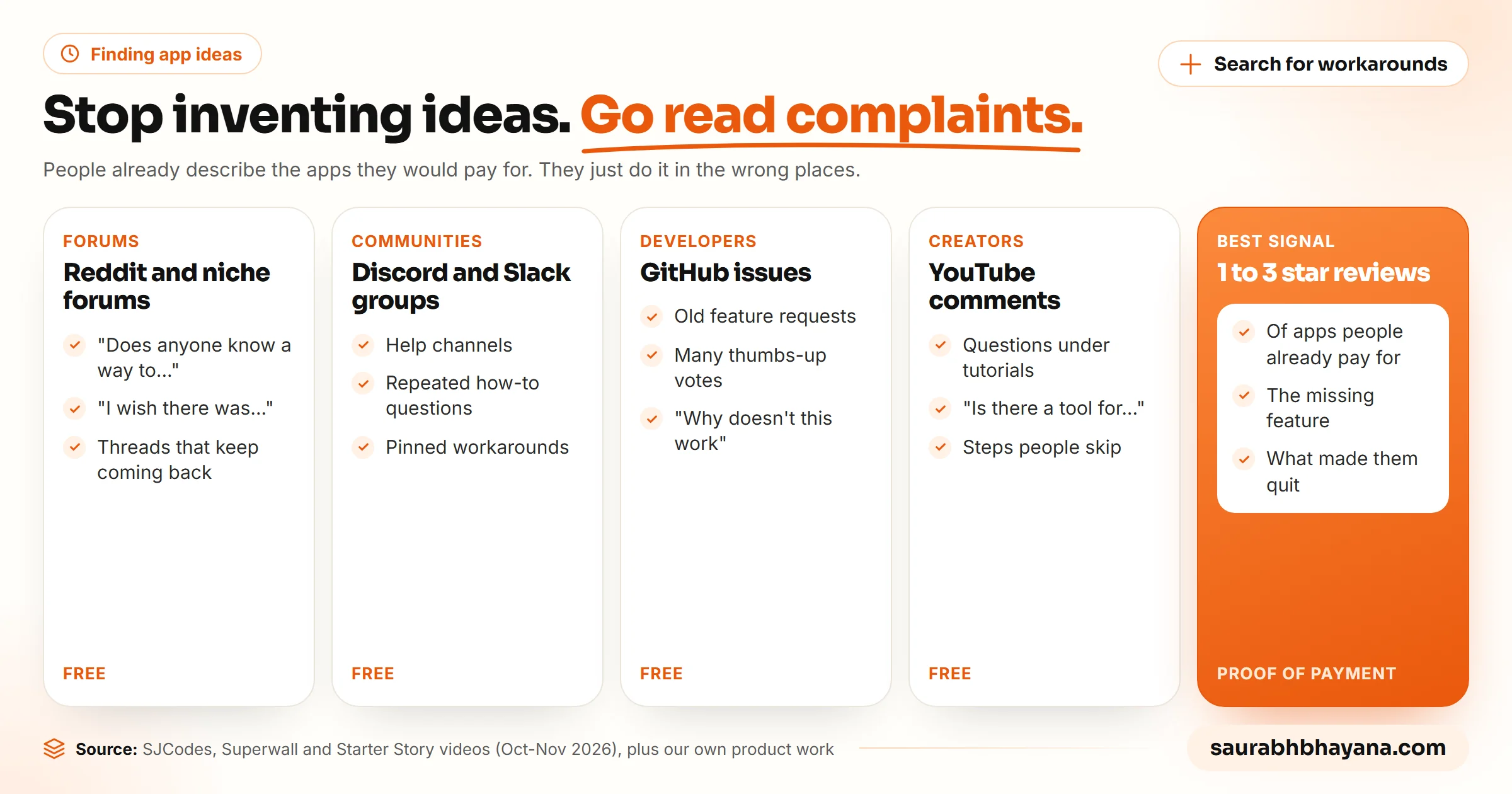
Stop inventing ideas and look for workarounds
SJCodes says his first app to earn more than $10,000 was not original at all. He used Google Gemini every day, his chats piled up, and there was no good way to organise them. So he built Fast Folders, a Chrome extension that sorts those chats into folders. Plenty of people had the same mess. Nobody had to be convinced the problem existed.
That is the pattern to look for: people already trying to solve a problem with something clumsy. A spreadsheet that gets copied every week. A Notion template held together with manual steps. Text pasted from one tool into another. A workaround tells you two things at once: the problem is real, and the person cares enough to spend effort on it. Effort is the step before money.
Your own annoyances count too, with one check. Sanskar built several of his apps for problems he had himself, but he warns that the people with the problem must be able to pay. A tool for broke students is harder to sell than the same tool for busy agencies.
Where to look for app ideas that make money
- •Reddit and niche forums. Search a subreddit for your field plus phrases like "does anyone know a way to", "is there an app that" and "I wish there was". Threads that come back every few months are worth more than one viral post.
- •Discord and Slack communities. Help channels are full of people asking the same how-to question. Pinned messages often describe a manual workaround.
- •GitHub issues. Old feature requests with many thumbs-up votes are a list of things users want and the maintainers have not built.
- •YouTube comments. Questions under tutorials show where people get stuck, and "is there a tool for this?" is a direct request.
- •App store and product reviews. The 1 to 3 star reviews of paid apps are the best source of all, because those people already pay. They tell you the missing feature, the confusing step and the reason they quit.
- •Revenue directories. Sanskar uses sites such as TrustMRR, where founders share verified revenue, to see which small products earn, then looks for a gap he can fill better or for a narrower audience.
If you have read our guide to validating a business idea with AI, this is the step before it. That guide covers testing an idea you already have. This one is about finding ideas worth testing in the first place.
Is competition a bad sign?
No. It is usually the best sign you will get. Competitors prove that people pay for the solution. An empty market more often means there is no demand than that you found a secret. What you need is a reason someone would pick your version: a missing feature from those low-star reviews, a simpler setup, or a tool built for one group that the big players treat as an afterthought.
This is how most of the small apps in our next post won. They did not invent new categories. They took a crowded one and made a version for churches, for Christians, for freelancers or for one country.
Why requests are not proof
SJCodes learned this the expensive way. People on Reddit kept asking for a way to search old conversations, so he built a search feature into Fast Folders. Soon after, Google added its own search to Gemini, and it was better. His feature went mostly unused. The lesson he took was not bad luck. It was that a request alone does not mean something is worth building.
People already have their own apps, routines and habits. Even if your version is technically better, they need a strong reason to change. Small details decide it: how fast they can start, whether they understand the app at once, and whether it fits the tools they already use.
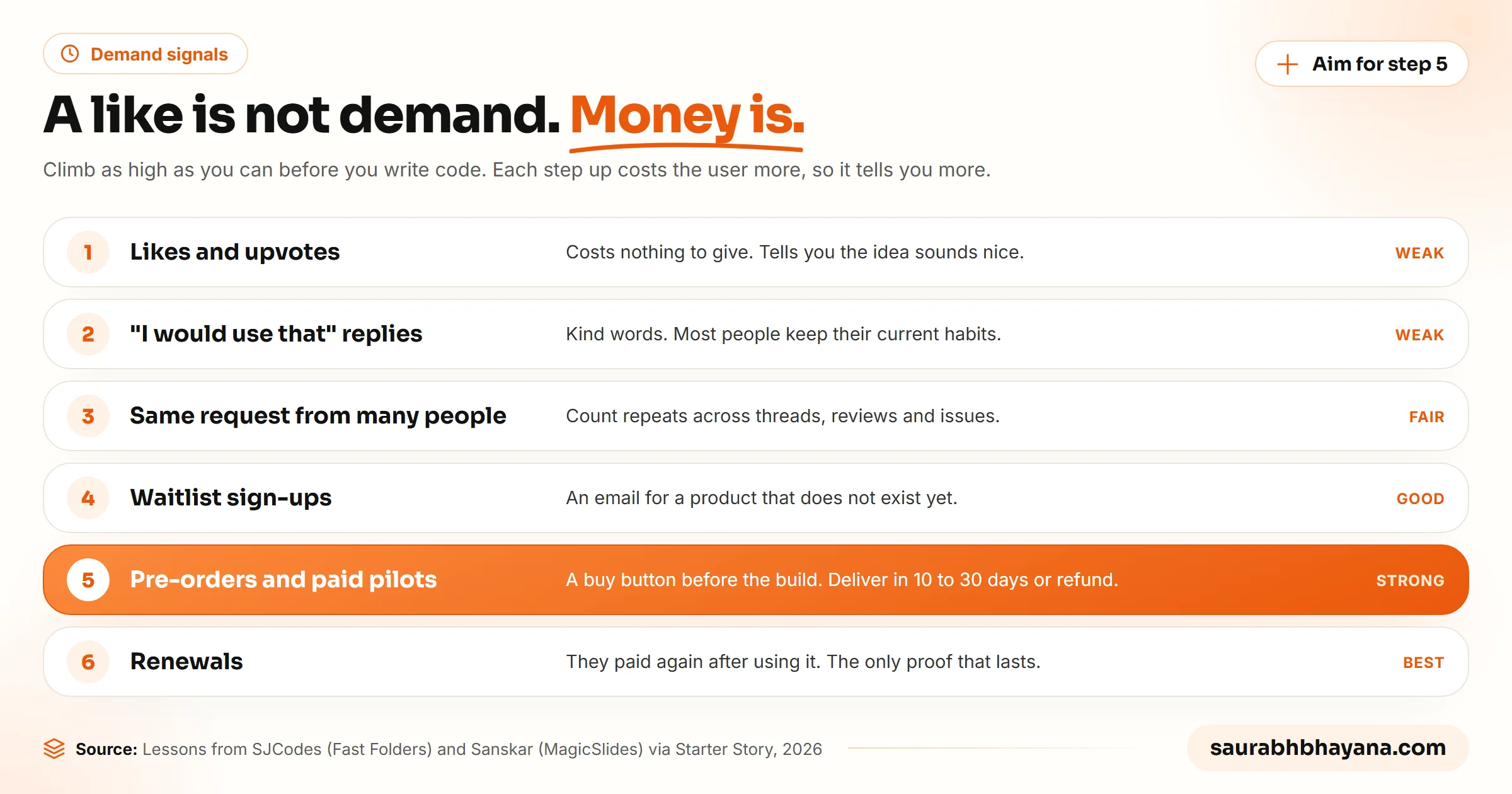
Two filters help. First, count. One request is an anecdote; the same request from many different people across threads, reviews and issues is a pattern. Second, ask whether you would use it yourself and whether it makes the existing experience better, or just bigger.
The five-question test for any app idea
SJCodes runs every idea through a short filter before writing code. We use a version of it and it takes an afternoon, not a month.
- 1.Is it a real problem? You can quote people describing it in their own words, rather than guessing at it.
- 2.Can you find the people who have it? There is a subreddit, a group, a directory or a job title where you could reach 50 of them.
- 3.Are they already trying to solve it? Look for the workaround: spreadsheets, templates, manual copying, hired help.
- 4.Is it worth paying for? Paid tools exist, the fix saves real time or money, or a business pays someone to do it by hand today.
- 5.Can you build a small version? One feature you could ship in days or weeks, not a platform that needs months.
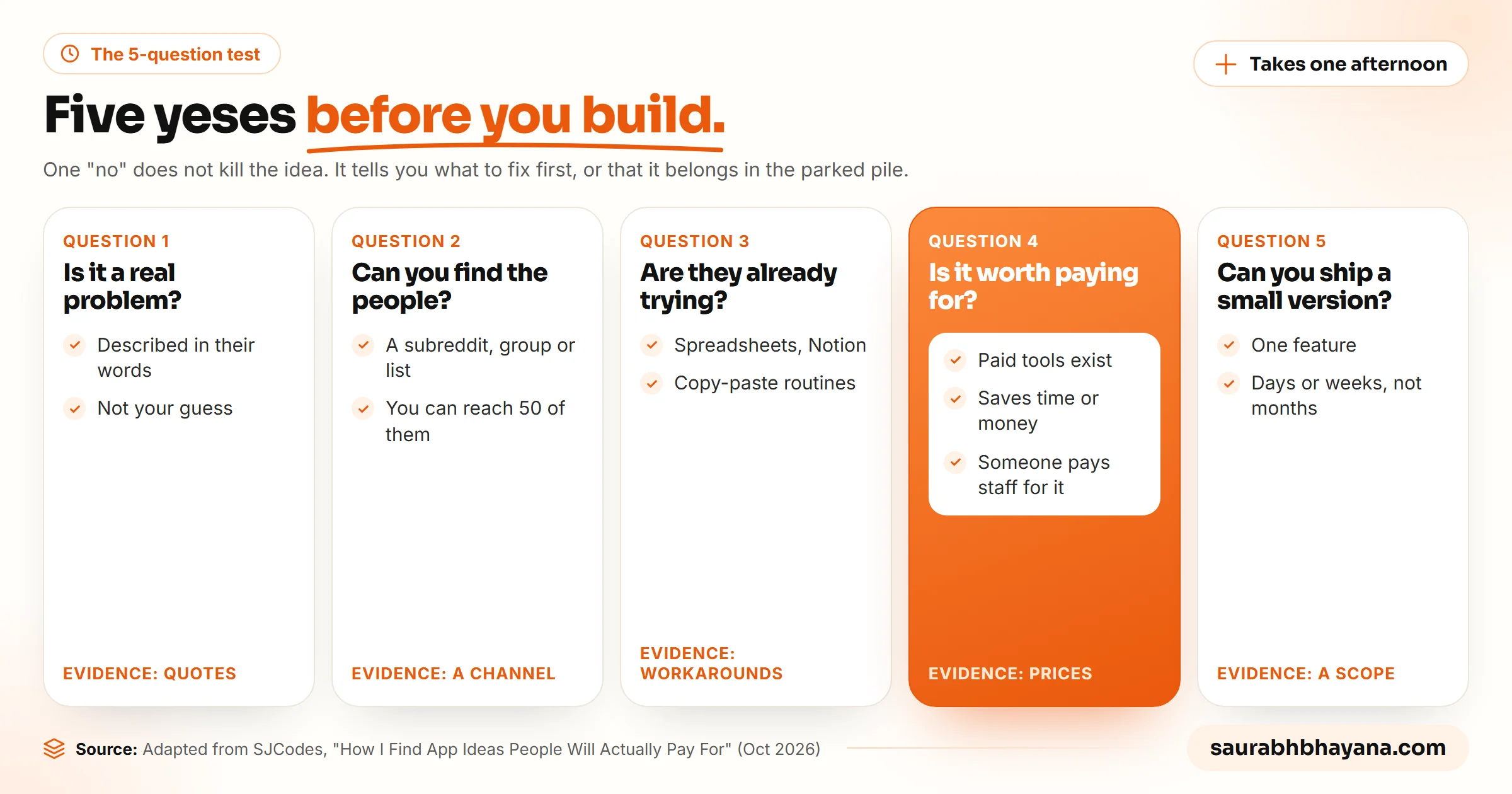
Question four is the one most people skip, and it decides the rest. A problem can be real, common and easy to build for and still not be worth paying for. When we look at a new feature for our own product, wptaskify, we ask it first: would a customer pay more for this, or just like it?
Put a buy button before you build
Sanskar's advice is the most useful line in all four videos: stop adding features and add buy buttons. Before building, he puts up a page that explains the product and lets people pay, with delivery promised in 10 to 30 days. If nobody pays, he has lost a few days, not a few months. If people do pay, he builds with their money and their feedback.
Done honestly, this is not a trick. Say clearly that the product is in development, give a delivery date, and refund anyone who asks or if you do not ship. A waitlist is a softer version of the same test. Superwall tells the story of Lily, whose notes app Breezy, now called Beam, got 350,000 views and 4,000 waitlist sign-ups from one TikTok before the app existed. Not all of them will pay, but it is a far better start than hoping a launch works.
Stop adding features. Add buy buttons. (Sanskar, MagicSlides, on Starter Story)
Two warnings from his own story. He built more than 30 products and only 8 make money, and he earned nothing for the first two years. Finding ideas this way raises your odds; it does not remove misses. Plan to test several small ideas rather than betting everything on one.
Ship the smallest version, then listen
Most of Sanskar's earners are tiny: Chrome extensions and Google Workspace add-ons that do one job, such as MagicSlides, which turns a document, PDF or YouTube video into slides, or SendSimple, which sends personalised Gmail from a Google Sheet. One feature is enough to charge for if it removes a real chore.
Then treat launch as the start. SJCodes thought conversation search would be his big feature and nobody used it. A button to sort folders A to Z, which he almost did not build, turned out to be one of the most loved. Until real people use your app, much of what you build is a guess. The sooner you swap guesses for feedback, the better your next decision.
Can you make money from an app idea alone?
Almost never. Ideas are cheap because they are everywhere, and companies rarely buy one without a product, users or revenue attached. What earns money is an idea plus proof: a working version, people using it, and ideally people paying. That is why every step above ends in a test with real users rather than a better pitch.
A one-week plan to find your next app idea
- 1.Day 1: pick two or three communities where you understand the people, and list every repeated complaint you find.
- 2.Day 2: read the 1 to 3 star reviews of the top three paid tools for each complaint and note what is missing.
- 3.Day 3: run your best three ideas through the five-question test and keep the one with the strongest answer to question four.
- 4.Day 4: talk to five people who have the problem. Ask how they handle it today and what it costs them.
- 5.Day 5: put up a one-page offer with a pre-order or waitlist and a clear delivery date.
- 6.Days 6 and 7: share it in the places you found the problem, following each community's rules on self-promotion, and count sign-ups and payments, not likes.
If people pay, build the smallest version that delivers on the page. If they do not, you have spent a week instead of a quarter, and you have a list of real problems to try next. Want to see what the winners look like once they work? Read our breakdown of small apps that make money and what they have in common.
Frequently asked questions
How can I find an app idea?+
Read where people complain rather than trying to invent something. Search Reddit, Discord, GitHub issues, YouTube comments and the 1 to 3 star reviews of paid apps for phrases like "does anyone know a way to" and "I wish there was". Ideas that keep coming up, and that people already handle with clumsy workarounds, are the ones worth testing.
How do I find profitable app ideas?+
Start where money already changes hands. If people pay for existing tools, pay staff to do a task by hand, or lose real time or money to a problem, there is room for a paid app. Then look at the low-star reviews of those tools to find what a better or narrower version should do.
Is it bad if an app idea already has competitors?+
Usually not. Competitors prove that people pay for the solution. An empty market more often means there is no demand. Win by serving one group better, fixing what reviewers complain about, or building for one country or language.
How do I validate an app idea before building it?+
Put a buy button before the build. A simple page that explains the product and takes pre-orders, with a delivery date and a refund promise, tells you more than any amount of positive feedback. A waitlist is a softer test. For a full method, see our guide to validating a business idea with AI.
How do I find micro SaaS ideas?+
Look for one painful task inside software people already use, then build a small add-on or tool that fixes it. Chrome extensions and Google Workspace add-ons are common examples: one feature, a clear audience and a low price. Revenue directories such as TrustMRR show which small products earn.
Can I get paid for an app idea?+
Rarely on the idea alone. Companies seldom buy ideas without a product, users or revenue. You get paid by turning the idea into something people use and pay for, even a very small first version.
Why do people say they want an app and then not use it?+
Because most people keep their current habits. Liking an idea costs nothing; changing tools costs time. Count how many different people ask for the same thing, make the app easy to understand and start, and fit it into tools they already use.
Read next
My team and I automate the work that eats your hours with AI, and get your business found on Google, Maps and in AI answers.