
Sam Altman's Advice: How to Be Successful (2026 Update)
Sam Altman's 13 rules for how to be successful, and what he says now: compounding first, non-consensus bets and the friend test, why he pushed to launch ChatGPT early, what he looks for in founders, and the advice we would skip.
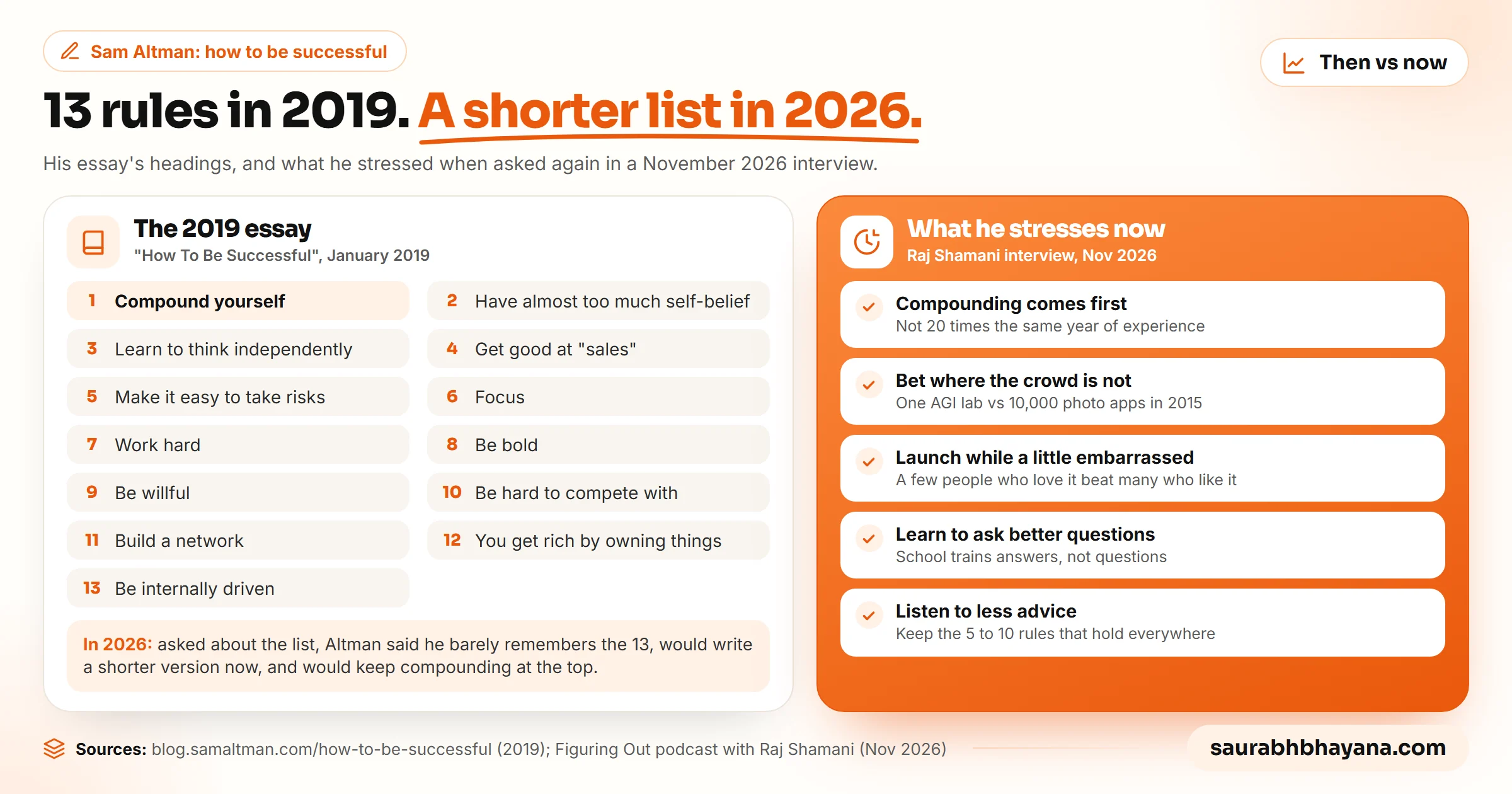
In January 2019, Sam Altman published an essay called "How To Be Successful" with 13 rules. Seven years later, as the CEO of OpenAI, he was asked about it on Raj Shamani's Figuring Out podcast. His answer: he barely remembers what the 13 were, he would write a shorter version now, and one rule would still come first.
Here is the honest caveat before the list: advice from one of the most successful founders alive comes with survivorship bias. For every person who made a bold bet and won, there are many who made the same bet and lost. Altman says something close to this himself, and his own top advice is to listen to less advice. So we kept only what you can test in your own work, and we say where we disagree.
Below are his 13 rules, the lessons he stressed in the 2026 interview, what he looks for in founders, and the quotes worth keeping. Quotes come from the interview transcript, lightly cleaned of filler words.
Sam Altman's 13 rules for how to be successful
These are the headings of the 2019 essay, with a one-line summary of each in our words. The essay itself is short and worth reading in full on his blog.
- 1.Compound yourself: aim to be on an exponential curve, where each year builds on the last.
- 2.Have almost too much self-belief: enough to keep going when others doubt you, checked by real feedback.
- 3.Learn to think independently: form your own view instead of copying the crowd.
- 4.Get good at "sales": convince other people of what you believe, honestly.
- 5.Make it easy to take risks: keep your life cheap and flexible so a bold bet does not ruin you.
- 6.Focus: decide what matters most and say no to the rest.
- 7.Work hard: effort compounds too, especially early.
- 8.Be bold: a hard, important project can be easier to rally people around than an easy one.
- 9.Be willful: ask for what you want and push the world to give it to you.
- 10.Be hard to compete with: become someone others cannot easily copy or replace.
- 11.Build a network: help people generously; the right relationships open doors later.
- 12.You get rich by owning things: equity in something that grows beats a salary alone.
- 13.Be internally driven: do the work because you care, not to beat other people.
The fix: do not try to follow all 13 at once. Pick the one you are weakest at this year and work on that. For most people we know, it is focus or making it easy to take risks.
Lesson 1: compounding comes first
When Raj Shamani asked which rule he would keep, Altman went straight to compounding: "Sure, you have 20 years of experience, but you have 20 times the same one year of experience." His point is that most people stop pushing early in their careers. They get good at one thing and repeat it, instead of building each phase on the last.
You have to continue to push yourself. You have to keep doing uncomfortable, non-obvious new things.
This is the rule we feel most in our own work. Every article on this site uses tools we built for earlier ones: the same chart templates, the same publishing scripts, the same fact-checking routine. The first post took days. Now the same quality takes a fraction of the time, which frees hours for the next new thing to learn.
The fix: once a quarter, write down one thing you can do now that you could not do a year ago. If the list is empty, you are repeating the same year.
Lesson 2: make non-consensus bets, then test them
Altman's biggest edge, by his own account, was spotting "the surprising properties of scale" early: when something works at small scale, doing it much bigger often gives much bigger returns. He saw neural networks improve as they grew and bet on scaling them up years before most experts believed it would work.
He also points out how lonely that bet was. When OpenAI started in 2015, he said you could count the labs openly trying to build AGI on less than one hand, while there were probably about 10,000 photo-sharing startups. The photo app looked like the smarter idea to most people, but it also had 10,000 competitors.
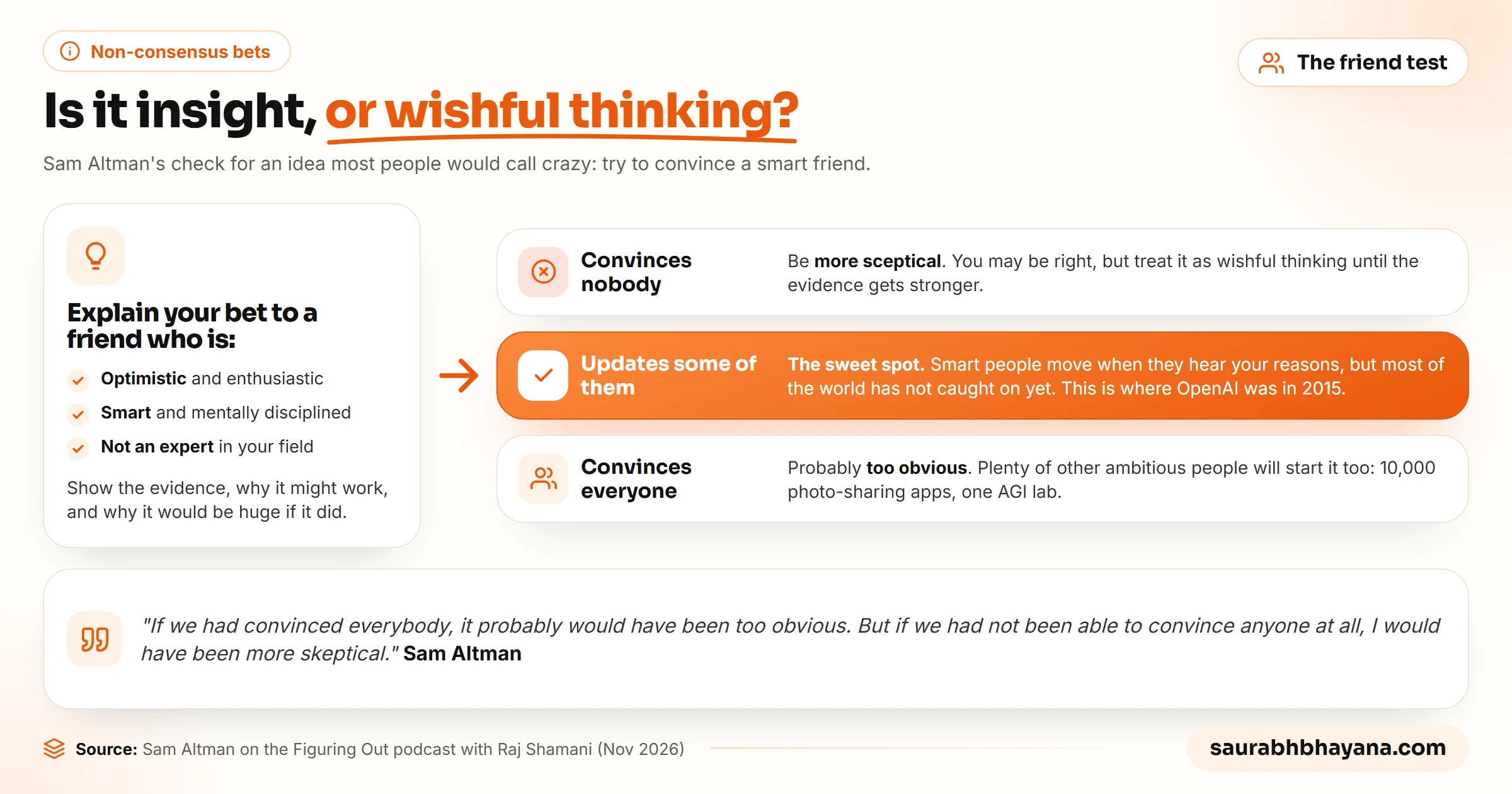
So how do you know you are right and not just stubborn? His test: explain the bet to a friend who is "optimistic, enthusiastic, but kind of mentally disciplined" and smart, but not an expert. Show the evidence, why it might work and why it would be huge if it did. If you convince nobody, be more sceptical. If you convince everybody, the idea is probably too obvious. The sweet spot is updating some of them.
He is also clear that going against everyone should be rare. "If you surround yourself by smart people, you should mostly listen to them." When he does overrule them, he treats it as an expensive, high-stakes call that is unlikely to be right.
The fix: write your bet in five sentences (what you see, the evidence, why it could work, why it would be big, what would prove you wrong) and pitch it to two smart friends this week. Their questions are the real test.
Lesson 3: launch before you feel ready
Launching ChatGPT is Altman's favourite example of acting against his own leadership team. Most of them thought it was too early and not good enough. By his memory, only about 5% of people who tried the early internal version kept using it, a number that would kill most product plans.
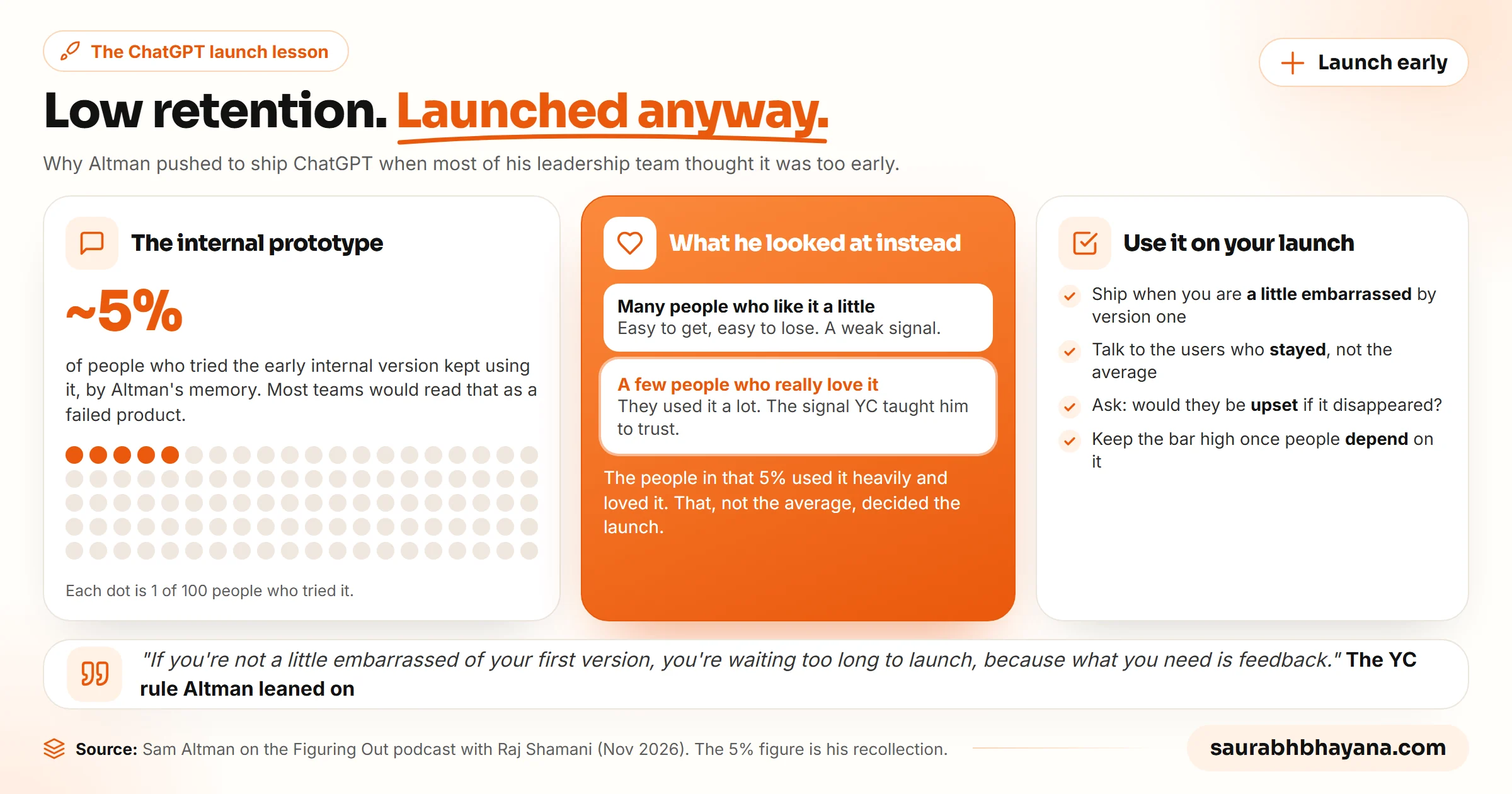
Two Y Combinator rules made him push anyway. First: "If you're not a little embarrassed of your first version, you're waiting too long to launch, because what you need is feedback." Second: early on, "a small number of people that really love something" matters more than "a lot of people that like it a little bit." The 5% who stayed used it heavily and loved it.
He adds a limit that small founders often miss. Now that companies depend on OpenAI almost like infrastructure, anything shipped to every user or to enterprise customers needs a very high bar. Early sketches still go out, but to smaller groups.
We do the same on a smaller scale. When we added Shopify and Pinterest features to our WordPress tool, we shipped them as a private beta to a short allowlist first, and everyone else saw a "coming soon" banner. Real use from a few people taught us more than another month of polishing would have. If you are still deciding whether your idea is worth building at all, start with our guide on how to validate a business idea with AI.
The fix: launch version one to 10 to 20 real users, then ask them one question: "How would you feel if this disappeared tomorrow?" Build for the people who say they would be upset.
Lesson 4: learn to ask better questions
Asked how he finds non-consensus bets, Altman said it was a skill "no one ever taught me". School trains you to answer other people's questions. Only much later, as a PhD student or a founder, do you get to choose the questions, and he thinks that skill should be taught to young people far earlier.
He believes it can be learned, and that getting good at it was the best way he found to spot ideas others missed. Good questions point at things that are interesting and not yet known, which is exactly where non-consensus bets live.
The fix: end each day by writing down one question you asked, not one thing you did. After a month, the list shows you where your curiosity actually goes, and that is a better source of ideas than any list of startup ideas.
Lesson 5: listen to less advice
Asked for the worst advice he ever got, Altman said almost all advice is terrible, and his "meta advice to founders is listen to less advice." He thinks Y Combinator could boil its experience down to five to ten general rules worth following, with "make something people want" as the single most important one. Beyond that, most of what you need is specific to your situation.
You're not going to become a great founder by listening to the 800th podcast of advice about how to start a startup. You got to just do it and figure it out on your own.
Yes, that applies to this article too. Read it, keep the one or two points that fit what you are working on, and go back to the work.
The fix: keep a list of no more than ten rules you trust. When new advice comes in, it has to replace something on the list to earn a place.
Lesson 6: ambition can be learned
One of Altman's "most pleasant surprises" from running Y Combinator was that you can teach people to be more ambitious. Not everyone, and it is hard to predict who, but it happens. Two things worked best: a peer group going through the same thing, and a series of challenges of increasing difficulty, so people learn they can do more than they think.
He says he became much more ambitious himself that way. On the old line that you become the average of your five closest friends, his verdict was "not quite, but there's some truth to it."
The fix: set your next goal one notch harder than the last one you hit, not ten notches. Then find two or three people working on something similar and compare progress every week.
What Sam Altman looks for in a founder
After meeting thousands of founders at Y Combinator and backing companies such as Stripe and Reddit, Altman says he can form a strong, though imperfect, intuition in a 30 to 40 minute meeting. He skipped the obvious traits and listed the ones people talk about less.
| What he looks for | Red flags he named |
|---|---|
| A clear communicator who explains things in a way that is easy to follow | Lack of drive |
| Someone he leaves the meeting wanting to work with, because founders must sell to co-founders, customers, hires and investors | Lack of focus |
| New ideas, generated and improved quickly in the conversation | Lack of clarity and vision |
| Interesting, well-reasoned thoughts about the world he has not heard before | Not being able to solve hard problems again and again "with a smile on your face" |
He also admits what a short meeting cannot show: how much pain someone can endure. For that he asks for stories from their life, and even then it is hard to judge. And there is no single pattern. If you swapped the founders of the top 10 YC companies between companies, he says, "it would be a disaster."
The fix: practise explaining your business in two minutes to someone outside your industry. If they cannot repeat it back, investors, hires and customers will struggle too.
How he works: pushback and thinking time
Altman says people in roles like his often go wrong when they get "surrounded by too many yes-men", and that he should probably hear that he is delusional more often than he does. His defences are old friends, people he has worked with for over ten years, and a culture that rewards pushing back hard when he is wrong. It gets harder, he says, the more often you have been right.
He also protects a rhythm: intense, interactive days in the office, then real blocks of solo time, often weekend mornings at home, to think and work alone. Only meetings, or only solitude, would not work for him. Within that, he questions his views from every angle, but acts with conviction until he finds a reason to change his mind.
The fix: name one person who will tell you when you are wrong, and give them permission in so many words. Then block two hours a week with no meetings and no messages.
Where we disagree, or would add context
- •Betting the company works when the company has billions behind it. After GPT-4 finished training in August 2022, OpenAI decided to "bet the company" on buying computing power. For a small business, make bold bets you can survive losing, which is rule 5 of his own essay.
- •"The best time in history to start a company" is probably true, and it is also the most crowded. AI makes building cheaper for everyone, so the edge moves to distribution, trust and a real customer problem.
- •Survivorship bias is everywhere in founder interviews, including this one. The 5% ChatGPT story worked because of what the 5% did next; many low-retention launches simply fail. Use the signal, not the story.
- •Some of what he mentions is still contested. The last time he felt nervous, he said, was before OpenAI announced an AI-produced proof on the Navier-Stokes equations in September 2026, a result that has not been independently verified and comes with a dispute over credit.
The fix: treat each lesson as a hypothesis for your own business, not a rule. Try it for a month, measure what changes, and keep it only if it works for you. If you want a practical next step, our guide on how to create a high-ticket offer turns the "make something people want" rule into an offer you can sell.
Best Sam Altman quotes from the interview
- •"Sure, you have 20 years of experience, but you have 20 times the same one year of experience."
- •"If you're not a little embarrassed of your first version, you're waiting too long to launch, because what you need is feedback."
- •"The more important thing for an initial project is a small number of people that really love something, not a lot of people that like it a little bit."
- •"My meta advice to founders is listen to less advice."
- •"If you surround yourself by smart people, you should mostly listen to them."
- •"If we had convinced everybody, it probably would have been too obvious. But if we had not been able to convince anyone at all, I would have been more skeptical."
- •"There's no way that anyone was going to get to build superintelligence and not have a crazy life."
- •"I believe it is probably the best time in history to be able to build something, to make a new company."
One more piece of context from the interview: Altman said India is now OpenAI's biggest market by users, and that people there are far more optimistic about AI than in the US. That matches what OpenAI's India head has said publicly. If you are in a fast-growing market, his advice to build now applies to you more than to anyone. And if you are wondering whether all this AI money is sustainable, we checked the numbers in our guide on whether AI is a bubble.
Frequently asked questions
What are Sam Altman's 13 rules for success?+
From his 2019 essay "How To Be Successful": compound yourself; have almost too much self-belief; learn to think independently; get good at "sales"; make it easy to take risks; focus; work hard; be bold; be willful; be hard to compete with; build a network; you get rich by owning things; be internally driven.
What is Sam Altman's best advice for founders?+
In his November 2026 interview with Raj Shamani, the points he stressed most were compounding (keep building on each phase of your career), making non-consensus bets you can explain to smart friends, launching before you feel ready, and listening to less advice, keeping only the few rules that hold everywhere, such as "make something people want".
Does Sam Altman think you should launch early?+
Yes. He pushed to launch ChatGPT when most of OpenAI's leadership thought it was too early, using the Y Combinator rule that if you are not a little embarrassed of your first version, you waited too long. He also says products that businesses rely on need a much higher bar.
How does Sam Altman decide if a contrarian idea is right?+
He explains it to an optimistic, smart, disciplined friend who is not an expert. If he convinces nobody, he becomes more sceptical. If he convinces everybody, the idea is probably too obvious. Updating some smart people is the signal he looks for.
What does Sam Altman look for in a founder?+
A clear communicator he would want to work with, someone who can sell the vision to co-founders, customers, hires and investors, who generates and improves ideas quickly, and who has new, well-reasoned views. Red flags include lack of drive, focus, clarity and vision.
Does Sam Altman own equity in OpenAI?+
In the November 2026 interview he said he does not have equity in OpenAI and called that a mistake, not for the money but because it confused people about why he does the job.
Where can I watch the Sam Altman and Raj Shamani interview?+
It is episode FO583 of Raj Shamani's Figuring Out podcast on YouTube, titled "Sam Altman On AI Revolution, Superintelligence & Future Of Humanity", released in November 2026.
Read next
My team and I automate the work that eats your hours with AI, and get your business found on Google, Maps and in AI answers.