
Claude Code Pricing 2026: Pro vs Max vs Ultra vs API Cost
Claude Code is not sold on its own. You get it with Pro ($20), Max ($100), Ultra ($200), a Team seat, or pay per token through the API. What each plan really gives you, what a day of Claude Code costs on the API, which plan fits you, and how to make your usage go further.
Search for Claude Code pricing and you find a dozen numbers: $17, $20, $100, $200, per-token rates, per-seat rates. They are all real, and they answer different questions. The short version is that Claude Code has no price tag of its own. It comes inside Claude's paid plans, or you pay for exactly what you use through the API.
This guide puts every option side by side, explains how usage limits work, shows what a day of Claude Code costs on the API, and helps you pick. One honest caveat first: Anthropic changes plans and prices regularly. Every number here was checked on Anthropic's own pricing page and documentation in November 2026. Check claude.com/pricing before you buy.
How much does Claude Code cost?
Claude Code costs $20 a month at the entry level, through the Claude Pro plan. Heavy users pay $100 a month for Max or $200 a month for Ultra. Teams pay $25 or $125 per seat per month. Or you skip the subscription and pay per token through an Anthropic Console account. The free plan does not include Claude Code at all.
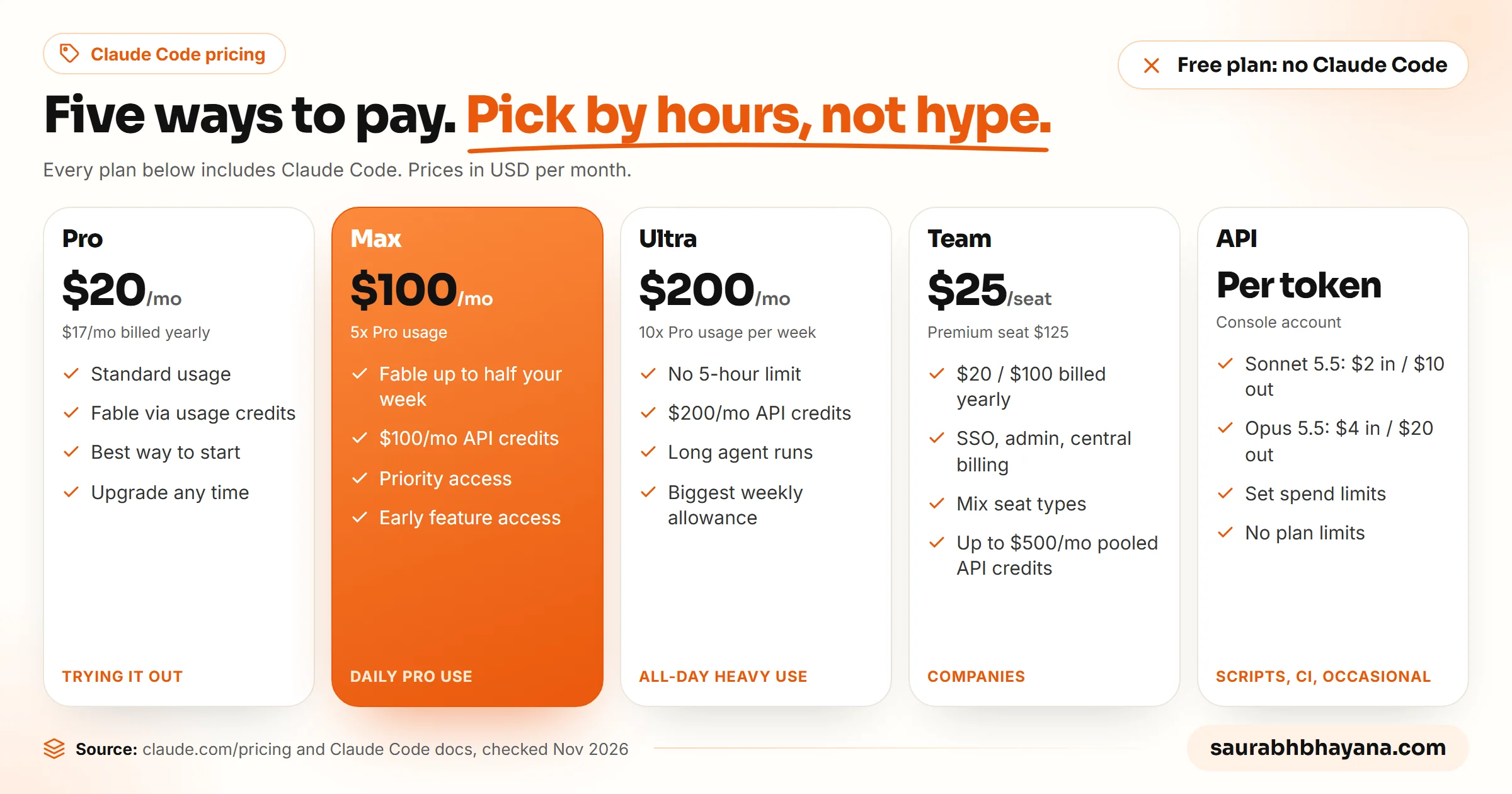
| Plan | Price | Claude Code usage | Extras that matter for coding |
|---|---|---|---|
| Free | $0 | Not included | Chat only |
| Pro | $20/month, or $17/month billed yearly ($200) | Included, standard limits | Fable models paid with usage credits |
| Max | $100/month | 5x Pro usage | Fable included up to half your weekly limit, $100/month in API credits, priority access |
| Ultra | $200/month | 10x Pro usage per week, no 5-hour limit | $200/month in API credits |
| Team (standard seat) | $25/month, or $20 billed yearly | More usage than Pro | Admin controls, SSO, central billing |
| Team (premium seat) | $125/month, or $100 billed yearly | 5x a standard seat | Same team features, mix seat types |
| API (Console) | Pay per token | No plan limit, you pay for what you use | Spend limits per workspace |
Subscription or API: two very different ways to pay
The plans and the API do not just differ in price. They differ in what you are buying.
- •A subscription (Pro, Max, Ultra, Team) buys a usage allowance. You pay the same every month, and when you use up the allowance you wait for it to reset or buy usage credits. Your bill never surprises you.
- •The API (an Anthropic Console account) bills every token Claude Code sends and receives. There is no allowance to run out of, but there is also no ceiling unless you set one. A long, careless session costs more than a short, focused one.
Predictable bill: subscription. Pay only for what you use, with spend limits you set yourself: API.
For one person using Claude Code most working days, a subscription is almost always cheaper and calmer. The API makes sense for occasional use, for automation in scripts and CI, and for companies that need per-user cost reports.
Claude Code API cost: the token prices
If you use Claude Code with a Console account, you pay Anthropic's standard API rates for whichever model the session uses. Prices are per million tokens (MTok). Roughly, a million tokens is a few hundred pages of text, but in Claude Code most tokens are your project files and the conversation being re-read, not words you type.
| Model | Input per MTok | Output per MTok | Cache hits per MTok | Good for |
|---|---|---|---|---|
| Haiku 5.5 (prompts up to 100k tokens) | $0.10 | $0.50 | $0.01 | Simple subagent jobs, quick edits |
| Sonnet 5.5 | $2 | $10 | $0.10 | Most everyday coding |
| Opus 5.5 | $4 | $20 | $0.20 | Hard architecture and multi-step reasoning |
| Fable 5.2 | $8 | $40 | $0.20 | The most demanding work |
Cache hits matter more than they look. Claude Code re-sends your conversation with every request, and most of it is served from Anthropic's prompt cache at a fraction of the input price. That is why a long session does not cost the full input price over and over, and also why it still costs something even when you only type one line.
What does a day of Claude Code cost on the API?
Anthropic publishes a real benchmark. Across enterprise deployments, Claude Code averages around $13 per developer per active day and $150 to $250 per developer per month, and 90% of users stay below $30 per active day. Your number depends on the model, the size of your project and how you work.
Here is a worked example with our own arithmetic, so you can see where the money goes. Say a focused hour on Sonnet 5.5 reads 2 million tokens from cache, sends 200,000 fresh input tokens and gets 50,000 output tokens back:
| Part of the session | Tokens | Rate (Sonnet 5.5) | Cost |
|---|---|---|---|
| Cache hits (conversation re-read) | 2,000,000 | $0.10 per MTok | $0.20 |
| Fresh input (new files, your prompts) | 200,000 | $2 per MTok | $0.40 |
| Output (code and answers) | 50,000 | $10 per MTok | $0.50 |
| Total | $1.10 |
The same hour on Opus 5.5 costs about $2.20, double the Sonnet price, and on Fable 5.2 about $4. Six Opus hours a day lands right on Anthropic's $13 average. That is the moment a $20 or $100 subscription starts to look cheap.
Type /usage in Claude Code at any time. On the API it shows the session's token use and estimated cost. On a subscription it shows how much of your 5-hour and weekly allowance you have used, and what is eating it.
Usage limits explained
Subscription plans do not count dollars. They count usage within two windows: a rolling 5-hour window and a weekly window. How fast you reach a limit depends on the model you use, how long your conversations are and how large your files are.
- •Pro gives the base allowance. Max gives 5x Pro. Ultra gives 10x Pro per week and has no 5-hour limit at all.
- •Your allowance is shared across Claude chat, Claude Code and Cowork, so a long chat session uses the same pool.
- •Fable models are the expensive exception. On Pro they are paid with usage credits; on Max they are included up to half your weekly limit.
- •When you hit a limit, you can wait for the reset or turn on usage credits to keep working, with a monthly spend limit you choose. Run /usage-credits inside Claude Code to manage them.
Which Claude Code plan should you choose?
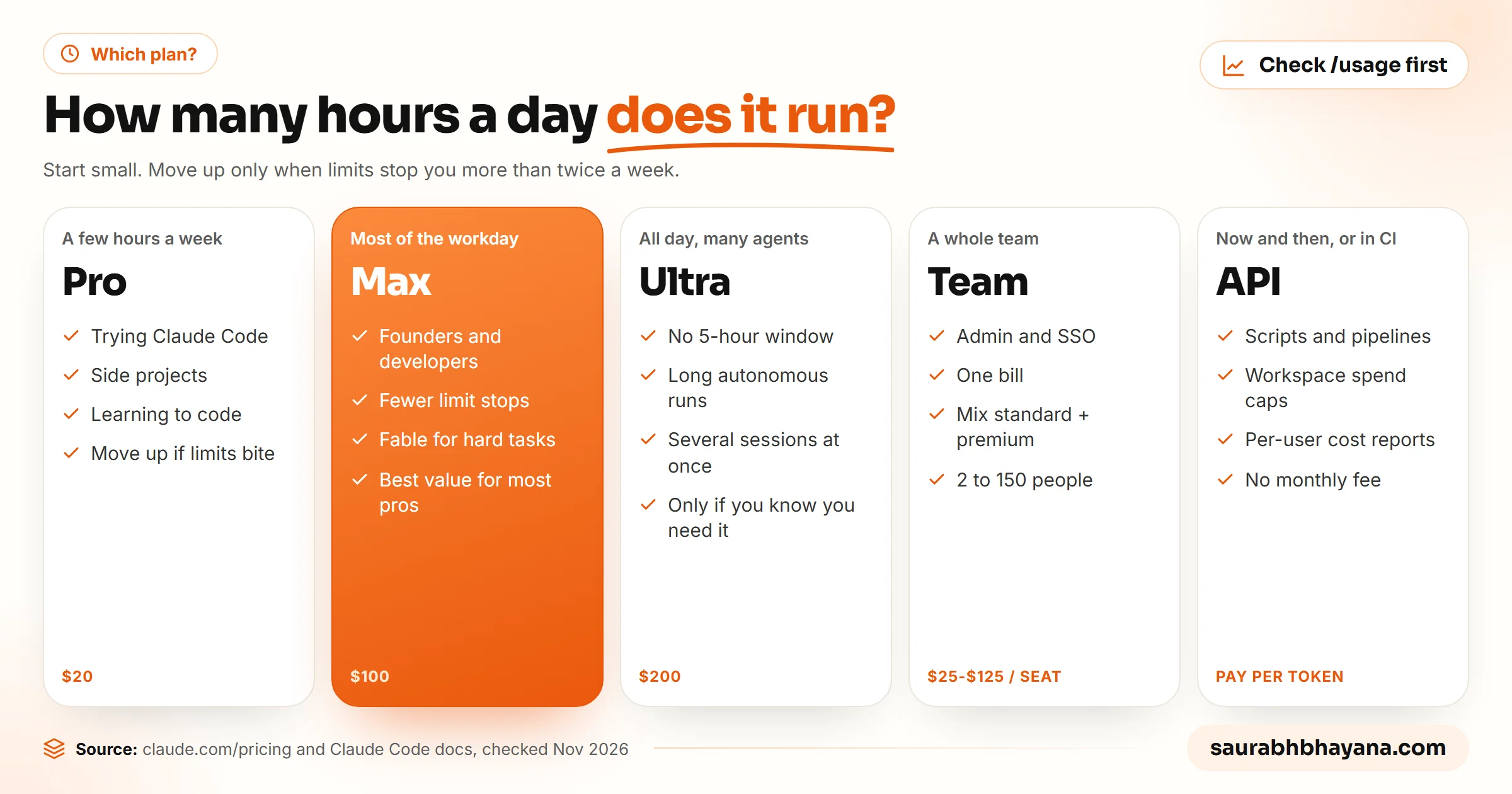
| You are | Pick | Why |
|---|---|---|
| Trying Claude Code, or using it a few hours a week | Pro | Cheapest way in; upgrade only if you keep hitting limits |
| A developer or founder using it most of the working day | Max | 5x the usage removes most limit stops for $100 |
| Running long sessions or several agents all day | Ultra | No 5-hour limit and 10x Pro weekly usage |
| A company with several people coding | Team | Admin controls, SSO, central billing, mix standard and premium seats |
| Running Claude Code in scripts, CI or only now and then | API | Pay only for what runs, set spend limits per workspace |
Our honest advice: start on Pro for a month with one real project. If you hit the limit more than a couple of times a week, move to Max. Do not start on Ultra unless you already know your usage is heavy.
How to make Claude Code cost less
Whether you pay per token or per month, the same habits stretch your usage. These come from Anthropic's cost guidance and from running Claude Code all day on our own products.
- 1.Clear between tasks. Use /clear when you switch to unrelated work. Old context is re-sent with every message and wastes tokens.
- 2.Use Sonnet for everyday coding. Switch to Opus or Fable with /model only for hard design or reasoning work, then switch back.
- 3.Plan big changes first. Plan mode lets Claude explore and propose before it edits, which saves expensive rework when the first idea is wrong.
- 4.Write specific prompts. "Add input validation to the login function in auth.ts" costs far less than "improve this codebase", which makes it scan everything.
- 5.Keep CLAUDE.md short. It loads into every session, so Anthropic suggests keeping it under 200 lines and moving long workflows into skills.
- 6.Turn off MCP servers you are not using, and prefer command-line tools such as gh where they exist.
- 7.Lower the effort level with /effort for simple tasks, and give quick subagent jobs a smaller model like Haiku.
New to the tool itself? Our guide to what Claude Code is and how to install it covers the basics, and the Claude models guide explains when each model is worth its price.
Is Claude Code worth the money?
Compare it with time, not with other subscriptions. If Claude Code saves a developer even one hour a week, Pro has paid for itself many times over at almost any hourly rate. We use it every working day to deploy our SaaS, edit WordPress sites and keep content schedules running, and for that kind of daily use a flat subscription is far easier to live with than watching a token meter.
Where it is not worth it: if you only need help writing text or answering questions, the normal Claude app does that, and our guide on how to use Claude explains it. Claude Code earns its price when it is working on real files.
Frequently asked questions
Is Claude Code free?+
No. The free Claude plan does not include Claude Code. The cheapest way to get it is Claude Pro at $20 a month, or $17 a month when billed yearly. You can also pay per token with an Anthropic Console account.
How much does Claude Code cost per month?+
Pro costs $20 a month, Max $100 and Ultra $200. Team seats cost $25 (standard) or $125 (premium) per month, less when billed yearly. On the API, Anthropic says enterprise developers average $150 to $250 a month.
Is Claude Code included in Claude Pro?+
Yes. Claude Code is included in Pro, Max, Ultra, Team and Enterprise plans. Your Claude Code usage shares the plan's allowance with Claude chat and Cowork.
Is Claude Max worth it for Claude Code?+
If you use Claude Code most of the working day and hit Pro's limits more than a couple of times a week, yes. Max gives 5x Pro usage for $100 a month, includes Fable models up to half your weekly limit and adds $100 a month in API credits.
Is the Claude Code API cheaper than a subscription?+
For light or occasional use, the API can be cheaper because you pay only for tokens used. For daily use, a subscription is usually cheaper and predictable: Anthropic's enterprise average is about $13 per developer per active day on the API.
What happens when I hit my Claude Code limit?+
On a subscription, Claude Code tells you the limit was reached and when it resets. You can wait, or turn on usage credits to keep working with a monthly spend limit you set. Run /usage-credits to manage them.
How do I check my Claude Code usage?+
Type /usage in Claude Code. On a subscription it shows your 5-hour and weekly usage and what is using it. On the API it shows the session's tokens and estimated cost.
What is the Claude Ultra plan?+
Ultra is Claude's $200 a month plan. It gives 10x Pro usage per week, has no 5-hour limit and includes $200 a month in API credits. It suits people running Claude Code or agents for long stretches every day.
Read next
My team and I automate the work that eats your hours with AI, and get your business found on Google, Maps and in AI answers.